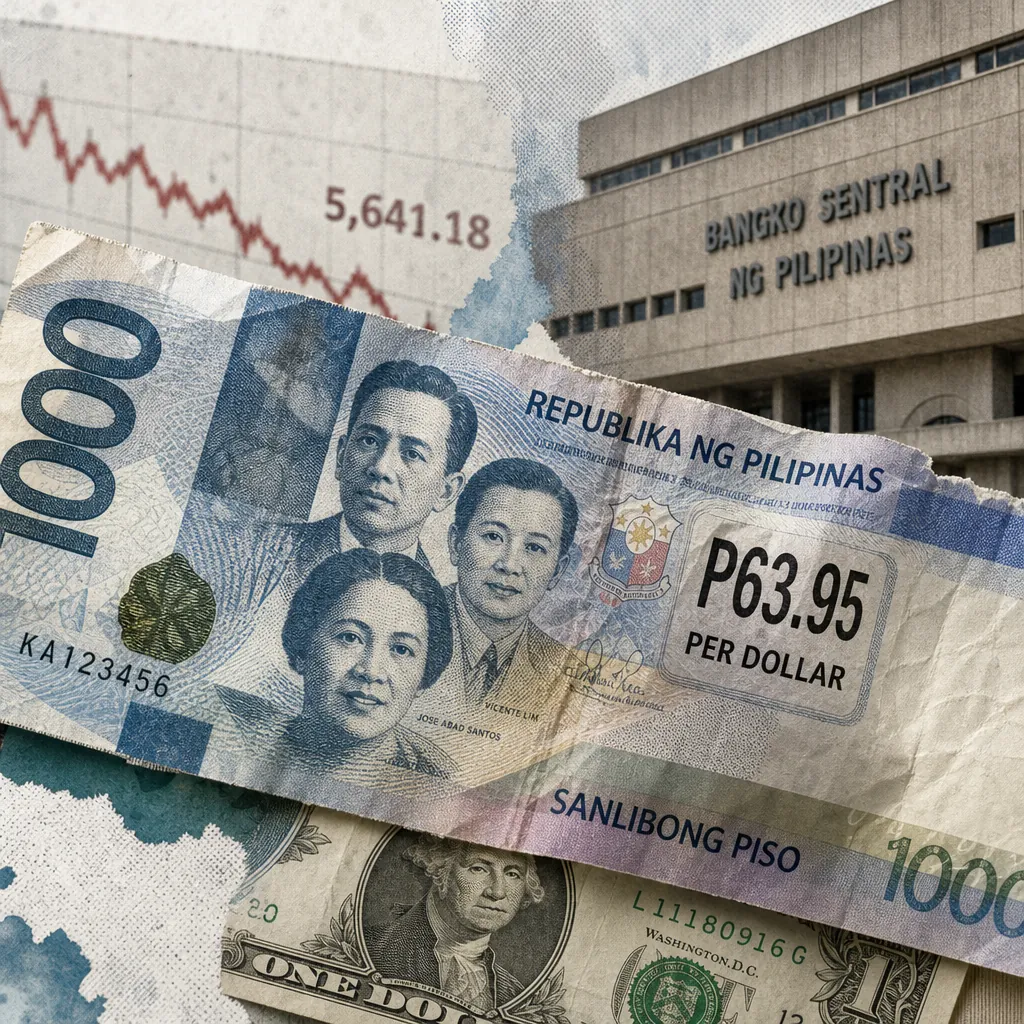
Peso closes at record P64.17 as inflation risk builds
The Philippine peso closed at an all-time low of P64.17 to the dollar on October 27, its seventh straight record close, as oil prices and Middle East tensions pushed the currency down. Broadsheets, tabloids and online outlets covered the fallout for electricity, mortgages and government borrowing, while the Golden Arrow Awards drew a separate run of corporate-governance coverage.
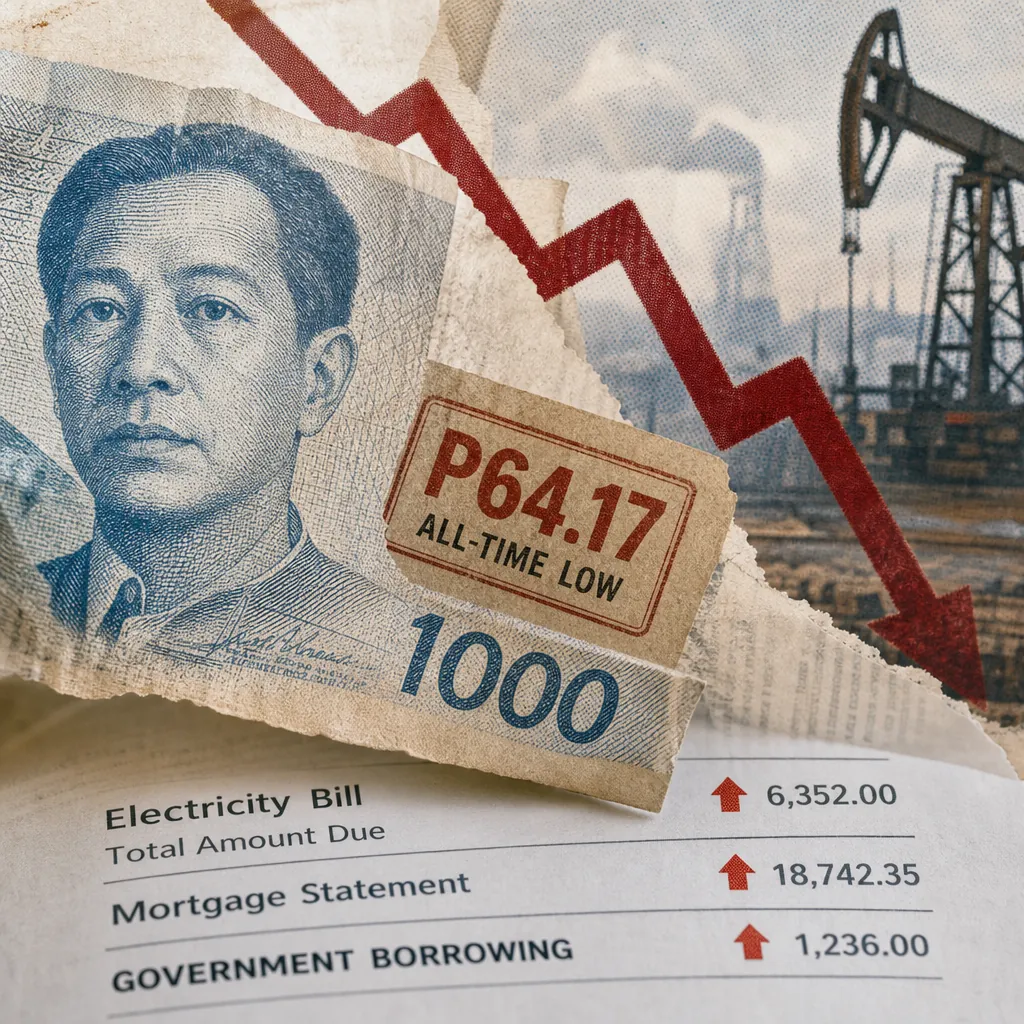
The peso closed at P64.17 to the dollar on Tuesday, October 27, the first time the currency has ended a trading day above P64 and its seventh consecutive record close1917. It has now fallen 8.38 percent this year from its December 29, 2025 finish of P58.79, and about 10 percent since February 28, when the Middle East conflict began19. The breach came eight days after the peso first broke the P63 level, and traders quoted by the Inquirer said it could test P6517. The move was covered across every medium in this set — broadsheet front pages, a tabloid item in Filipino, business dailies, online news and a Manila Times podcast — and the coverage ran well beyond the exchange rate itself, into electricity bills, mortgage costs, government borrowing and food prices.
A second, quieter story ran alongside it: the Institute of Corporate Directors (ICD) handed out its Golden Arrow Awards for corporate governance on October 23, and the results were published this week across several outlets11361. Ayala Corp. kept the top five-arrow distinction for a second year, Globe Telecom entered the awards' Hall of Fame after five straight years at the top, and Philippine National Bank took four arrows for the fifth consecutive year21361. The awards carry no direct market consequence, but they generated a steady run of coverage in the business pages and supplements.
There was no social-media monitoring writeup for this window, so the picture here rests entirely on the published coverage. What that coverage shows is a currency story with unusually wide reach: the peso's slide made the front page of BusinessWorld and Manila Standard, ran in tabloid Filipino, was summarized in a Manila Times podcast episode, and drew comment from the Energy Secretary speaking in Singapore53197142. The peso story is the day's lead on consequence — it touches fuel, food, power, borrowing costs and the government's own budget — and the governance awards are the secondary corporate thread.
Key themes
- The peso closed above P64 to the dollar for the first time, at P64.17. That was 22 centavos weaker than Monday's P63.95 close and the seventh straight record close, per Bankers Association of the Philippines data1719. BusinessWorld counted it as the peso's 38th record low this year and its ninth in October alone19.
- Oil and Middle East tension are driving the fall. Brent crude peaked at $117.45 a barrel on October 23, and markets are weighing a possible US strike on Iran after the November 3 midterm elections, which pushed investors toward the dollar4219. The peso has lost about 10 percent since February 28, when the conflict began19.
- Electricity rates are expected to rise because fuel is priced in dollars. Energy Secretary Sharon Garin said imported coal, diesel and liquefied natural gas all cost more in pesos as the currency weakens, and those costs pass through to the per-kilowatt-hour rate1942.
- Higher policy rates are already cooling housing demand. The central bank raised its benchmark rate by 50 basis points to 5.5 percent on October 22, and Colliers Philippines reported "a lot of back-outs" from buyers facing higher mortgage costs46.
- The government borrowed less than it wanted at its bond auction as yields jumped. The Bureau of the Treasury raised P21.775 billion against a P35-billion target, and the seven-year bonds cleared at 7.737 percent, up 91.2 basis points from the last award of that series in August49.
- Stocks rose 2.13 percent even as the peso fell. The Philippine Stock Exchange index gained 120.01 points to 5,761.19 on bargain-hunting after Monday's sell-off, its best day since September 119.
- Ayala Corp. kept five Golden Arrows and Globe entered the awards' Hall of Fame. The ICD recognition is based on the ASEAN Corporate Governance Scorecard, a regional benchmarking exercise covering shareholder rights, disclosure, board responsibility and sustainability1361.
- Bank consolidation talk surfaced: BPI and Metrobank are reported to be eyeing CIMB's Philippine unit. A deal could value the digital bank at up to $200 million, with binding bids due before the end of October51.
How the narratives stack
Dominant: The peso's record close and its knock-on effects dominated the coverage in this set. BusinessWorld led its front page with the P64.17 close and the 38-record-low count for the year19; Manila Standard ran a front-page warning from the Energy Secretary under the headline "Dark clouds ahead"42; the Inquirer and its Plus edition both ran the "free fall" framing with the eight-day move from P63 to P641732; Malaya Business Insight led with the dollar's record close and the oil-price link42; the Manila Times ran a news story and a podcast episode on the breach653; and a tabloid item in Filipino reported the intraday slide and noted the central bank sees no need yet to defend the currency71. The breadth is unusual: the same fact reached readers through broadsheets, a tabloid, online business desks and audio.
Counter-narrative: The stock market's 2.13 percent rebound sits against the currency story. Both Manila Standard and BusinessWorld reported the PSE index's 120.01-point gain to 5,761.19, attributing it to bargain-hunting after Monday's drop and to a rebalancing of the WisdomTree emerging markets index that added volatility near the close19. COL Financial's Denisse Joaquin was quoted saying sentiment was supported by higher US equities overnight "even as the peso notched another record low nearing the P64:$1 level"19. The two facts — a weak currency and a rising stock market — are not contradictory; they reflect different groups of buyers reacting to different signals.
Emerging: The peso's effect on household borrowing and on the government's own finances is showing up in specific numbers. Colliers Philippines' Joey Roi Bondoc said higher rates will hurt residential take-up and that cancellations are already visible46. The Bureau of the Treasury's partial award of its bond offer, at a 7.737 percent average rate on the seven-year tranche, shows investors demanding more yield to lend to the government49. Chinabank's chief economist, Domini Velasquez, said October and November inflation could approach 8 percent and third-quarter GDP growth could fall below 3 percent51. These are forward-looking estimates, not confirmed outcomes, but they set the frame for the next several weeks.
Under-covered: The peso's effect on food access got one outlet's attention. A Daily Guardian column cited a figure that 52.6 million Filipinos could not afford a healthy diet in 2025, second in Southeast Asia only to Indonesia, and described the grocery-aisle arithmetic of trading down65. That connects directly to the currency story — imported food and fuel cost more in pesos — but it ran as a single opinion piece rather than as part of the main coverage. The Golden Arrow Awards, meanwhile, drew a cluster of items across Manila Times, Manila Standard and Head Topics, but they are corporate-recognition stories with limited reach beyond the business pages1136123.
Platform insights
- Facebook: No social-media monitoring data was captured for this window, so engagement on Facebook cannot be described here. The coverage that did run was published news, not social conversation.
- X: No posts from X were captured in this set.
- Reddit: No Reddit activity was captured in this set.
- YouTube: No YouTube activity was captured in this set.
The absence of social data is itself worth noting for how the story travelled: the peso coverage was driven by news desks and columnists, not by viral posts. The Manila Times packaged its peso story as a daily podcast episode, which is the closest thing in this set to an audio or social format53.
Key voices and communities
Economic journalists and business desks. BusinessWorld, the Inquirer, Malaya Business Insight, Manila Standard and the Manila Times all ran the peso story with the same core numbers — the P64.17 close, the 22-centavo drop, the seventh straight record — but framed it differently. BusinessWorld emphasized the year-to-date count of 38 record lows19; the Inquirer emphasized the speed of the move from P63 to P64 in eight days17; Malaya emphasized the oil-price link and the possibility of a US strike on Iran after the midterms42.
Government officials. Energy Secretary Sharon Garin, speaking at the Singapore International Energy Week conference, gave the most concrete warning about household costs, saying the peso's fall would raise electricity rates because fuel is imported and priced in dollars42. Presidential Communications Office Undersecretary Claire Castro acknowledged the pressure and pointed to Middle East conflict as the cause, saying "This is not what the president wanted"6. Bangko Sentral ng Pilipinas Governor Eli Remolona Jr. said the central bank does not use monetary policy to defend a specific exchange rate, and that it intervenes only when the peso's movement threatens to become inflationary1971.
Bank economists. Chinabank's Domini Velasquez gave the most specific forecast in the set: inflation approaching 8 percent in October and November, and third-quarter GDP growth possibly below 3 percent51. Rizal Commercial Banking Corp. chief economist Michael Ricafort tied the peso's fall to Brent crude above $116 a barrel and to market positioning ahead of the US midterms42.
Corporate governance community. The ICD, which serves as the Philippines' designated Domestic Ranking Body for the ASEAN Corporate Governance Scorecard, published its awardees with messages from founder Dr. Jesus P. Estanislao and capital-markets advocate Atty. Francisco Ed. Lim3. Ayala President and CEO Cezar Consing said the company must "earn our stakeholders trust every day"13.
Narrative streams
The peso breaks P64 and the cost of imported fuel follows
The peso opened Tuesday at P63.95, briefly strengthened to P63.90, then fell to an intraday record of P64.20 before closing at P64.1719. Trading volume rose to $1.726 billion from $1.6485 billion the day before42. The trigger was a combination of higher oil prices and expectations that the US Federal Reserve will keep rates high, which strengthens the dollar against emerging-market currencies32. Brent crude had reached $117.45 a barrel on October 23, near its highest since April 30, and markets were pricing in the possibility of a US attack on Iran after the November 3 midterm elections42.
The peso's fall matters to ordinary Filipinos because the country imports most of its fuel. Energy Secretary Garin put it plainly: "It will impact the rate of electricity because it passes through, so it will impact per kilowatt-hour"19. She listed coal, diesel and liquefied natural gas as the fuels whose peso cost rises with the exchange rate42. The Philippines is a net fuel importer, so a weaker peso means power producers need more pesos to buy the same amount of fuel, and those costs flow into generation charges on electricity bills.
The central bank's position is that it will not spend reserves defending a particular exchange rate. Governor Remolona said the BSP has estimates of how far the peso can move before it becomes inflationary, "and that's when we tend to intervene"71. That leaves the currency to find its own level for now, with the risk that further oil-price spikes push it toward P65, the level a trader told the Inquirer was possible17.
For banks and businesses that borrow or buy in dollars, the practical effect is higher repayment costs on foreign-currency debt and tighter margins for importers. For households, the effect arrives through electricity bills and transport fares before it shows up in official inflation data. The read for the sector: lenders should expect more demand for peso hedging and for restructuring of dollar-denominated obligations, and power distributors should prepare customers for higher generation charges in the next billing cycles.
Higher rates meet a weaker peso and housing demand cools
The central bank's 50-basis-point rate hike on October 22, its fourth increase this year, took the benchmark rate to 5.5 percent46. That was meant to defend the currency and contain inflation, but it also raised the cost of borrowing for households and businesses. Colliers Philippines' Joey Roi Bondoc said the effect on residential demand is already visible: "It will really have a detrimental impact on take-up because higher interest rates will likely result in higher mortgage rates. We're already seeing a lot of back-outs"46.
A back-out is a buyer who reserves a unit and then withdraws before closing, usually because financing falls through or the monthly payment becomes unaffordable. Bondoc's comment, made at Colliers' third-quarter market briefing on Tuesday, is the clearest evidence in this set that the rate increase is reaching household decisions. The counterweight is subsidized housing: loans released by the Home Development Mutual Fund, known as Pag-IBIG, for socialized housing nearly tripled in the first nine months of the year, according to the same BusinessWorld report46. That means the government's subsidized lending window is doing more of the work as private mortgage rates rise.
Cebu offers a regional view. The Inquirer's Plus edition reported that Metro Cebu residential prices fell 0.2 percent year-on-year in the second quarter after a 9.4 percent gain in the first, and housing loans in Metro Cebu fell 24.9 percent from a year earlier46. Prices still rose 2.4 percent from the previous quarter, which suggests the market is cooling rather than collapsing46.
For developers, the read is that the affordable and socialized segments will hold up better than the middle market, and that financing partnerships matter more than location marketing in the near term. For banks, mortgage growth will depend on how much of the subsidized pipeline they can capture.
The government pays more to borrow as bond yields jump
The Bureau of the Treasury, the agency that manages the national government's debt, offered dual-tranche Treasury bonds on Tuesday and raised only P21.775 billion against a P35-billion target, even though total bids reached P35.069 billion49. The seven-year tranche, which has a remaining life of two years and 11 months, cleared at an average rate of 7.737 percent — 91.2 basis points higher than the 6.825 percent the same series fetched at its last award on August 2549. A basis point is one-hundredth of a percentage point, so the government is now paying nearly a full percentage point more to borrow for the same period than it did two months ago.
The partial award is a signal that the government was unwilling to accept the higher rates for the full amount it wanted. Investors, in turn, were demanding more yield because they expect inflation to keep rising, which erodes the value of fixed-interest payments49. The peso's fall feeds that expectation directly, since imported fuel and food become more expensive in pesos.
For the sector, the read is that the government's borrowing costs set a benchmark for corporate borrowers. If the Treasury is paying 7.737 percent on a seven-year bond, large companies will pay more than that, and smaller ones more still. Banks that hold government securities will see the market value of existing holdings fall as yields rise, which affects their capital ratios. The government's budget will also feel the difference: higher interest payments leave less room for spending on infrastructure and social programs.
Stocks rebound on bargain-hunting even as the currency falls
The Philippine Stock Exchange index rose 2.13 percent, or 120.01 points, to close at 5,761.19 on Tuesday, recovering from Monday's decline19. The broader all-shares index gained 1.67 percent to 3,213.96. All sector indices ended higher, led by financials at 3.28 percent and holding firms at 2.88 percent19. Advancers outnumbered decliners 104 to 6619.
COL Financial's Denisse Joaquin attributed the gain to bargain-hunting after Monday's sell-off and to the annual rebalancing of the WisdomTree emerging markets index, which added volatility near the close19. She noted that sentiment was supported by higher US equities overnight "even as the peso notched another record low"19. The divergence between a falling currency and a rising stock market is not unusual in the short term: a weaker peso can help exporters and companies with foreign-currency revenues, and bargain hunters look for stocks that fell too far on the previous day.
The rebound does not reverse the year's trend. The index closed at 6,093.89 on September 1, and Tuesday's close of 5,761.19 is well below that19. For retail investors, the read is that volatility will continue as long as the currency and oil prices move sharply, and that the financial sector's 3.28 percent gain reflects expectations of higher lending margins rather than stronger loan demand.
Golden Arrow Awards put corporate governance in the business pages
The Institute of Corporate Directors recognized publicly listed companies and insurance companies at its Golden Arrow Awards ceremony on October 23 at the Rizal Ballroom of the Makati Shangri-La, and the results were published this week2. The awards are based on the ASEAN Corporate Governance Scorecard, a regional benchmarking tool that evaluates companies on shareholder rights, equitable treatment of shareholders, sustainability and resilience, stakeholder engagement, and transparency and accountability2. The ICD serves as the Philippines' designated Domestic Ranking Body, appointed by regulators to assess and grade companies3.
Ayala Corp. retained the highest distinction of five Golden Arrows for the second consecutive year13. Nine other Ayala group companies were also recognized: Globe Telecom and Bank of the Philippine Islands earned five arrows each, with Globe entering the Hall of Fame after five consecutive years at the top; ACEN Corp. and Ayala Land Inc. received four arrows each; and Integrated Micro-Electronics Inc., AREIT Inc., AyalaLand Logistics Holdings Corp. and BPI AIA Life Assurance Corp. each earned three61. Philippine National Bank received four arrows for the fifth consecutive year2. DMCI Holdings, D&L Industries, Century Pacific Food and Manila Electric Co. were also among the awardees13.
Ayala President and CEO Cezar Consing said the recognition must be earned repeatedly: "Whatever our history, we must earn our stakeholders trust every day"13. The awards matter to investors because governance scores feed into decisions by foreign funds that screen for board independence and disclosure quality. For the sector, the read is that Philippine companies are being graded on a regional standard, and those with lower scores face a disadvantage when competing for institutional capital.
Bank consolidation talk: BPI and Metrobank eye CIMB's Philippine unit
Malaysia-based CIMB Group Holdings is exploring a sale of its Philippine business, CIMB Bank PH, and Bank of the Philippine Islands and Metropolitan Bank & Trust Co. are among the parties that have shown interest, according to Bloomberg-sourced reports carried by Manila Standard and BusinessWorld51. A deal could value the unit at up to $200 million, and binding bids are due before the end of October51. CIMB entered the Philippine market in December 2018 and had 10 million customers as of September 2025; it operates as a fully licensed digital-only commercial bank51.
Neither BPI nor Metrobank commented on the report51. The interest is significant because it would consolidate a digital bank with an established universal bank, giving the buyer a ready customer base and a digital platform. CIMB's exit would also signal that standalone digital banks face a harder path to profitability in the Philippines than their backers expected.
For the sector, the read is that digital banking is entering a consolidation phase. Banks with large branch networks and cheap deposits can absorb digital players more easily than digital players can build scale alone. Customers of CIMB Bank PH should watch for changes in product terms and service channels if a sale proceeds.
Consumer credit expands in the Visayas and Mindanao
EMCOR and Tonik Digital Bank signed a memorandum of agreement on October 23 at EMCOR's head office in Bajada, Davao City, to expand installment financing for household appliances, smartphones, electric bicycles and furniture under Tonik's Shop Installment Loan program18. EMCOR president and chief operating officer Nelson Aparejo said the agreement followed nearly two years of negotiations and framed it as responsible lending: "Giving credit to customers that we know could not pay is also a disservice to them"18.
The partnership matters because access to credit outside Metro Manila is thinner than in the capital, and installment financing is how many households buy appliances and phones. The Inquirer's GLoan feature made a related point: the central bank's 2025 Consumer Finance and Inclusion Survey found more Filipinos moving toward formal lenders and away from informal borrowing for food, education, healthcare and livelihood expenses10. A TransUnion Consumer Pulse Study cited in the same piece found 58 percent see access to credit as important to achieving their financial goals10.
For the sector, the read is that consumer lending is shifting toward digital channels and installment products, and that lenders who can underwrite borrowers without formal credit histories will capture the demand. The risk is that a weaker peso and higher rates make those loans more expensive to fund, which could tighten approval standards in the segments that need credit most.
Conversation trajectory
Watch the November 3 US midterm elections and any US action on Iran. Oil prices have been the main external driver of the peso's fall, and markets are pricing in the possibility of a US strike on Iran after the midterms42. A strike or a sharp escalation would push Brent higher and likely weaken the peso further toward P65. A de-escalation would relieve some pressure. Observation window: the first two weeks of November.
Watch the October inflation release in early November. Chinabank's Velasquez expects October and November inflation to approach 8 percent51. The Philippine Statistics Authority publishes the October figure in the first week of November. A print near 8 percent would confirm that the peso's fall is feeding through to consumer prices and would increase pressure on the central bank to raise rates again at its December meeting.
Watch the central bank's December policy meeting. The BSP raised rates by 50 basis points on October 22 and has signaled it will act if the peso's movement becomes inflationary71. A December hike is plausible if inflation and the currency both worsen. A pause would signal the BSP believes the pass-through is contained.
Watch the CIMB Philippines bidding deadline at the end of October. Binding bids are due before the end of the month51. A confirmed bid from BPI or Metrobank would start a regulatory review by the Philippine Competition Commission and the central bank, and would set a valuation benchmark for other digital banks.
Watch the Senate impeachment trial resuming November 9. The House prosecution says it will present evidence on P817.87 million in allegedly unexplained wealth, a figure it says could reach P1.5 billion7060. The trial is a political story, but it affects investor perception of policy stability, which feeds into the peso and the stock market.
Watch the Treasury's next bond auctions. The partial award on Tuesday showed investors demanding higher yields49. If the next auction also falls short of the target, the government will have to choose between paying more or borrowing less, which affects spending plans.
Response guidance
Banks and lenders: prepare customers for higher mortgage and loan repricing. Send clear notices to borrowers whose loans are due for repricing, with the new rate, the effective date and the monthly payment change. Offer fixed-rate options where available and explain the trade-offs in plain language. Borrowers who understand the change in advance are less likely to default or complain publicly.
Power distributors and energy companies: explain the pass-through mechanism before bills arrive. Generation charges will rise as the peso weakens, and customers will see it on their bills. Publish a plain-language explanation of how imported fuel costs translate into per-kilowatt-hour charges, and give customers a timeline. The Energy Secretary has already said the effect is coming42; companies that explain it first will face less backlash than those that do not.
Corporate communicators: separate the currency story from the company story. If your company has dollar-denominated debt or imports raw materials, state the exposure and any hedging in place. Investors are already reading the peso headlines; they need to know what it means for your specific numbers. Avoid vague reassurance.
Consumer lenders: keep responsible-lending messages concrete. The EMCOR-Tonik partnership shows that installment credit is expanding outside Metro Manila18. Marketing should state the total cost of the loan, the monthly payment and the consequences of missed payments. Regulators and consumer groups are watching, and a mis-selling scandal would invite tighter rules.
Listed companies with governance scores: treat the Golden Arrow results as an investor-relations tool. Companies that earned arrows should note the recognition in their annual reports and investor presentations, with the specific scorecard categories where they performed well1361. Companies that did not should review their disclosure practices before the next assessment cycle.
All communicators: avoid predicting the peso's floor. Traders and economists have given ranges, but no one knows where the currency will settle1751. Statements that the peso "will recover soon" or "has bottomed" invite ridicule if the currency falls further. Stick to what is known: the current rate, the drivers and the company's exposure.
Sensitive topic: food prices. The Daily Guardian column on 52.6 million Filipinos unable to afford a healthy diet shows that food access is a live concern65. Companies in food retail and consumer goods should avoid tone-deaf promotions and be prepared to explain price changes in terms of input costs rather than blaming suppliers.
See the full picture behind today's signals.
This report draws from Media Meter's MediaWatch, our real-time monitoring engine tracking 2,470+ Philippine sources across print, broadcast, digital, and social. Explore how the platform turns raw coverage into decision-grade intelligence, then see how it's configured for teams like yours — whether you're in PR agencies, corporate comms, government, or marketing.
Want more? Browse our Report Library for sector and crisis intelligence, or request a demo and we'll have your brand set up before the call.
Want this kind of intelligence on your brand?
This brief is built on the same MediaWatch methodology that runs continuously across every brand we monitor. See your competitive landscape, Impact Score, and narrative trajectory in a 30-minute demo.