Philippine Banks Face Growth Cut, Peso Slide
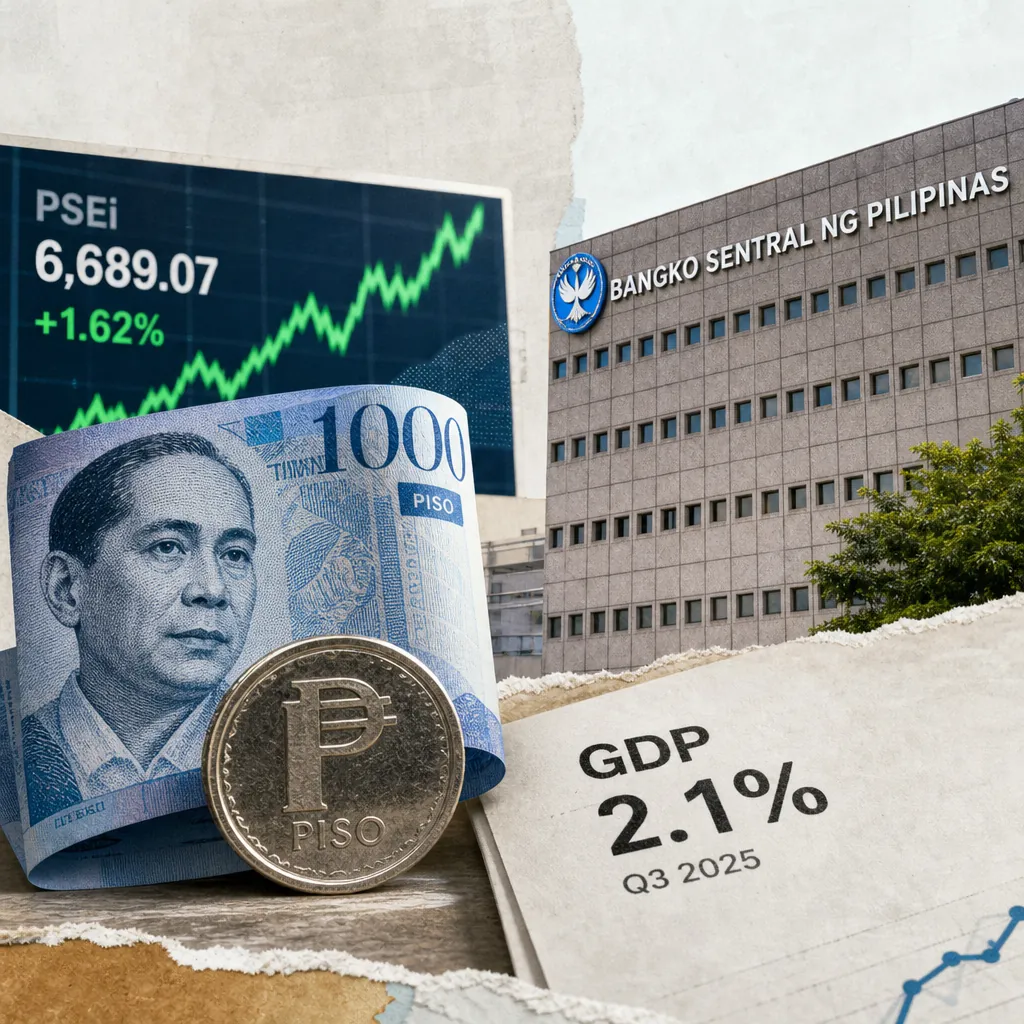
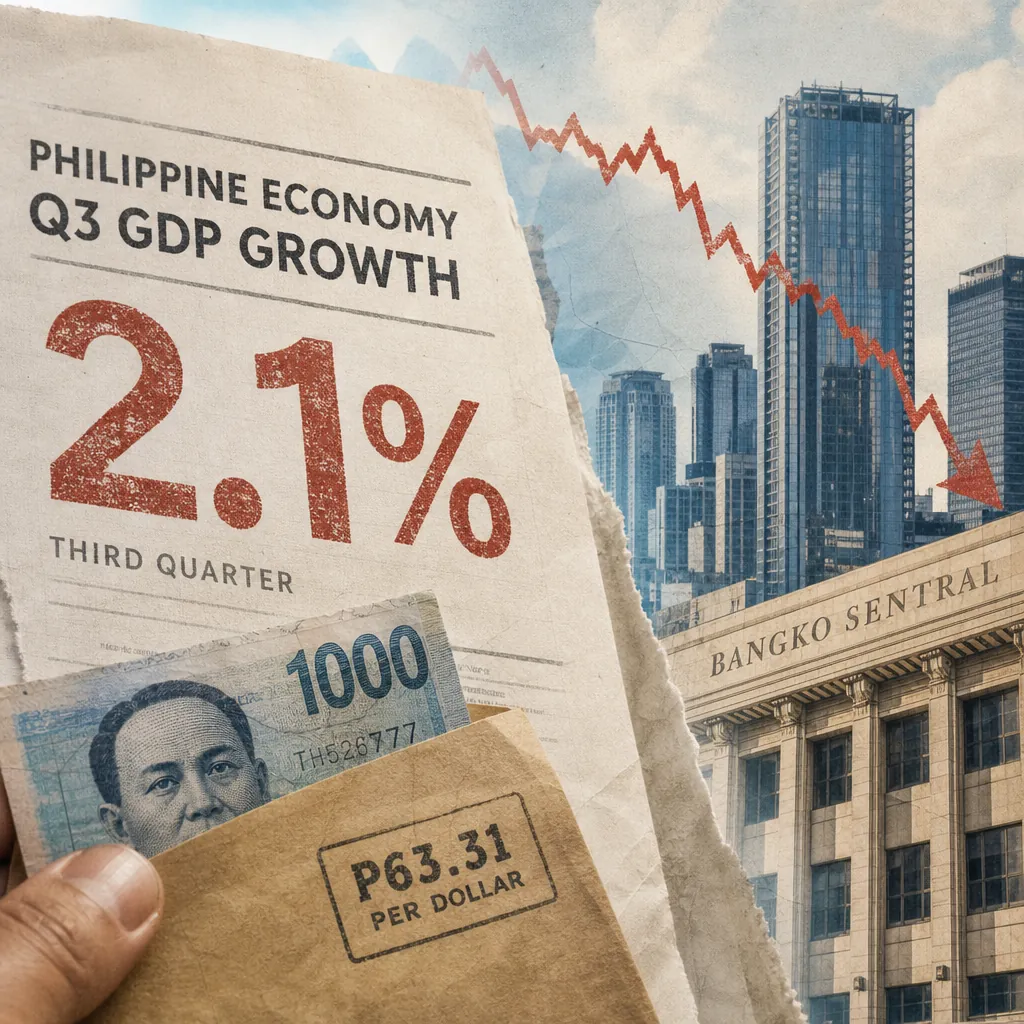
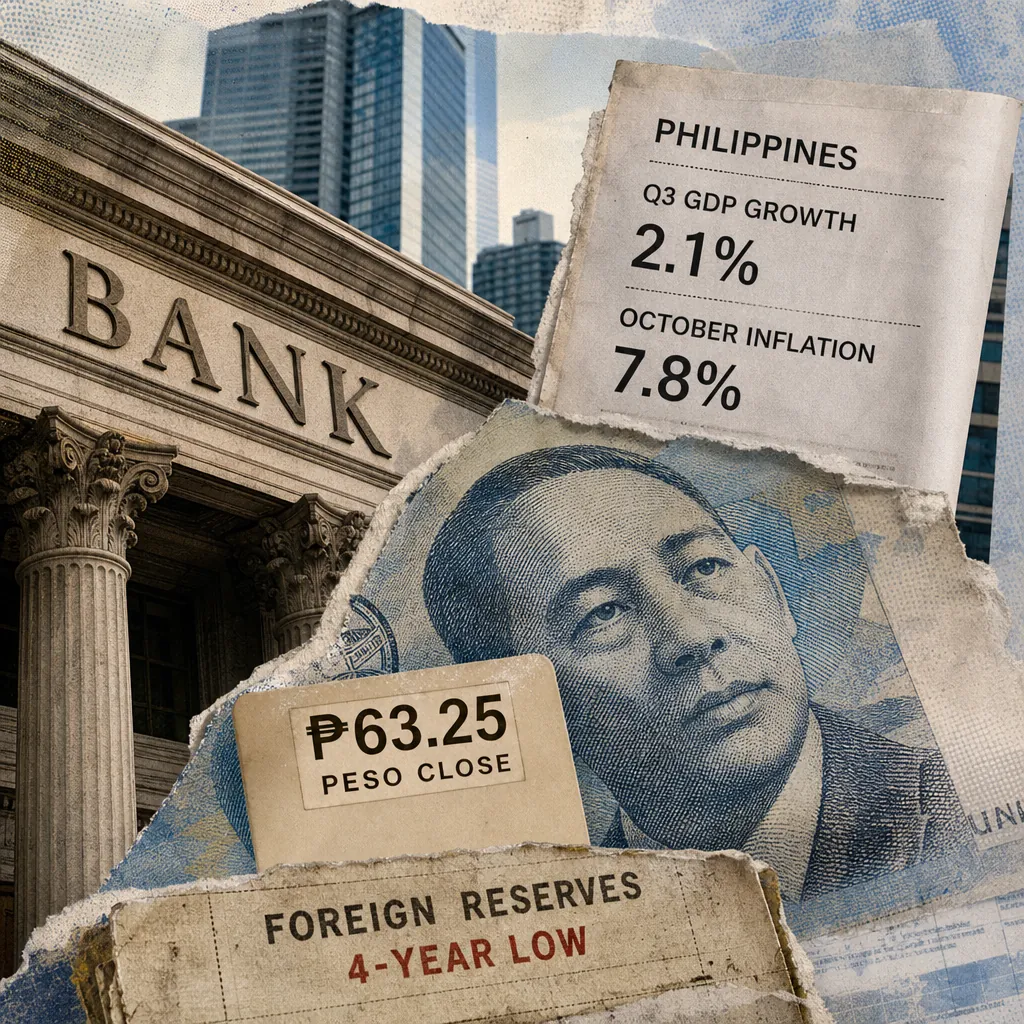
Third-quarter growth of 2.1 percent and October inflation of 7.8 percent push Fitch Solutions, Nomura and Security Bank to cut Philippine forecasts, while the peso closes at ₱63.25 and reserves fall to a four-year low. RCBC, SM Investments and Globe report earnings against that backdrop.
The Conversation
Fitch Solutions cut its 2026 Philippine growth forecast to 2.6 percent from 3 percent and its 2027 projection to 4 percent from 4.5 percent, and Nomura lowered its 2026 figure to 3 percent from 3.8 percent, after the economy expanded just 2.1 percent year-on-year in the third quarter48. Security Bank cut its full-year projection to 2.5 percent and its 2027 forecast to 3.8 percent in the same round of revisions48. The cuts followed a quarter that came in below the most pessimistic independent estimates, with October inflation at 7.8 percent59.
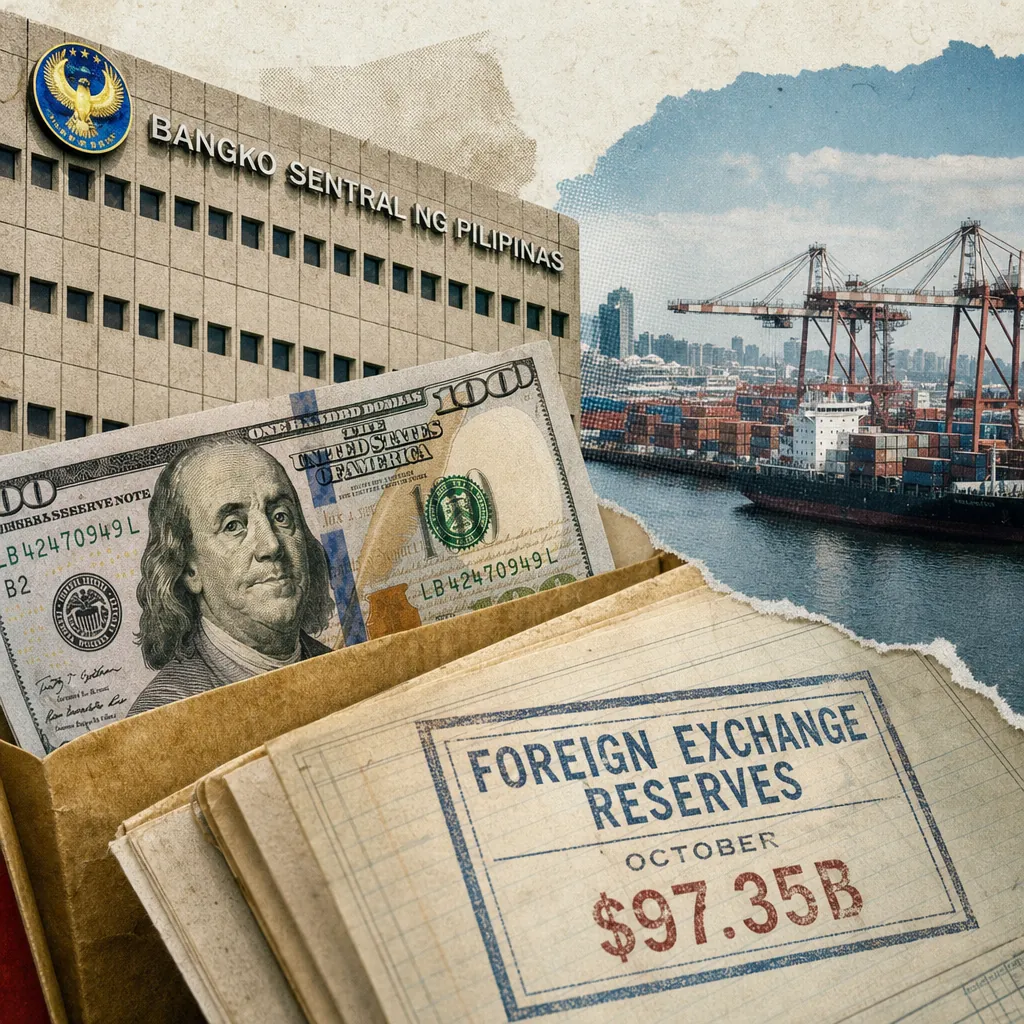
The peso closed at ₱63.25 to the US dollar on Wednesday, weaker by 34 centavos from Tuesday's ₱62.91, after stronger-than-expected US inflation data lifted demand for the greenback; the currency had touched a record low of ₱64.17 the previous week35. Gross international reserves — the central bank's stock of foreign currency it can use to pay for imports and defend the currency — fell to $97.4 billion at end-October, down 2.11 percent from September and nearly 12 percent from $110.25 billion a year earlier, the lowest level in almost four years51. Import cover, the number of months of imports those reserves can pay for, stood at 6.1 months, the thinnest since the 5.9 months recorded at the height of the 2008 global financial crisis51.
Against that, the banks reported. Rizal Commercial Banking Corp. (RCBC) posted a 13.5 percent increase in pre-provision operating profit to ₱23.6 billion in the first nine months of 2026, on consolidated gross income up 9 percent to ₱51 billion and net interest income up 15.2 percent to ₱47.1 billion; its net interest margin — the gap between what a bank earns on loans and pays on deposits — widened by 37 basis points to 5.05 percent8. SM Investments Corp. (SMIC) grew earnings 9 percent to ₱70.2 billion on revenues up 5 percent to ₱506.8 billion, with banking contributing 48 percent of income15. Globe Telecom reported record consolidated gross service revenues of ₱129.0 billion for the nine months to September, up 6 percent from ₱121.7 billion, with data-related revenues at about 90 percent of the total10. Foreign direct investment net inflows rose 24.9 percent to $690 million in August, a seven-month high, though the eight-month tally of $4.8 billion was 19.2 percent below a year earlier and short of the central bank's $6.5 billion full-year target166256.
Key themes
- Forecasters cut Philippine growth to as low as 2.5 percent for 2026. Fitch Solutions moved to 2.6 percent from 3 percent, Nomura to 3 percent from 3.8 percent and Security Bank to 2.5 percent, all after the 2.1 percent third-quarter print48. The Asian Development Bank said it will update its own projections in its December 9 Asian Development Outlook release and may retain or change them33.
- The peso closed at ₱63.25 to the dollar, 34 centavos weaker than Tuesday. Stronger US inflation data drove demand for the dollar, and the currency had hit a record ₱64.17 the week before, even after the central bank raised its key rate by half a percentage point35.
- Reserves fell to $97.4 billion, covering 6.1 months of imports. That is the lowest reserve level in almost four years and the thinnest import cover since the 2008 crisis, which the central bank attributes to foreign exchange operations, lower gold valuations and government withdrawals for external debt servicing51.
- RCBC's pre-provision operating profit rose 13.5 percent to ₱23.6 billion. Net income was ₱5 billion as the bank kept credit provisioning prudent and lending selective, with gross customer loans up 6.3 percent to ₱812.5 billion and total resources at ₱1.42 trillion8.
- SM Investments earnings rose 9 percent to ₱70.2 billion, with banking at 48 percent of income. BDO Unibank posted record nine-month earnings of ₱63.6 billion with its loan portfolio up 16 percent, and China Banking Corp. also improved on stronger lending15.
- Foreign direct investment inflows hit a seven-month high of $690 million in August. The 24.9 percent year-on-year rise came mostly from more equity placements and reinvested earnings, but the cumulative $4.8 billion remains 19.2 percent below 2025 and below target166256.
- Globe's nine-month service revenues reached a record ₱129.0 billion. The 6 percent rise was broad-based across mobile, home broadband and corporate data, with data now about 90 percent of gross service revenues10.
- Digital payments reached 64.7 percent of retail transaction volume in 2025. The central bank figure, cited as retailers prepare for the 11.11 and 12.12 shopping campaigns, sets the scale of the fraud-control problem at checkout60.
How the narratives stack
Dominant. The growth downgrades and the currency and reserves numbers carried the most consequence in the items captured here. Fitch Solutions, Nomura and Security Bank all published revised forecasts within a day of each other, and the ADB put a date on its own revision4833. The peso and reserves stories ran alongside them, with the reserve figure framed against the 2008 crisis3551. This is the story that sets the terms for every other financial item in the set: it determines what the central bank does at its December meeting, what banks provision for, and what borrowers pay.
Counter-narrative. The banks' own results argue that the slowdown has not yet reached their books. RCBC's pre-provision operating profit grew 13.5 percent, its margin widened, and its loan book still grew 6.3 percent8. SMIC grew earnings 9 percent with banking the largest contributor, and BDO posted record nine-month earnings with loans up 16 percent15. Globe's record revenue adds a telecoms data point on the same side10. The counter-narrative is not that the economy is fine; it is that lending spreads widened even as volumes slowed, which is how banks earn more in a weak quarter.
Emerging. The reserve position is the item most likely to grow. Import cover at 6.1 months invites questions about how much further the central bank can spend defending the peso, and the editorial framing — a central bank working the peso's edges while the Treasury drains the same vault — points at the fiscal side51. The peso's move back into ₱63 territory after a half-point rate hike raises the same question from the currency side35. Neither item has a scheduled resolution; both will be tested at the December policy meeting and in the next reserves release.
Under-covered. The clearest under-covered story in this set is the data breach affecting government agencies. The National Privacy Commission confirmed it had received breach notifications from at least 10 major agencies, including the Department of Information and Communications Technology, the Presidential Commission on Good Government, the labor department's Bureau of Local Employment, the Bureau of Internal Revenue and the Philippine Amusement and Gaming Corp.61. A separate monitoring account put the count at 23 institutions, with 19.2 million records taken from the labor department and nearly 500 gigabytes from the interior department13. For a banking readership this is the most directly relevant item after the macro numbers, because stolen government IDs and payroll files are the raw material for loan fraud, and it drew a fraction of the coverage the GDP print did.
Platform insights
- Facebook. The impeachment trial coverage that circulated in Filipino-language form — the Bombo Radyo Cauayan and RMN reports on the defense dropping bank witnesses — is built for sharing among general audiences rather than for financial specialists4341. The substance is procedural: 15 of 16 withdrawn witnesses were representatives of seven banks, and only a Bank of the Philippine Islands official will appear41.
- X. The macro numbers are the kind that travel on X in chart form: a 2.1 percent growth print, 7.8 percent inflation and a peso at ₱63.25 give commentators a single sentence to post5935. The opinion piece calling the Philippines "the village fool at 2.1 percent" among ASEAN-5 economies is the sort of line that gets quoted without its context59.
- Reddit. Discussion of the data breaches is the most likely to sustain threads, because the affected agencies touch ordinary transactions — tax filing at the Bureau of Internal Revenue, local government registrations at the interior department6113. The practical question readers raise is whether their own records are in the leaked sets, which neither the privacy commission nor the reporting answers yet.
- YouTube. The clearest video-native material is the technology conference: the fourth IoT Conference Philippines and first AI Philippine Expo closed at SM Megamall after two days of keynotes, panels and a hackathon5. Panel content on digital governance and the future of marketing gives clip-length material that the financial stories do not.
Key voices and communities
Macro forecasters and research desks. Fitch Solutions, Nomura, Security Bank and the ADB are the group setting expectations4833. Their revisions matter because they feed into how investors price Philippine risk and how the government's own targets are judged; the full-year official target of 3.5 to 4.5 percent now sits well above most private projections59.
The central bank and its critics. The Bangko Sentral ng Pilipinas raised its key rate by half a percentage point and still saw the peso weaken, which is the basis of the argument that rate hikes cannot fix inflation driven by supply costs and a weak currency35. The reserve editorial extends the critique to the Treasury's withdrawals51.
Listed banks and conglomerates reporting results. RCBC, SMIC, BDO and China Bank are speaking to shareholders through their nine-month numbers815. Their framing — resilient consumer demand, selective lending, prudent provisioning — is the industry's answer to the downgrades.
The privacy regulator and breach monitors. The National Privacy Commission is evaluating notifications from at least 10 agencies, while the monitoring group Deep Web Konek has published a wider count of 23 institutions and named the threat groups involved6113. The gap between the two counts is itself a story about how quickly the scope is being established.
Retailers and payment operators. As the 11.11 and 12.12 campaigns approach, merchants are balancing fraud checks against checkout speed, with digital payments at 64.7 percent of retail transaction volume60. This group carries the operational consequences of both the breach story and the central bank's July 2026 call for stronger authentication and incident response60.
Narrative streams
Forecasters cut 2026 growth to 2.6 percent after a 2.1 percent quarter
The third quarter's 2.1 percent growth was lower than the most pessimistic independent predictions, and it matches the country's population growth rate, which means per-capita output was roughly flat59. Fitch Solutions attributed the weak momentum to elevated inflation eroding household purchasing power, higher borrowing costs, weaker labor market conditions and negative consumer confidence, and said it expects that weakness to carry into 202748. Nomura's cut to 3 percent and Security Bank's to 2.5 percent bracket the range48. The ADB's country director, Andrew Jeffries, said the bank's December 9 Asian Development Outlook update may retain or change its projections, which keeps a scheduled moment for the next revision33.
For banks, the consequence is a lending environment where demand weakens before margins do. RCBC's numbers show the pattern already: loans grew 6.3 percent, slower than the 16 percent BDO reported, and RCBC explicitly described selective lending and tighter underwriting to protect asset quality815. A bank that expects slower growth and higher inflation provisions more and lends to fewer borrowers, which is what RCBC's ₱5 billion net income against ₱23.6 billion pre-provision profit implies. The read for the sector is that earnings growth in the next two quarters will come more from spreads than from volume, and that consumer lending — the segment most exposed to 7.8 percent inflation — is where asset quality will show first.
The peso closes at ₱63.25 after a half-point rate hike
The central bank raised its key rate by 50 basis points to contain inflation and support the peso, and the currency still weakened to ₱63.25 on Wednesday and had hit a record ₱64.17 the week before35. The mechanism the rate hike relies on is demand-side: costlier loans mean households borrow less and businesses invest less, so less money chases goods and prices ease35. The critique published in the same set is that not all inflation comes from too much spending, and rate hikes do little against supply-driven price increases35. Nomura still expects a half-point hike to 6 percent at the December meeting, with a quarter-point move possible if global oil prices keep falling and offset food costs6.
For borrowers, the practical effect is that the cost of credit is likely to rise again in December regardless of the growth slowdown, because the central bank's mandate is price stability and the peso is the transmission channel. For banks, a wider net interest margin is a short-term gain and a medium-term risk: RCBC's margin widened 37 basis points to 5.05 percent, but every increase in the policy rate also raises the odds that existing borrowers struggle to repay8. The read for the sector is that the December meeting is the single most consequential scheduled event for Philippine lending costs in the next month, and that a quarter-point versus half-point outcome changes the outlook for consumer loan demand into 2027.
Reserves fall to $97.4 billion, covering 6.1 months of imports
Gross international reserves fell 2.11 percent month-on-month and nearly 12 percent year-on-year to $97.4 billion, the lowest in almost four years51. The central bank's stated reasons — net foreign exchange operations, lower gold valuations and government withdrawals for external debt servicing — are each routine, but together they describe a central bank selling foreign currency to steady the peso while the Treasury draws on the same reserves to pay foreign debt51. Import cover of 6.1 months is the measure that matters for a currency defender, because it sets how long the central bank can keep intervening. The last time cover was this thin was 5.9 months in 200851.
The read for the sector is that the central bank has less room to defend the peso than it did a year ago, which shifts more of the adjustment onto interest rates and onto the government's borrowing plan. Banks holding peso assets face a currency that has weakened through a rate hike, and corporate clients with foreign-currency debt face higher servicing costs. The next reserves release and the December policy meeting are the two points at which this becomes measurable rather than directional.
RCBC earns ₱23.6 billion before provisions and ₱5 billion after
The gap between RCBC's pre-provision operating profit of ₱23.6 billion and its net income of ₱5 billion is the cost of provisioning for bad loans, and the bank described the provisioning as prudent amid economic uncertainty8. Gross income rose 9 percent to ₱51 billion, net interest income rose 15.2 percent to ₱47.1 billion, and total resources reached ₱1.42 trillion with deposits of ₱1.07 trillion8. The bank serves 7 million customers and 1.6 million credit cardholders8.
SM Investments' results show the same divergence from a conglomerate angle: earnings up 9 percent to ₱70.2 billion, revenues up 5 percent to ₱506.8 billion, and banking at 48 percent of income, with president and chief executive Frederic DyBuncio citing "ongoing resilient consumer demand" for retail and malls15. BDO's record ₱63.6 billion and 16 percent loan growth, and China Bank's stronger profit, complete the picture of a banking sector still expanding its book while the economy slows15. The read for the sector is that the large banks are using the slowdown to widen spreads and gain share, and that the credit-card segment — 1.6 million cardholders at RCBC alone — is where the combination of 7.8 percent inflation and higher policy rates will first show in delinquency.
Foreign direct investment rebounds 24.9 percent in August but stays below target
Net FDI inflows of $690 million in August were the highest since January's $800 million and 24.9 percent above the $552 million recorded a year earlier, driven by more equity placements and reinvested earnings1662. The eight-month total of $4.8 billion is 19.2 percent below the same period in 2025, when it was $5.9 billion, and the central bank's revised full-year target is $6.5 billion1656. The decline came mainly from lower intercompany borrowings, the financing between related companies that forms part of direct investment56.
FDI matters to banks because it is the firmer kind of foreign money: unlike portfolio investment, which leaves at the first sign of trouble, direct investment establishes a lasting interest in a local company and can create jobs16. The read for the sector is that the August rebound is a single month against a weak eight-month trend, and that hitting the $6.5 billion target would require roughly $1.7 billion in the last four months of the year — more than double the monthly pace of the first eight. Corporate banking desks should expect the investment pipeline to stay thin into 2027 unless the growth outlook stabilizes.
Data breaches hit at least 10 government agencies
The National Privacy Commission confirmed it received breach notifications on Tuesday from at least 10 major agencies, including the Department of Information and Communications Technology, the Presidential Commission on Good Government, the labor department's Bureau of Local Employment, the Bureau of Internal Revenue and the Philippine Amusement and Gaming Corp.61. A monitoring group, Deep Web Konek, put the count at 23 government agencies, private companies and schools, with leaks between November 5 and 7 that included personally identifiable information, government IDs, corporate registrations and payroll files; it attributed 10 gigabytes from the Office of the Vice President and 19.2 million records from the labor department to one group, and nearly 500 gigabytes containing 19 million resident profiles from the interior department to another13. A DICT official said all breaches were contained61.
The read for the sector is that stolen government IDs and payroll records are the inputs to identity fraud, and identity fraud is how people end up with loans they never took. The parallel is direct: a Vietnamese police cyber unit arrested a suspect who used forged identity documents bearing his own photo but other people's personal details to sign installment contracts with consumer finance companies, leaving the victims with bad credit records and daily collection calls2. Philippine banks and consumer lenders that onboard customers with ID checks should expect pressure to strengthen verification, and the central bank's July 2026 instruction to supervised institutions to tighten authentication, cyber-threat monitoring and incident response gives it a supervisory basis60.
Digital payments reach 64.7 percent of retail volume as 11.11 approaches
Digital transactions accounted for 64.7 percent of retail payment transactions by volume in 2025, according to the central bank, and retailers preparing for the 11.11 and 12.12 campaigns face the problem of screening for fraud without slowing checkout60. The difficulty is structural: promotional events bring sudden volume spikes, first-time buyers and repeated purchase attempts, all of which look like fraud signals60. The central bank's July 2026 guidance asked supervised institutions to strengthen authentication, cyber-threat monitoring and incident response60.
For payment providers and merchants, the read is that the remaining 35.3 percent of retail transactions still done in cash is the share still open to digital conversion, and that the conversion will be won or lost on checkout speed during the two promotional peaks. A fraud check that adds friction at 11.11 pushes buyers back to cash on delivery, which is the outcome both the central bank's financial inclusion goals and the retailers' margins want to avoid.
Globe's data revenues reach 90 percent of gross service revenues
Globe reported record consolidated gross service revenues of ₱129.0 billion for the nine months to September, up 6 percent from ₱121.7 billion, with growth across mobile, home broadband and corporate data10. Data-related revenues are now about 90 percent of the total, which the company presents as evidence of its transformation into a data-driven connectivity and digital solutions provider10.
For banks, the relevance is distribution: a telecoms operator with 90 percent data revenue is a channel for embedded financial services, and the same logic appears in EastWest's partnership with the healthcare platforms SeriousMD and NowServing, which connects the bank to an estimated 20,000 healthcare professionals through loan referrals and embedded payment for professional fees55. UnionBank's Negosyante BOOSTcamp, a six-week program that graduated 27 small-business owners on October 24, is the same play from the small-business side22. The read for the sector is that customer acquisition is moving onto platforms banks do not own, and the terms of those partnerships — who holds the customer relationship — will determine which banks keep the margin.
Conversation trajectory
December 9: ADB Asian Development Outlook update. The ADB's country director said the bank will publish updated projections on that date and may retain or change them33. Watch whether the ADB joins Fitch Solutions and Nomura below 3 percent; a third major forecaster moving under 3 percent would make the government's 3.5 to 4.5 percent target look unreachable rather than merely optimistic.
December: central bank policy meeting. Nomura expects a half-point hike to 6 percent, with a quarter-point move possible if oil prices keep falling6. The peso's close at ₱63.25 after the last half-point hike is the test case: a second half-point hike that fails to strengthen the currency would shift the argument toward the reserve-and-fiscal explanation3551.
Next reserves release. Import cover at 6.1 months is the thinnest since 2008, and the next monthly figure will show whether the decline is a one-month drawdown or a trend51. A further fall toward 6 months would put the central bank's capacity to intervene at the center of the currency debate.
11.11 and 12.12 shopping campaigns. Retailers are preparing fraud controls for both events, with digital payments at 64.7 percent of retail volume60. Watch for reported fraud incidents or checkout failures during the campaigns; either would give the central bank reason to tighten authentication rules further.
Ongoing: scope of the data breaches. The privacy commission is evaluating notifications from at least 10 agencies while a monitoring group counts 23 institutions6113. The gap between the two counts should narrow as the investigation proceeds, and the number of affected individuals will determine whether this becomes a consumer-credit problem for lenders.
Trigger events. A third forecaster cutting below 3 percent, a peso close weaker than ₱64.17, import cover falling below 6 months, or a confirmed breach at a bank or consumer lender would each move this from a sector signal to a pressing problem.
Response guidance
Lead with the spread, not the growth number. Banks reporting results in this environment should explain that earnings growth came from wider margins and selective lending, and state plainly what that means for borrowers: fewer approvals and higher rates. RCBC's 37-basis-point margin widening and 6.3 percent loan growth tell that story accurately8.
Put a number on provisioning. The gap between RCBC's ₱23.6 billion pre-provision profit and ₱5 billion net income is the clearest public explanation of how much the bank is setting aside for bad loans8. Communicators should expect questions about credit-card delinquency given 1.6 million cardholders and 7.8 percent inflation, and should answer with the provisioning figure rather than with confidence language.
Address the reserve question directly. The reserve editorial's argument — that the central bank is defending the peso while the Treasury draws on the same reserves — will circulate51. Institutions with foreign-currency exposure should prepare a plain explanation of their own position rather than waiting for the question at an investor briefing.
Treat the data breaches as a customer-service issue. Lenders should publish what they are doing to verify identities and protect customers whose government IDs may have been leaked, and should say whether they have seen fraudulent applications traceable to the leaked sets6113. Silence on this reads as unpreparedness.
Prepare for the 11.11 and 12.12 fraud questions now. With digital payments at 64.7 percent of retail volume, any checkout failure or fraud incident during the campaigns will be attributed to the payment providers60. Publish the fraud-control measures and the response times before the campaigns, not after.
Use the December dates. The ADB update on December 9 and the central bank meeting in December are fixed points336. Communications plans should be built around those dates rather than around the daily currency moves, which invite reactive statements.
Keep platform partnerships transparent. As banks move onto healthcare, telecoms and small-business platforms, customers should be told who holds their data and who is lending552210. The reputational risk in embedded finance sits with the bank whose name appears on the loan.
See the full picture behind today's signals.
This report draws from Media Meter's MediaWatch, our real-time monitoring engine tracking 2,470+ Philippine sources across print, broadcast, digital, and social. Explore how the platform turns raw coverage into decision-grade intelligence, then see how it's configured for teams like yours — whether you're in PR agencies, corporate comms, government, or marketing.
Want more? Browse our Report Library for sector and crisis intelligence, or request a demo and we'll have your brand set up before the call.
Want this kind of intelligence on your brand?
This brief is built on the same MediaWatch methodology that runs continuously across every brand we monitor. See your competitive landscape, Impact Score, and narrative trajectory in a 30-minute demo.