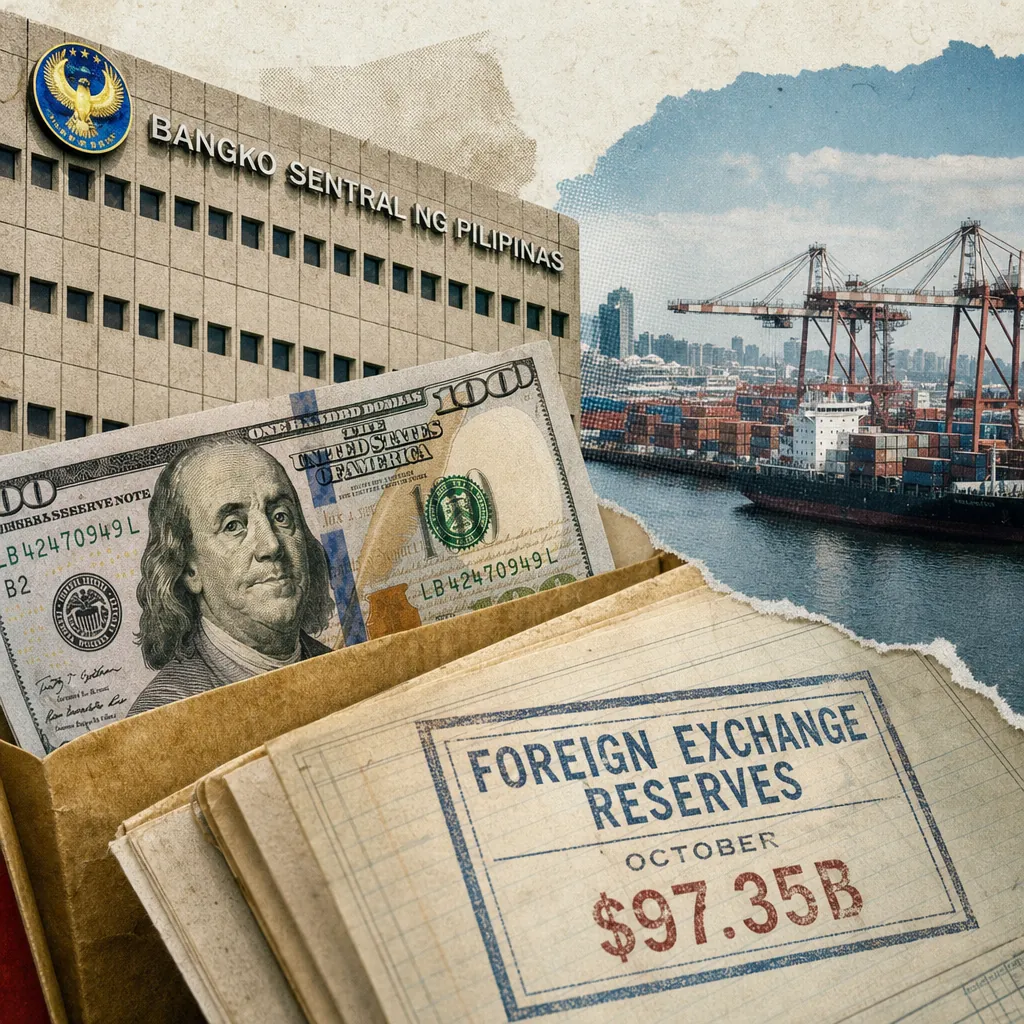
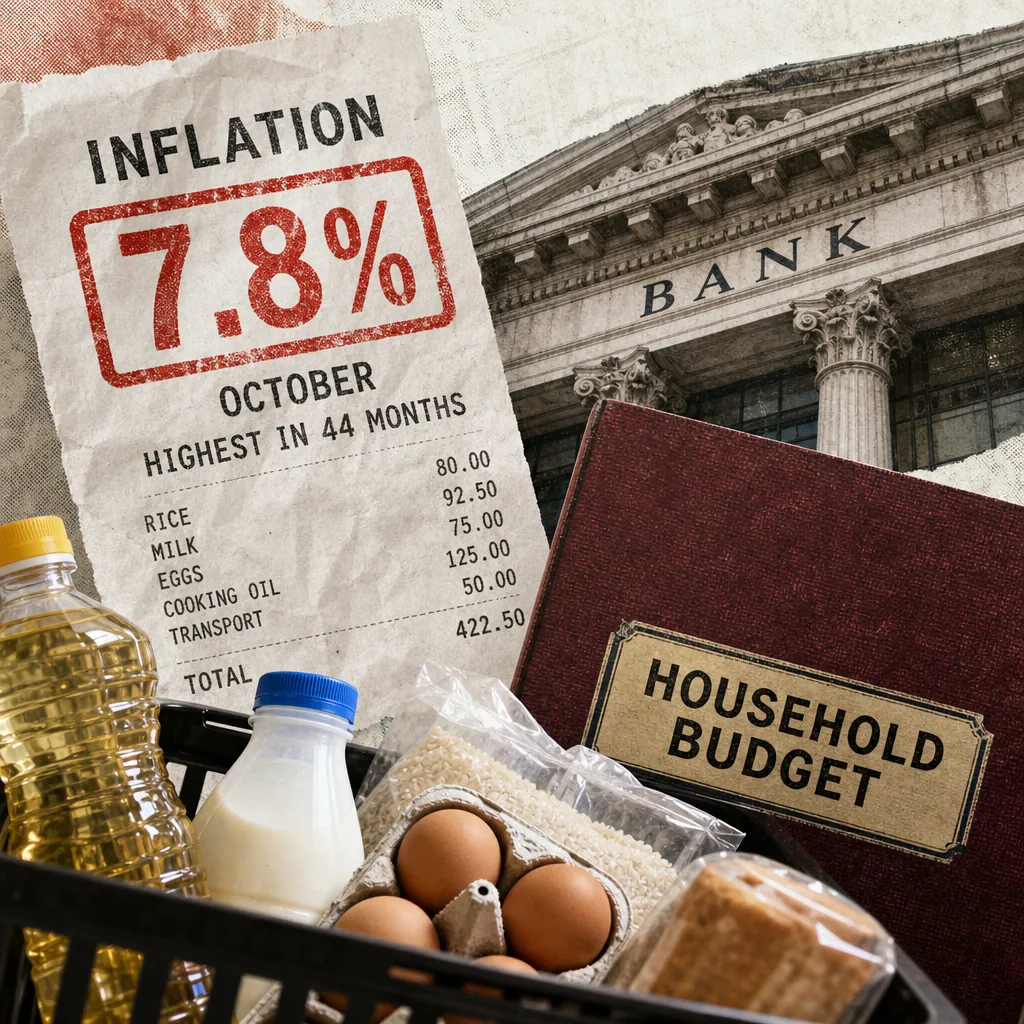
Philippine GDP Growth Slows to 2.1% in Q3
Philippine economic growth fell to 2.1 percent in the third quarter, its weakest reading outside the pandemic since 2009, pulling the stock index down 1.46 percent and the peso to P63.31 per dollar. Banks and analysts expect inflation to stay elevated into 2027 while the central bank nears the end of its tightening cycle.
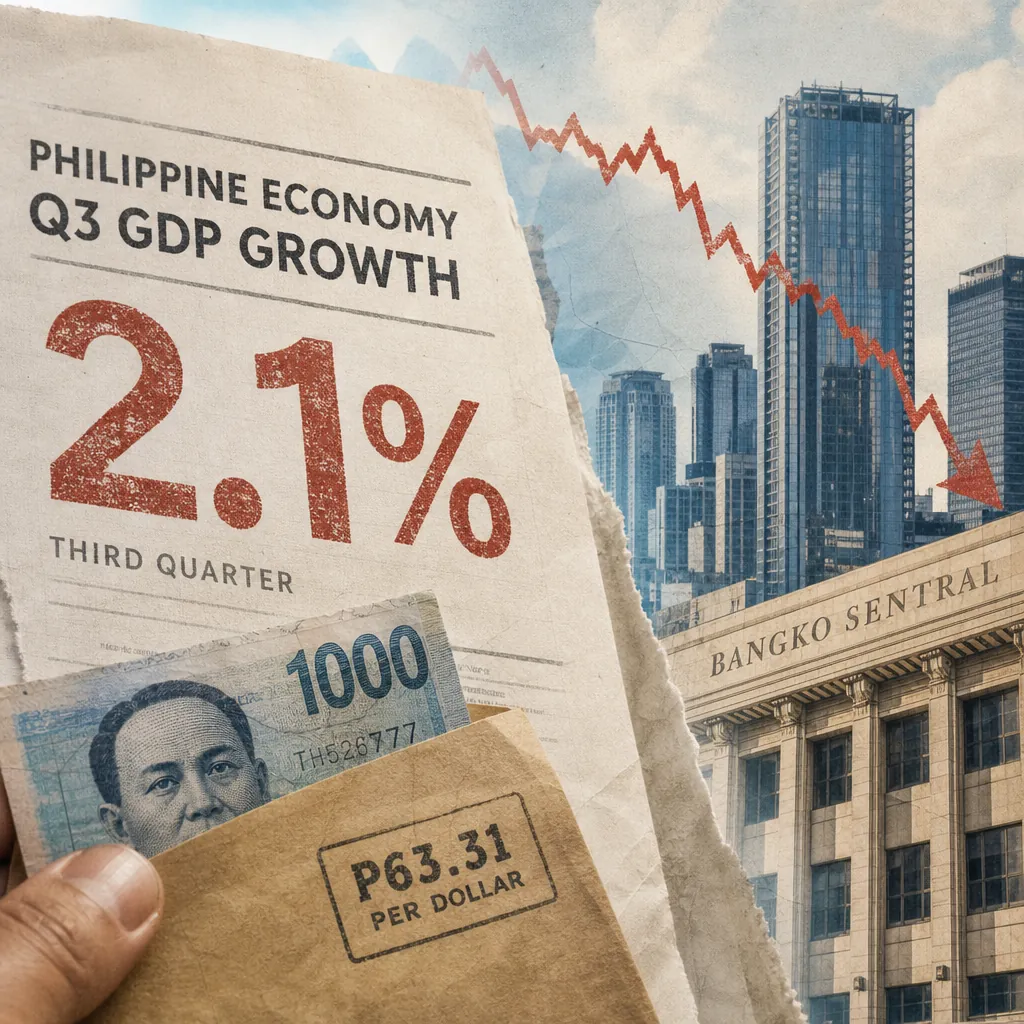
The Philippine economy grew 2.1 percent in the July-to-September quarter, the Philippine Statistics Authority reported on Monday, down from a revised 2.4 percent in the second quarter and 4.0 percent a year earlier2548. It was the fifth consecutive quarter of slowing growth and, excluding the pandemic years, the weakest expansion since the 1.8 percent recorded in the fourth quarter of 20092558. The figure landed below the 2.7 percent median forecast in a BusinessWorld poll of 16 economists58.
Markets repriced immediately. The Philippine Stock Exchange index (PSEi) — the benchmark gauge of the country's 30 largest listed companies — fell 84.03 points, or 1.46 percent, to 5,677.92, while the peso weakened 25.5 centavos, or 0.40 percent, to P63.31 per US dollar from Friday's P63.055 close1962. The peso has now weakened for three straight sessions27. The sell-off dominated the business pages: the GDP story alone carried an estimated P828,432 in advertising-equivalent value in BusinessWorld's front page58, and the market reaction drew further coverage across the Manila Times, Daily Tribune, Philstar and Manila Standard251962.
Behind the headline number, the components explain the anxiety. Agriculture contracted 4.8 percent, industry was nearly flat, household consumption — the largest driver of Philippine GDP — expanded by just 2.4 percent, and gross capital formation, a measure of investment, declined 0.2 percent19. Year-to-date growth averaged 2.5 percent, below the government's downwardly revised 3.5 to 4.5 percent target for the year25.
Key themes
- GDP growth of 2.1 percent is the weakest outside the pandemic since 2009. The third-quarter print extended a five-quarter slowdown, with agriculture contracting 4.8 percent and investment falling 0.2 percent2519.
- The PSEi fell 1.46 percent and the peso closed at P63.31 per dollar. Investors sold on the growth miss, with Regina Capital's Luis Limlingan citing "potential El Niño risks and persistent inflationary pressures"6219.
- Citi expects inflation to stay between 7.5 and 8.1 percent into early 2027. The bank cited stagflation-like conditions, food supply risks and below-normal rainfall lasting well into the first quarter of 20271.
- Manulife sees bond yields easing within six to 12 months as the BSP nears its rate peak. Fixed-income head Jean Olivia de Castro said the 7.8 percent October inflation print "keeps the BSP hawkish near term, but we believe policy is approaching peak tightness"618.
- The Treasury made a partial award of short-term securities at higher yields. It raised P51.12 billion against a P55-billion plan, with the one-month bill averaging 5.81 percent, up 20.3 basis points from the prior week.
- TransUnion found Mindanao consumers the most willing to borrow. Fifty-four percent of Mindanao respondents intended to use credit in coming months, against 42 percent in the Visayas and 40 percent in Luzon, with the national credit perception score rising two points to 75 out of 1002639.
- GCash is piloting an AI assistant that executes transactions, not just answers questions. Gabby combines customer support, financial guidance and task execution, including buying mobile load, with users confirming payment at the GCash cashier4.
- The BSP plans to produce polymer banknotes locally within 2027. Deputy Governor Mamerto Tangonan said the central bank must "learn to operate the polymer lines so that we're not forever just importing," while continuing to outsource from Australia to meet demand.
How the narratives stack
Dominant: The GDP miss and the market reaction. Across the items captured here, this was the most heavily covered story of the day, with the BusinessWorld front-page report alone carrying an estimated P828,432 in advertising-equivalent value — the estimated cost of buying the same space as paid advertising, not a measure of readership58. The Manila Times' version carried an estimated P773,65625, and the Philstar, Daily Tribune, Manila Standard and GMA News Online reports added further coverage621927. The dominance is a property of this captured set, which skews toward business broadsheets and their online editions; it is consistent with the size of the news but should not be read as a census of all coverage.
Counter-narrative: Two forward-looking views that cut against the gloom. Citi's forecast that inflation has "probably not yet peaked" but that the pace of increase will decelerate, with the post-US-election retreat in oil prices providing relief to domestic energy prices1. And Manulife's call that bond yields will move lower over six to 12 months as the BSP approaches peak tightness, making current levels "increasingly attractive for adding duration"861. Neither disputes the weak growth; both argue the worst of the rate pressure is close.
Emerging: Consumer credit behavior outside the capital. TransUnion's 2026 Credit Perception Index — a survey of 1,000 Filipino consumers conducted May 6 to 26 — found the national credit perception score at 75 out of 100, its highest since the index began in 2023, with Mindanao gaining three points to 77 and 54 percent of its respondents intending to borrow2639. That is a signal about where lending demand may grow even as headline consumption weakens.
Under-covered: The operational side of digital finance. GCash's explanation of why it cut its interbank transfer fee to P10 from P15 rather than waiving it entirely — to keep funding its fraud management system — appeared in a single BusinessWorld item, and the BSP's polymer banknote localization plan ran on the BusinessWorld front page. Both matter to how payments and currency work for ordinary Filipinos, but neither drew the volume of the GDP story in this set.
Platform insights
The monitoring writeup for this window contained no social-media posts with engagement figures, so no platform-by-platform engagement comparison can be made. The conversation captured here ran through published news items rather than social posts.
Key voices and communities
Economic analysts and brokerages. Regina Capital's Luis Limlingan framed the sell-off around "fragile" sentiment and El Niño risk62; RCBC chief economist Michael Ricafort attributed the peso's move to the "softer-than-expected local GDP growth at 2.1%"27. Their commentary set the tone for how the GDP print was read.
Bank and asset-manager research desks. Citi's inflation outlook1 and Manulife's fixed-income view861 gave the market a forward path, and both were picked up by multiple outlets.
The Bangko Sentral ng Pilipinas. The central bank appeared in two roles: as the authority whose tightening cycle analysts are trying to time61, and as an operator planning local polymer note production.
Consumer-credit researchers. TransUnion's index put regional borrowing attitudes on the record, with Mindanao standing out2639.
Digital finance providers. GCash and BPI both made news on access and cost — GCash on the trade-off between lower fees and fraud protection, BPI on data-free app access for Globe and TM subscribers.
Narrative streams
GDP growth of 2.1 percent pulls the PSEi down 1.46 percent
The Philippine Statistics Authority's third-quarter report showed gross domestic product — the total value of goods and services produced in the economy — expanding 2.1 percent year on year, below the 2.7 percent median estimate in a BusinessWorld poll of 16 economists58. On a seasonally adjusted quarter-on-quarter basis, GDP inched up 0.1 percent, easing from 0.6 percent in the previous quarter58. The Manila Times noted the July-September slowdown was the fifth consecutive quarter of slumping growth and, excluding the pandemic, the slowest since the fourth quarter of 200925. GMA News Online, reporting in Filipino, described it as the weakest since the 3.8 percent contraction in the first quarter of 2021, when COVID-19 lockdowns were at their height27.
The market response was immediate and broad. The PSEi opened higher at 5,771.58 and reached an intraday peak of 5,785.13 before closing at its session low of 5,677.92, down 1.46 percent. The broader All Shares index fell 1.08 percent to 3,183.5262. Among the day's biggest decliners were Manila Electric Co. at P424.00, down 4.93 percent, Jollibee Foods Corp. at P144.00, down 3.36 percent, and Ayala Land and Aboitiz Equity Ventures, each down 2.50 percent. The peso's slide to P63.31 per dollar marked its third straight session of weakening27.
For households, the read is direct: a 2.1 percent growth rate is slower than the pace of price increases, meaning the economy in real terms is barely expanding per person while costs continue to climb. For banks and lenders, weak investment — gross capital formation fell 0.2 percent — points to softer loan demand from businesses even as consumer borrowing attitudes improve in places like Mindanao1926. For the government, year-to-date growth of 2.5 percent sits well below its 3.5 to 4.5 percent target, which narrows the fiscal room for any stimulus25.
Citi sees inflation holding at 7.5 to 8.1 percent into early 2027
American banking giant Citi predicted Philippine inflation will remain high through the first quarter of next year, staying between 7.5 and 8.1 percent until early 2027 due to food supply risks and ongoing cost pressures1. "Although YoY inflation has probably not yet peaked, we expect the pace of increase to decelerate further," Citi said, adding that the recent retreat of oil prices after the US elections should relieve domestic energy prices and reduce foreign-exchange pressure by compressing the energy trade deficit1. The bank also flagged below-normal rainfall lasting well into the first quarter of 2027 as a food supply risk1.
That rainfall warning connects to El Niño, the periodic warming of the Pacific that brings drier conditions to the Philippines and hits farm output — the same risk Limlingan cited in explaining the stock market's fragility62. Agriculture's 4.8 percent contraction in the third quarter shows the channel is already active19.
For food retailers, processors and agribusiness, the read is that input costs are unlikely to normalize soon, and hedging or supply diversification has a longer runway than a single quarter. For consumers, it means the purchasing power squeeze that has defined the past year extends into 2027 on Citi's numbers.
Manulife expects bond yields to ease as the BSP nears its rate peak
Manulife Investment Management and Trust Corp. said Philippine government bond yields may only start easing over the next six to 12 months as inflation peaks and the central bank nears the end of its tightening cycle8. "The 7.8-percent inflation print keeps the BSP hawkish near term, but we believe policy is approaching peak tightness," said Jean Olivia de Castro, Manulife's head of fixed income61. She added that yields "may remain elevated over the next few months, but over a six- to 12-month horizon, we expect yields to move lower as inflation peaks and the market begins pricing the end of the tightening cycle, making current levels increasingly attractive for adding duration"8.
The Bangko Sentral ng Pilipinas is the country's central bank; it sets the policy interest rate that anchors borrowing costs across the economy, and "hawkish" means leaning toward higher rates to fight inflation. "Duration" is a measure of how sensitive a bond's price is to rate changes — adding duration means buying longer-dated bonds in anticipation of falling yields.
The same day, the Bureau of the Treasury — the government's debt issuer — made a partial award of the short-term securities it offered, raising a combined P51.12 billion against a P55-billion plan even as total tenders reached P92.097 billion. The one-month bill fetched an average rate of 5.81 percent, up 20.3 basis points from 5.607 percent the prior week. A basis point is one-hundredth of a percentage point.
For institutional investors and pension funds, Manulife's view argues for patience: the pain in bond portfolios is near its end. For the government, the partial award at higher yields shows borrowing is getting more expensive precisely when weak growth argues for more spending — a squeeze that will shape the 2027 budget.
TransUnion finds Mindanao consumers most willing to borrow
TransUnion's 2026 Credit Perception Index found that 54 percent of respondents in Mindanao intended to use credit in the coming months, compared with 42 percent in the Visayas and 40 percent in Luzon26. The study surveyed 1,000 Filipino consumers from May 6 to 26, examining knowledge, trust and attitudes toward credit26. The country's overall credit perception score rose two points from 2025 to 75 out of 100, its highest since the index began in 2023; Mindanao posted the biggest improvement, gaining three points to 77, while Luzon edged up one point to 74 and the Visayas held at 752639.
For banks and fintech lenders, the read is that growth in consumer credit is likelier to come from the south than from the capital region, and that product design and distribution should follow. For regulators, rising credit confidence is a positive for financial inclusion but also a reminder that lending standards matter more as more first-time borrowers enter the market.
GCash pilots an AI assistant and defends its fee cut
GCash is testing Gabby, an artificial-intelligence-powered assistant designed to understand user requests and carry them out, not merely answer questions4. The pilot combines customer support, financial guidance and task execution; for example, Gabby can analyze a user's previous transactions and recommend load offers, then route the transaction to the secure GCash cashier, where the user must confirm payment4.
Separately, Mynt Inc. chief regulatory and compliance officer Ceferina Sison said GCash's decision to cut its interbank transfer fee to P10 from P15 — even as traditional banks moved to waive such charges entirely — was meant to keep funding its fraud management system. "It's a heavy balancing act actually," she said. "Consumer protection is security, technology."
For e-wallet users, the read is that the cheapest transfer option may not be the safest, and the trade-off between price and fraud protection is now explicit. For competitors, GCash is staking its position on capability — an assistant that completes tasks — rather than on being the lowest-cost rail.
BPI and Globe remove data charges from mobile banking
Bank of the Philippine Islands said clients using Globe and TM mobile services can now access the BPI app without incurring mobile data charges, under a partnership that took effect Nov. 5, 2026. As of end-September, BPI had more than 10 million clients enrolled in its mobile app, while Globe serves about 67 million subscribers. BPI president and chief executive Jose Teodoro Limcaoco said the partnership would help remove connectivity barriers.
For low-income users who ration data, waiving the data cost removes a real barrier to checking balances or paying bills digitally. For the banks, it is a customer-acquisition play in a market where Globe's subscriber base dwarfs BPI's app enrollment.
The BSP plans local polymer banknote production in 2027
The Bangko Sentral ng Pilipinas plans to start locally producing the First Philippine Polymer banknote series next year, Deputy Governor Mamerto Tangonan said, to reduce reliance on imports. "We have to learn, learn to operate the polymer lines so that we're not forever just importing," he said, though he gave no specific start date and said the central bank will continue outsourcing polymer bills from Australia to meet high demand.
Polymer notes are the plastic-based currency the BSP has been introducing to replace paper bills, which last longer and are harder to counterfeit. For the currency supply chain and the printers and suppliers involved, local production is a multi-year procurement signal. For the public, it means the notes in circulation will increasingly be made at home, with import dependence easing only gradually.
Conversation trajectory
Inflation and the BSP's December meeting (watch window: 4–6 weeks). Investors currently expect the US Federal Reserve to raise rates at its December 8-9 meeting, and Richmond Fed President Tom Barkin said the appropriate direction of policy is "relatively straightforward" though it should move "with care"3533. The BSP's own next policy decision will be read against Citi's 7.5 to 8.1 percent inflation path1 and Manulife's peak-tightness call61. Watch whether the BSP signals a pause; a pause would validate Manulife's duration argument and could steady the peso.
Fourth-quarter GDP and the 2027 budget (watch window: late January 2027). With year-to-date growth at 2.5 percent against a 3.5 to 4.5 percent target, the fourth-quarter print will determine whether the government revises its fiscal assumptions25. A second consecutive sub-3 percent quarter would intensify pressure for spending measures even as Treasury borrowing costs rise.
Food supply and rainfall (watch window: through the first quarter of 2027). Citi's below-normal rainfall forecast and the 4.8 percent agriculture contraction are the leading indicators to track119. A poor harvest would push inflation toward the top of Citi's range and could force the BSP to stay hawkish longer than Manulife expects.
Consumer credit expansion outside Metro Manila (watch window: 6–12 months). TransUnion's Mindanao finding will be tested by actual lending data26. Watch bank disclosures on regional loan growth for confirmation.
Trigger events: the BSP's December policy meeting; the release of November inflation data in early December; the fourth-quarter GDP release in late January 2027; and any El Niño advisory from the weather bureau.
Response guidance
Banks and lenders: Lead communications with the practical effect of rate decisions on borrowers, not with the policy language. With the one-month Treasury bill at 5.81 percent and rising, explain in plain terms what a higher policy rate means for mortgage and loan rates, and time any product messaging to the BSP's December decision.
Consumer-credit providers: Treat Mindanao as a growth market and say so with evidence. TransUnion's 54 percent borrowing intention there against 40 percent in Luzon is a concrete basis for regional product launches, and messaging should address first-time borrowers' knowledge gaps rather than assume familiarity26.
E-wallets and digital banks: Address the fee-versus-security trade-off directly. GCash's explanation that lower fees must still fund fraud protection is the kind of plain accounting users can evaluate; competitors should be prepared to explain what their own pricing pays for.
Asset managers: Frame bond positioning around the peak-tightness thesis with the caveat Manulife itself gave — yields may stay elevated for months before easing8. Avoid presenting the six-to-12-month view as a certainty.
On sensitive topics: Do not attribute the growth slowdown to a single cause. The data show agriculture contracting, investment falling and consumption weak simultaneously19; messaging that pins the blame on one factor will read as political. On inflation, avoid predicting relief before the rainfall and food-supply picture clarifies1.
On the peso: The currency's slide to P63.31 is a three-session move, not a trend27. Communications about imported costs should acknowledge the pressure without forecasting a level.
See the full picture behind today's signals.
This report draws from Media Meter's MediaWatch, our real-time monitoring engine tracking 2,470+ Philippine sources across print, broadcast, digital, and social. Explore how the platform turns raw coverage into decision-grade intelligence, then see how it's configured for teams like yours — whether you're in PR agencies, corporate comms, government, or marketing.
Want more? Browse our Report Library for sector and crisis intelligence, or request a demo and we'll have your brand set up before the call.
Want this kind of intelligence on your brand?
This brief is built on the same MediaWatch methodology that runs continuously across every brand we monitor. See your competitive landscape, Impact Score, and narrative trajectory in a 30-minute demo.