Reserves hit 4-year low as inflation grips peso
The Philippines' dollar reserves fell to $97.35 billion in October, the lowest in nearly four years, as inflation stayed above target and economists pushed back expectations for central bank rate cuts. The peso's slide and a hot October inflation print dominated business coverage ahead of third-quarter growth data.
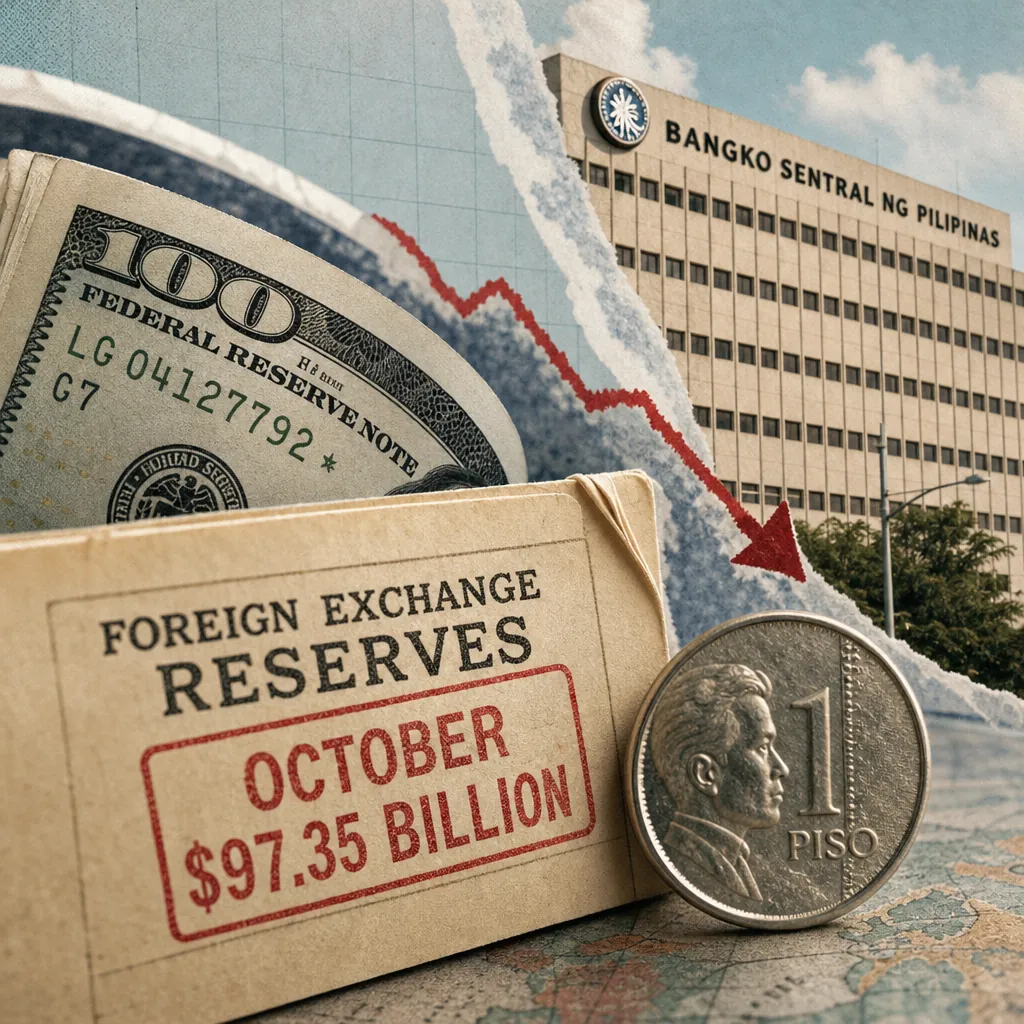
The Philippines' buffer of foreign currency fell to $97.35 billion at the end of October, the lowest level in nearly four years, the Bangko Sentral ng Pilipinas (BSP) reported on Friday1519. The central bank, which holds these reserves to pay for imports and settle foreign debt when other inflows weaken, said the stock dropped 11.7 percent from $110.25 billion a year earlier and 2.2 percent from September's $99.49 billion5438. The peso closed at 63.05 to the dollar on Friday, weaker than Thursday's 62.9733.
The reserve decline drew the widest coverage of any single story in the items reviewed here, running across the front pages and business sections of the Manila Standard, BusinessWorld, the Manila Bulletin, the Philippine Star, the Daily Tribune, BusinessMirror and the regional Daily Guardian19485443. BusinessWorld's front-page report carried an estimated ₱779,117 in advertising-equivalent value, the cost of buying the same space as paid advertising, and the Manila Bulletin's version ₱277,37648. The story's weight in print reflects how central the reserves figure is to how the country finances itself, not how many people read it.
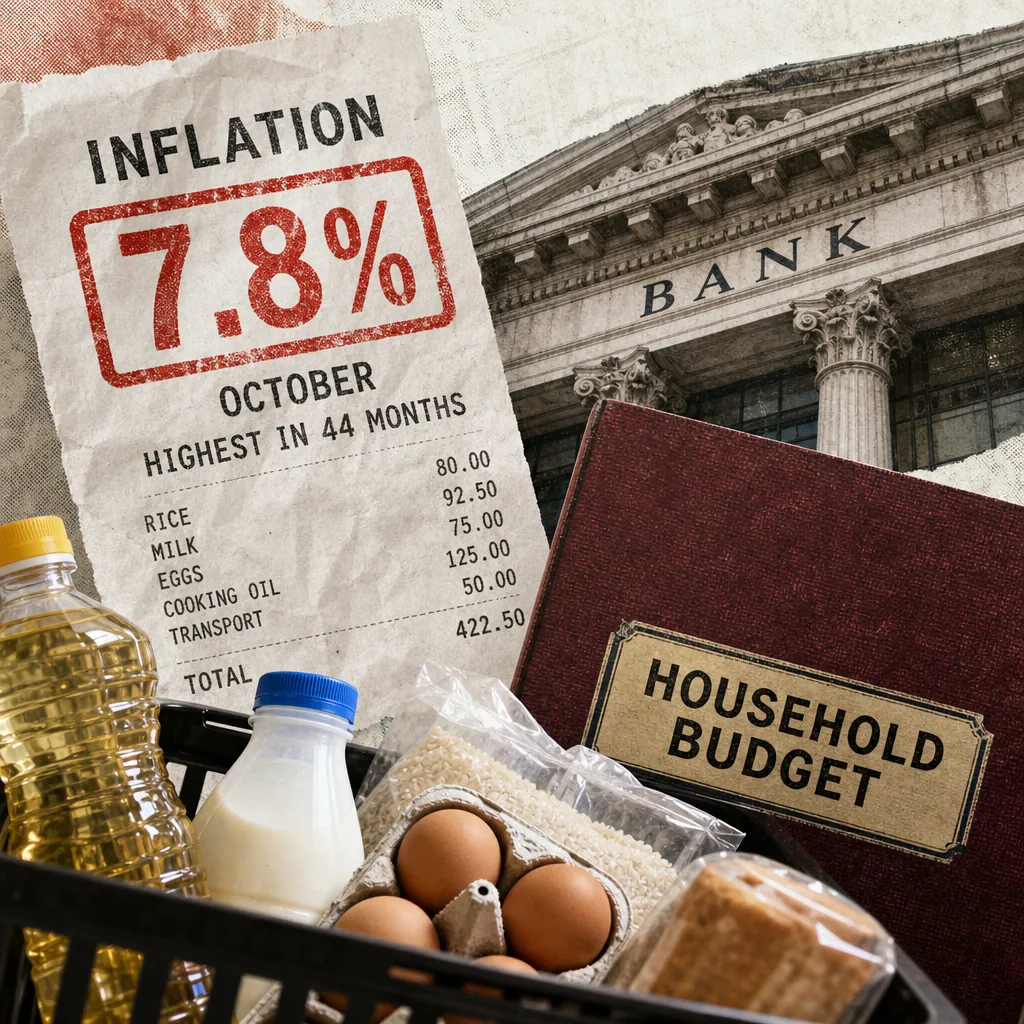
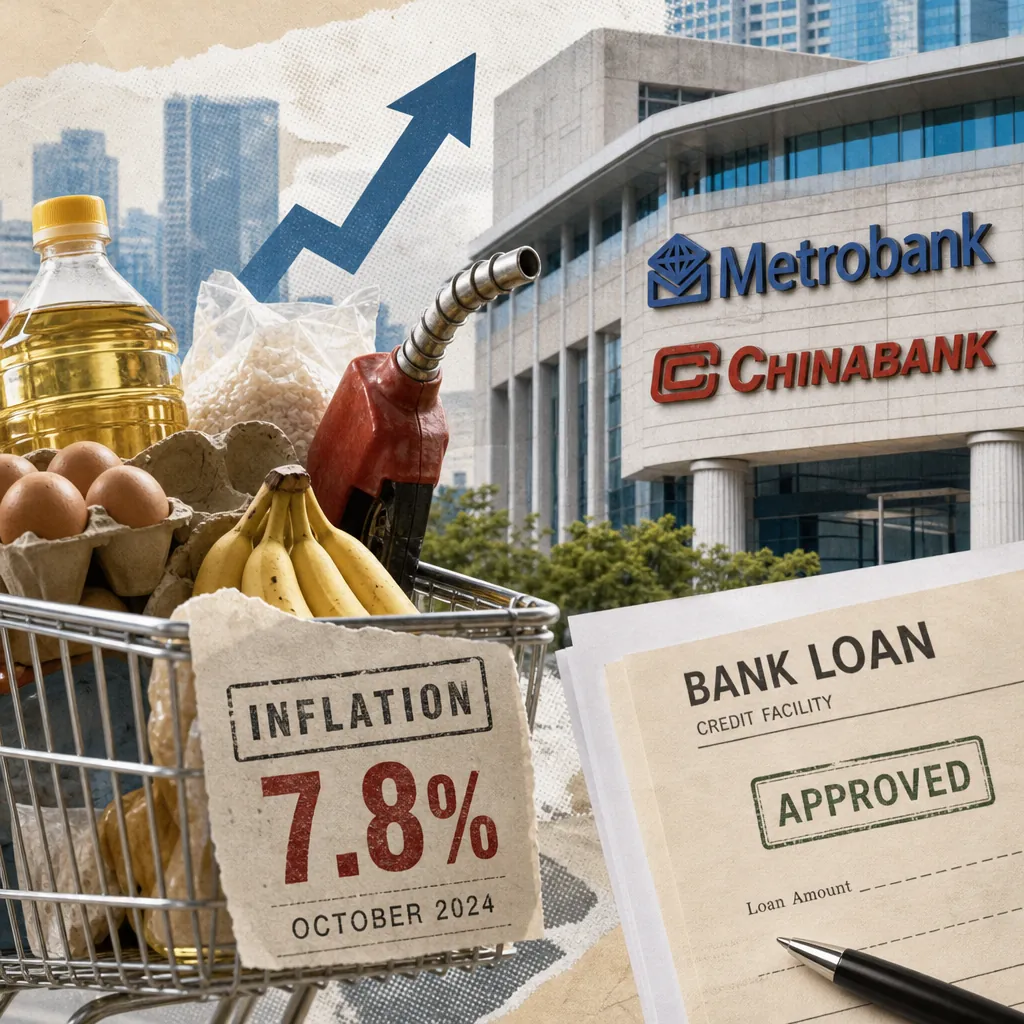
A second economic thread ran alongside it: October inflation came in at 7.8 percent, up from 7.2 percent in September, the eighth straight month above the BSP's 2-to-4 percent target band41. That reading, released before the reserves data, has pushed economists to expect the central bank to keep raising its benchmark interest rate rather than begin cutting it. Nomura now sees the BSP holding off on any rate cut until the fourth quarter of 2027 and raised its full-year 2026 inflation forecast to 5.9 percent from 5.8 percent14. The two stories together set the tone for the business pages: a currency under pressure, prices rising faster than the target, and a central bank with little room to ease.
Key themes
- Dollar reserves fall to $97.35 billion, lowest since 2022. The BSP attributed the drop to its own foreign exchange operations, lower global gold prices reducing the peso value of its gold holdings, and the national government withdrawing foreign currency from its deposits with the central bank to service external debt1519. The reserves remain above the International Monetary Fund's traditional adequacy thresholds, which use three months of imports and full coverage of short-term external debt as benchmarks43.
- October inflation of 7.8 percent keeps the BSP on a tightening path. Transport costs jumped 20.1 percent and housing, utilities and fuel rose 9.3 percent, which former BSP deputy governor Diwa Guinigundo said shows price pressures are "broader and more persistent" and strengthens the case for a 50-basis-point hike in December rather than the usual 2541. A basis point is one-hundredth of a percentage point.
- Economists expect third-quarter growth of about 2.8 percent, below the government's target. A Manila Times poll of economists put the median forecast at 2.8 percent, up from 2.3 percent in the first quarter but down from 4.0 percent a year earlier and below the government's revised 3.5-to-4.5 percent target for 20269. The Philippine Statistics Authority was scheduled to release the official figure on Monday12.
- The peso is forecast to weaken further despite a brief rebound. United Overseas Bank expects the peso to reach ₱64 per dollar by the fourth quarter and a record ₱66 in 2027, citing the country's foreign borrowing needs and thinning fiscal buffers53. The peso hit a historic low of ₱64.17 on October 27 before recovering to the ₱62 level53.
- Bank lending is expected to slow as borrowers and lenders turn cautious. Bankers Association of the Philippines president Ana Aboitiz Delgado said loan growth will be "a little bit slower" because of weak demand and high rates, even as BSP data showed universal and commercial bank loans rose 11.4 percent to ₱15.265 trillion as of September5633.
- Bank profits rose 5.2 percent in the first half even as bad loans climbed. The BSP's Report on the Philippine Financial System for the First Semester of 2026 showed combined net profit of ₱208.5 billion, total assets up 10.3 percent to ₱31.1 trillion, and nonperforming loans up 10.3 percent to ₱585 billion, concentrated in selected consumer lending portfolios2245.
- The stock market faces a test from growth data and earnings. The Philippine Stock Exchange index closed at 5,761.95 on Friday, down 0.28 percent for the day but up 1.44 percent for the week, and analysts expect narrow trading as investors weigh the GDP release against inflation and corporate results4755.
- Business registrations rose 6.5 percent in the first 10 months of 2026. The Department of Trade and Industry recorded 986,780 business name registrations from January to October, up from 925,994 a year earlier, with wholesale and retail trade accounting for more than half50.
How the narratives stack
Dominant. The reserves decline and the inflation outlook dominated the business coverage in this set. The reserves story alone appeared in at least seven outlets, and the inflation story in at least four, with the two often linked in the same articles151948544114. The dominance is a property of the items captured here, which skew toward business desks covering the central bank's Friday data release. The reserves figure matters because it is the country's first line of defense for paying for imports and maturing foreign debt when export earnings or overseas financing weaken, and a smaller cushion leaves less room to absorb external shocks that raise the cost of fuel, food, medicine and machinery imports43.
Counter-narrative. The peso's brief rebound to ₱62 per dollar and the stock market's 1.44 percent weekly gain offered a counterpoint to the gloom, but both came with caveats. UOB's forecast of ₱66 by 2027 undercut the rebound's significance53, and analysts described the market's recovery as fragile, with one noting that "Friday's modest pullback indicates that conviction remains fragile"41. The counter-narrative is not that things are fine; it is that the deterioration is gradual and uneven rather than a sudden break.
Emerging. Two stories point to longer-term shifts. First, the BSP's push for a "package of response" from the national government alongside its own rate hikes: Deputy Governor Zeno Ronald Abenoja said the central bank has raised rates four times since April, including a 50-basis-point move two weeks ago, "but that may not be enough. We need to do more," and called for the national government to address the direct impact of inflation35. Second, the Salmon Bank partnership with the Philippine Statistics Authority to use the National ID system for opening bank accounts, which the BSP backs as part of its financial inclusion agenda39. Both suggest the policy response is broadening beyond interest rates.
Under-covered. The BSP's own assessment that the banking system remains sound got less attention than the bad-loan figures. The report showed capital up 5.3 percent to ₱3.7 trillion and liquidity ample, but the headline number in most coverage was the 10.3 percent rise in nonperforming loans4522. The distinction matters for depositors and borrowers: a banking system with adequate capital can absorb losses that would otherwise require public support.
Platform insights
The monitoring writeup for this window did not include social media engagement data, so this section is limited to what the news coverage itself reveals about how the stories traveled.
- Business press and wire services. The reserves and inflation stories moved through the business desks of the major broadsheets and online outlets, with BusinessWorld, the Manila Standard, the Manila Bulletin, the Philippine Star, BusinessMirror and the Daily Tribune all carrying versions1519485438. The repetition across outlets reflects the central bank's Friday data release schedule rather than independent reporting.
- Regional and community outlets. The Daily Guardian in Iloilo carried both the reserves story and a separate report on bank office expansion in Western Visayas, which added 15 offices in the year to June 2026 to reach 597, outpacing the national growth rate of 1.7 percent4243. Regional coverage tends to localize national data, which gives readers outside Metro Manila a stake in the numbers.
- Analyst commentary. Much of the interpretive content came through Viber messages from economists quoted in the business press, a common channel for Philippine market commentary413356. These quotes carry the analytical weight that the raw data releases do not.
Key voices and communities
The Bangko Sentral ng Pilipinas. The central bank is the primary source for the reserves and inflation data and the main actor setting the policy response. Its statements attributed the reserves decline to specific operations and valuations, and its deputy governor called for government action alongside rate hikes1535. The BSP's credibility in explaining the decline matters for how markets and the public interpret it.
Private-sector economists. Diwa Guinigundo of GlobalSource Partners, Michael Ricafort of Rizal Commercial Banking Corp., Ruben Carlo Asuncion of UnionBank, Angelo Taningco of Security Bank and the Nomura research team provided the forward-looking analysis41914. Their forecasts shape expectations for the December 17 BSP meeting and the peso's path.
The Bankers Association of the Philippines. President Ana Aboitiz Delgado's comments on slower loan growth signal that lenders themselves expect the economy to cool, which affects how businesses plan borrowing and investment56.
The national government. The government's withdrawals from its BSP deposits to service external debt contributed to the reserves decline, and the BSP is now calling on it to address inflation directly through measures beyond monetary policy1935. The coordination between fiscal and monetary authorities is the subtext of both stories.
Narrative streams
Reserves fall to $97.35 billion as peso and gold prices weigh
The BSP's gross international reserves, the central bank's holdings of foreign assets including gold, securities and foreign currency deposits, fell to $97.35 billion at end-October from $99.49 billion in September and $110.25 billion a year earlier5415. The decline was driven by three factors the central bank named: its net foreign exchange operations, downward valuation adjustments on its gold holdings as global prices fell, and the national government's net foreign currency withdrawals from its deposits with the BSP to pay external debt and meet other financing needs1938. Foreign currency reserves held in securities fell to $62.84 billion from $79.47 billion a year earlier, a 20.93 percent drop, while gold holdings rose slightly to $16.95 billion3348.
The reserves figure matters because it is what the country draws on to pay for imports and maturing foreign debt when export earnings or overseas financing weaken43. A smaller cushion leaves less room to absorb external shocks that raise the cost of fuel, food, medicine and machinery imports43. The Daily Guardian noted that the latest level nevertheless remained above traditional reserve adequacy thresholds, which the International Monetary Fund measures as three months of imports and 100 percent coverage of short-term external debt43.
President Ferdinand Marcos Jr. had earlier assured the public that the reserves could support the peso, and the BSP's data shows the stock has fallen $15.9 billion from its peak of $113.3 billion in February 202619. The peso's depreciation since the Middle East conflict began on February 28 has been the main driver: the currency has lost about 11 percent against the dollar since then, from ₱57.66 to the current level33. UOB expects further weakness to ₱64 by the fourth quarter and ₱66 in 2027, citing the country's external financing needs and higher energy prices depleting fiscal buffers53.
For businesses that import equipment and materials, the weaker peso raises project costs. PLDT senior vice president Blums Pineda said the depreciation is increasing cost pressures on information and communications technology projects, particularly those requiring imported equipment, though the company also has dollar-denominated revenue that provides some offset33. The read for the sector is that import-dependent firms face margin pressure that will show up in fourth-quarter earnings, while exporters and businesses with dollar revenue gain a competitive edge.
Inflation at 7.8 percent pushes rate-cut expectations to late 2027
October inflation rose to 7.8 percent from 7.2 percent in September, the eighth consecutive month above the BSP's target band of 2 to 4 percent41. Transport costs jumped 20.1 percent and housing, utilities and fuel rose 9.3 percent, which Guinigundo said shows price pressures are "broader and more persistent" and strengthens the case for a 50-basis-point hike in December rather than the usual 2541. Nomura raised its full-year 2026 inflation forecast to 5.9 percent from 5.8 percent and its core inflation forecast to 4.2 percent from 4 percent, and now expects the BSP to begin cutting rates only in the fourth quarter of 202714. Core inflation strips out volatile food and energy items to show underlying price trends.
The BSP has raised its benchmark rate four times since April, three times by 25 basis points and once by 50 basis points two weeks ago, for a cumulative 125 basis points35. Deputy Governor Abenoja said the policy intent is to influence second-round effects and inflation expectations, but "that may not be enough. We need to do more," and called for a "package of response" from the national government to address the direct impact of inflation35. Second-round effects are the knock-on price increases that occur when businesses and workers adjust their expectations and contracts to higher inflation.
The inflation outlook has consequences across the economy. Higher rates raise borrowing costs for businesses and consumers, which is why the Bankers Association expects loan growth to slow56. The stock market's rebound has been fragile because investors know the BSP may tighten further; 2TradeAsia said the October print reinforced expectations for a potential tightening at the December 17 meeting41. For households, the 7.8 percent inflation rate means the peso buys less than it did a year ago, and the categories rising fastest, transport and utilities, are ones that cannot easily be cut from a budget.
Growth forecast at 2.8 percent ahead of Monday's GDP release
Economists polled by the Manila Times put the median forecast for third-quarter gross domestic product growth at 2.8 percent, up from 2.3 percent in the first quarter but down from 4.0 percent a year earlier and below the government's revised 3.5-to-4.5 percent target for 20269. The Philippine Statistics Authority was scheduled to release the official figure on Monday12. UnionBank chief economist Ruben Carlo Asuncion, whose 2.2 percent forecast was the lowest in the poll, cited "elevated inflation, weaker household purchasing power, subdued investment and high borrowing costs" as significant drags9.
A separate poll by the Manila Bulletin found nine of 13 forecasts projecting growth of 3 percent to 3.7 percent, faster than the revised 2.4 percent expansion in the second quarter, which was a post-pandemic low52. The PSA last week revised second-quarter growth upward from the 2.3 percent initially reported in August, reflecting adjustments to wholesale and retail trade, agriculture, and transportation and storage52. GDP growth averaged 2.6 percent in the first half52.
Economists expect a modest rebound in the fourth quarter from holiday spending, remittance inflows and a possible pickup in government infrastructure spending. Security Bank's Angelo Taningco expects a modest recovery, and RCBC's Michael Ricafort projects 5 percent growth in the October-to-December period and 3.5 percent for the full year, at the lower end of the government's target33. Maybank's Azril Rosli sees 3.2 percent in the fourth quarter33. The read for the sector is that the growth figure will determine whether the BSP's tightening has room to continue without tipping the economy into contraction; a print below 3 percent would strengthen the case for caution on further hikes, while a print above 3.5 percent would give the central bank more room to focus on inflation.
Bank lending slows as borrowers and lenders turn cautious
Bank lending grew 11.4 percent to ₱15.265 trillion as of September, but the Bankers Association of the Philippines expects slower growth ahead3356. President Ana Aboitiz Delgado said the slowdown reflects both tighter lending conditions and subdued demand: "Some of it is deliberate and some of it is just that there's not a lot of demand right now"56. She said banks are preparing to support growth "as soon as we see signs of stability"33.
The BSP's financial system report for the first half showed a banking system that remains sound by its own measures: net profit up 5.2 percent to ₱208.5 billion, total assets up 10.3 percent to ₱31.1 trillion, capital up 5.3 percent to ₱3.7 trillion, and loans up 11.9 percent to ₱17.8 trillion4522. But nonperforming loans rose 10.3 percent to ₱585 billion, concentrated in selected consumer lending portfolios45. Nonperforming loans are those on which borrowers have stopped paying for a set period, typically 90 days.
The combination of slower lending and rising bad loans matters for businesses that depend on credit to expand and for consumers who borrow for purchases. The BSP's assessment that the system has adequate capital and ample liquidity means the bad loans are a profitability concern rather than a solvency one, but the trend bears watching if unemployment or underemployment rises. The read for the sector is that banks will tighten credit standards, which will make it harder for marginal borrowers to obtain loans and could slow the recovery that the fourth-quarter holiday spending is expected to bring.
Government securities yields and the stock market wait on data
Yields on government securities, which move opposite to prices, ended mixed on Friday as the market priced in inflation, the Middle East war and the US midterm elections33. The Bureau of the Treasury planned to auction ₱55 billion in short-term securities on Monday and ₱30 billion in reissued 20-year bonds on Tuesday33. RCBC's Ricafort said yields could mirror the mixed week-on-week movements seen in the secondary market following the inflation data and before the GDP report33.
The Philippine Stock Exchange index closed at 5,761.95 on Friday, down 0.28 percent for the day but up 1.44 percent for the week47. Foreign investors, who accounted for 57 percent of trades, were net buyers at ₱1.77 billion41. Analysts expect narrow trading this week as investors wait for the GDP release and corporate earnings. Regina Capital's Luis Limlingan said the market will lean mostly downward, with October's 7.8 percent inflation "actively squeezing consumer demand and reinforcing fears of prolonged high interest rates"47. Unicapital's Wendy Estacio-Cruz said investors will monitor whether lower oil prices and peso gains can be sustained55.
The read for the sector is that the market's direction this week depends on whether the GDP print beats or misses the 2.8 percent consensus. A beat would support the case that the economy is absorbing the rate hikes; a miss would reinforce the case for the BSP to pause. Either way, the elevated inflation reading limits how much the market can rally, because it keeps the possibility of a December rate hike in play.
Business registrations rise as entrepreneurship holds up
Business name registrations with the Department of Trade and Industry reached 986,780 in the first 10 months of 2026, up 6.5 percent from 925,994 a year earlier50. New business names accounted for 86 percent of the total at 848,694, with the rest renewals50. Wholesale and retail trade, including motor vehicle and motorcycle repair and personal and household goods, accounted for more than half at 534,286, followed by accommodation and food service at 136,149, manufacturing at 54,253 and real estate at 52,59750. Calabarzon logged the highest number of registrations50.
The registration data is a leading indicator of small-business formation, which matters because micro, small and medium enterprises employ the majority of Filipino workers. The 6.5 percent increase suggests that despite high inflation and borrowing costs, people are still starting businesses, often out of necessity when wage employment is scarce. The read for the sector is that the pipeline of small borrowers will keep growing even as banks tighten standards, which could widen the gap between businesses that can access credit and those that cannot.
Financial inclusion and digital infrastructure advance
Salmon Bank partnered with the Philippine Statistics Authority to integrate the National ID Authentication Services into its customer onboarding, allowing applicants to open an account by scanning their National ID QR code and completing a liveness check instead of presenting physical IDs39. The BSP backs wider National ID adoption across the financial sector as part of its financial inclusion agenda39. The partnership matters because identity verification is one of the main barriers to opening a bank account for Filipinos without standard documents, and a simpler process could bring more people into the formal financial system.
Separately, Western Visayas added 15 bank offices in the year to June 2026 to reach 597, a 2.6 percent increase that outpaced the national growth rate of 1.7 percent42. The region accounted for about 4.4 percent of the country's 13,688 bank offices42. The read for the sector is that physical bank presence is still expanding outside Metro Manila even as digital channels grow, which suggests that for many customers, a branch remains the entry point to banking.
Conversation trajectory
December 17 BSP meeting (observation window: five weeks). The central bank's policy-setting meeting is the next scheduled decision point on interest rates. Guinigundo's call for a 50-basis-point hike and Abenoja's statement that current rates "may not be enough" suggest the BSP is leaning toward further tightening, but the GDP release on Monday and November inflation data due in early December will shape the decision4135. Watch whether the BSP raises by 25 or 50 basis points, and whether it pairs the decision with a call for fiscal measures.
Third-quarter GDP release (observation window: Monday, November 9). The Philippine Statistics Authority's report will confirm or contradict the 2.8 percent median forecast912. A print below 3 percent would strengthen the case that the economy is slowing under the weight of rate hikes; a print above 3.5 percent would give the BSP more room to focus on inflation without worrying about growth.
Peso trajectory (observation window: through the fourth quarter of 2026 and into 2027). UOB's forecast of ₱64 by the fourth quarter and ₱66 in 2027 provides a checkable benchmark53. Watch whether the peso holds the ₱62 level or resumes its slide, and whether the BSP intervenes in the foreign exchange market to slow the depreciation. Further declines would raise import costs and add to inflation, creating a feedback loop the central bank would have to manage.
Bank lending and bad loans (observation window: the next BSP financial system report, likely covering the second half of 2026). The 10.3 percent rise in nonperforming loans in the first half bears watching45. If the trend accelerates in the second half, it would signal that borrowers are struggling under higher rates, which could prompt banks to tighten further and slow the economy.
Trigger events. A sharper-than-expected peso decline, a November inflation print above 8 percent, or a GDP print below 2.5 percent would each change the policy calculus. A resolution of the Middle East conflict, which the peso's slide has been tied to since February, would ease energy prices and take pressure off the currency33.
Response guidance
Explain the reserves figure in plain terms. When communicating about the reserves decline, state what the reserves are for (paying for imports and foreign debt) and what the current level means (still above adequacy thresholds but thinner than a year ago). Avoid framing the decline as a crisis; the data shows a gradual erosion driven by identifiable factors, not a sudden loss of confidence.
Separate inflation from growth in public messaging. The 7.8 percent inflation rate and the 2.8 percent growth forecast are different problems with different remedies. Communications that conflate them will confuse audiences about whether the priority is fighting inflation or supporting growth. State each figure with its baseline and what it measures.
Address borrowing costs directly for business audiences. The combination of slower loan growth and higher rates means businesses need clear information about what credit will cost and how to plan for it. Guidance that acknowledges the tightening and explains the BSP's reasoning is more useful than reassurance that conditions will improve soon.
Use the peso's movement as a planning input, not a prediction. The peso's path depends on external factors including US dollar strength and energy prices. Communications that present UOB's ₱66 forecast as a certainty will mislead; present it as one scenario among several and explain what would need to happen for it to materialize.
Highlight the banking system's capital position when discussing bad loans. The rise in nonperforming loans is a profitability concern, not a solvency one, given the system's ₱3.7 trillion in capital45. Communications that mention bad loans without the capital context will unnecessarily alarm depositors.
For financial inclusion messaging, focus on the practical barrier removed. The Salmon Bank-National ID partnership removes the need to present physical documents, which is a concrete benefit for people without standard IDs. Lead with that practical change rather than with the broader policy agenda.
Prepare for the GDP release with both scenarios. The 2.8 percent consensus is not a certainty, and the range of forecasts runs from 2.2 to 3.7 percent952. Communications prepared in advance for both a beat and a miss will be more credible than reactions assembled after the fact.
See the full picture behind today's signals.
This report draws from Media Meter's MediaWatch, our real-time monitoring engine tracking 2,470+ Philippine sources across print, broadcast, digital, and social. Explore how the platform turns raw coverage into decision-grade intelligence, then see how it's configured for teams like yours — whether you're in PR agencies, corporate comms, government, or marketing.
Want more? Browse our Report Library for sector and crisis intelligence, or request a demo and we'll have your brand set up before the call.
Want this kind of intelligence on your brand?
This brief is built on the same MediaWatch methodology that runs continuously across every brand we monitor. See your competitive landscape, Impact Score, and narrative trajectory in a 30-minute demo.