BSP Signals December Rate Hike as Inflation Bites
Economists expect the Bangko Sentral ng Pilipinas to raise interest rates again in December after a larger-than-expected 50-basis-point hike, while banks report stronger loan demand and UnionBank seeks capital relief for its digital bank merger. Separately, the BIR's suspension of its online seller registration badge leaves open questions about how it returns.
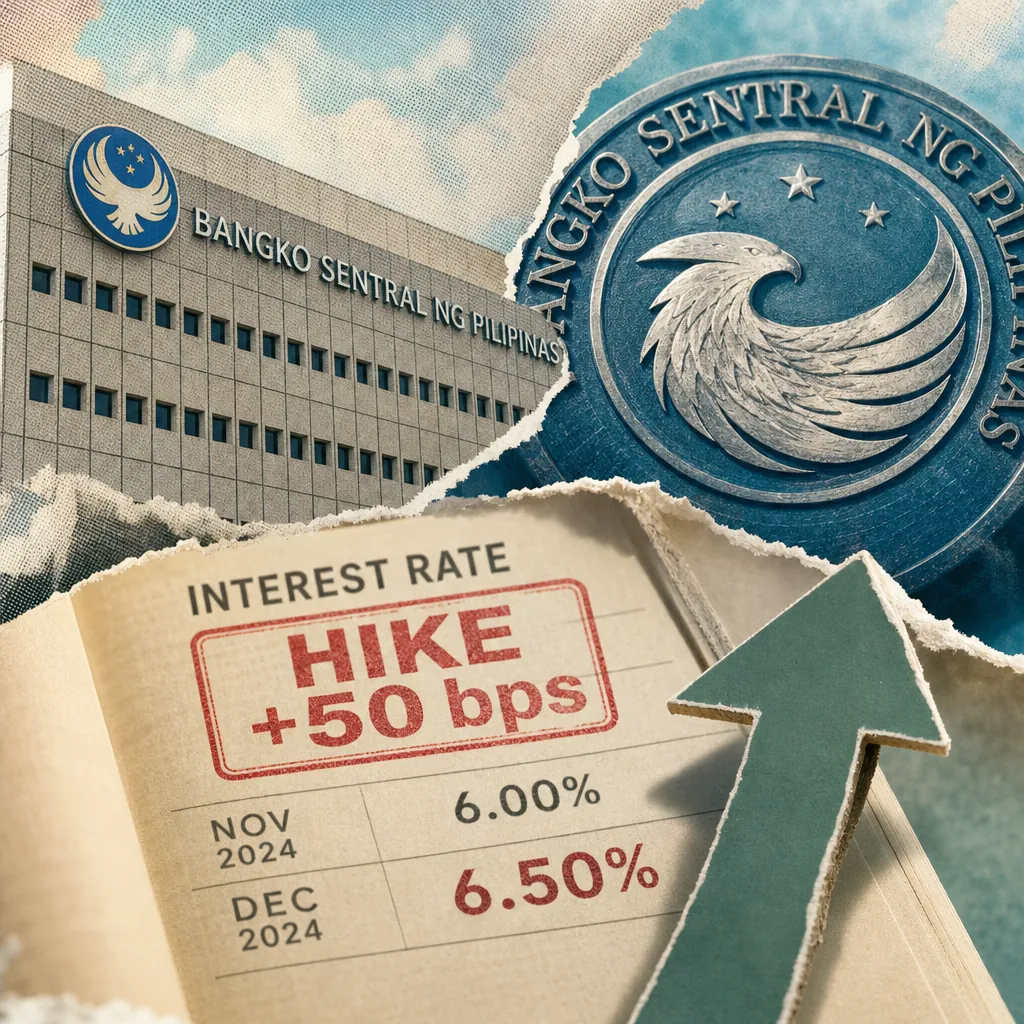
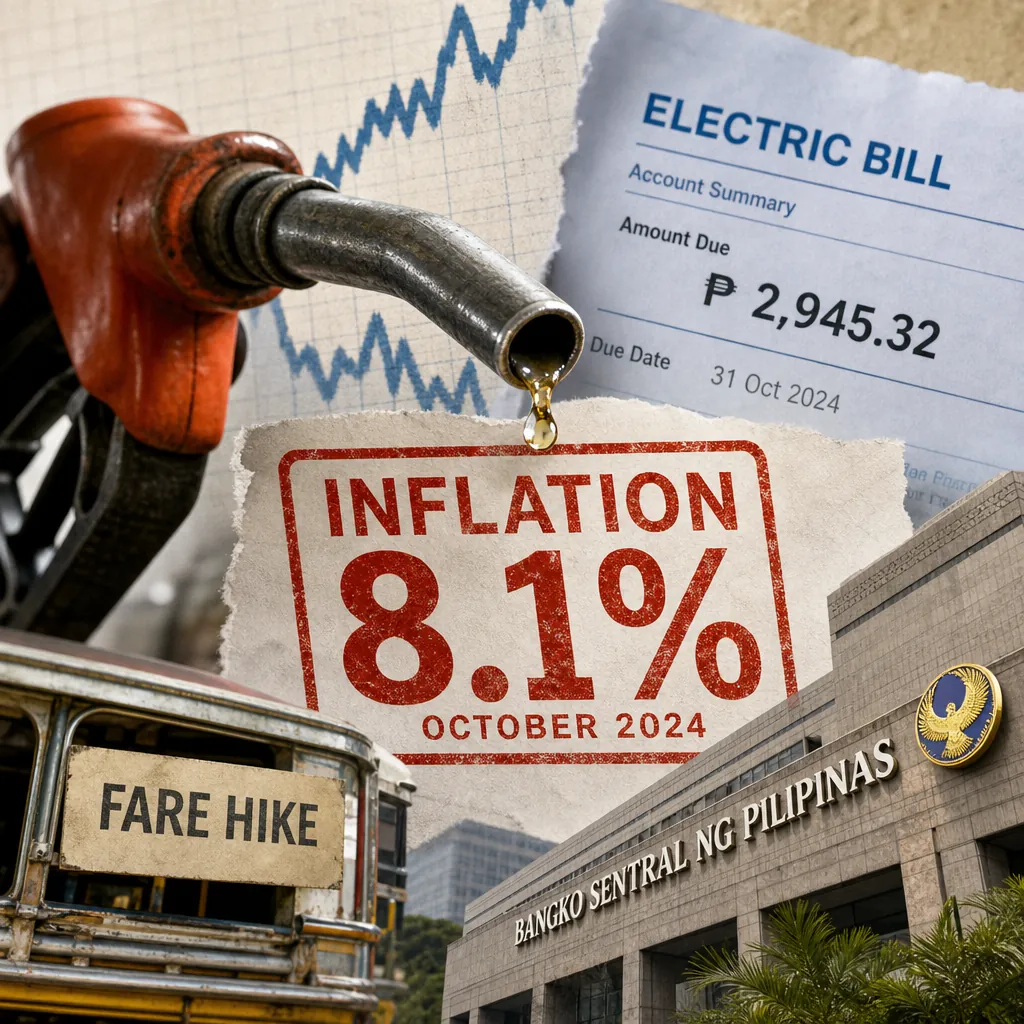
The Bangko Sentral ng Pilipinas (BSP), the country's central bank, is likely to raise its benchmark interest rate again in December, according to economists at Citi, Oxford Economics, Security Bank and Chinabank Research, after the Monetary Board delivered a larger-than-expected 50-basis-point increase last week that brought the policy rate to 5.50 percent 34. That single decision, and the expectation of more to come, set the terms for most of the banking and finance coverage captured for October 31: what it costs to borrow, whether lenders will tighten, and how the country's digital banks fit into a higher-rate environment.
The same day's items show the pressure points spreading outward from that rate decision. Banks told the BSP they expect stronger loan demand this quarter while keeping lending standards largely unchanged 33. Union Bank of the Philippines asked the BSP for relief from capital rules as it absorbs its digital banking subsidiary, UnionDigital Bank, by April 2027 31. Metrobank was named the Philippines' strongest bank by The Asian Banker for a sixth straight year, a ranking built on balance-sheet strength and asset quality 23. And a Philippine Star column warned about "money muling," the practice of lending out bank accounts and e-wallets to move stolen funds, which has become a more visible problem as digital payments expand 38.
A separate regulatory thread ran alongside the rate story. The Bureau of Internal Revenue (BIR), the country's tax authority, has suspended its requirement that online sellers display a Registration Seal Badge, a QR-code-style marker that buyers could scan to confirm a seller was registered 8. The suspension, issued through Revenue Memorandum Circular No. 113-2026 dated October 26, followed complaints from sellers and creators and calls from Senators Bam Aquino and Pia Cayetano, with the Makabayan bloc in the House filing a resolution seeking an inquiry 8. The column argued the badge needs three fixes before it returns, and noted that badges already posted online still lead buyers to the BIR's verification page.
Key themes
- A 50-basis-point hike puts a December increase in play. The Monetary Board raised the benchmark rate to 5.50 percent last week, a larger move than analysts expected, and Citi sees it reaching 6 percent by February 2027 while Oxford Economics expects a pause after December 34. The disagreement is about how long inflation stays elevated, not whether the last hike happened.
- Banks expect more borrowers and no change in lending rules. In the BSP's latest Senior Bank Loan Officers Survey, 80.8 percent of respondent banks said they expect to keep credit standards for business loans unchanged in the fourth quarter, up from 71.2 percent the previous quarter, and 85.7 percent said the same for household loans, up from 77.1 percent 33. Credit standards are the rules banks use to approve loans, covering interest rates, collateral, loan amounts and repayment terms.
- UnionBank wants capital relief to absorb its digital bank. Union Bank of the Philippines has asked the BSP to exempt it from certain capital requirements and to exclude its equity investment in UnionDigital Bank from deductions when computing the parent bank's regulatory capital ratios, arguing that a fresh capital infusion into a subsidiary being folded in "will no longer serve its intended prudential objective" 31.
- Metrobank's strongest-bank title rests on a first-half profit of ₱24.9 billion. The Asian Banker's annual ranking of the world's 1,000 largest and strongest banks weighs financial performance, balance-sheet strength, asset quality, liquidity and risk management; Metrobank has taken the Philippine title six years running 23.
- The BIR badge suspension has no new deadline. Revenue Memorandum Circular No. 113-2026 suspended the mandatory display "until further notice" and states that "no penalties shall be imposed solely on account of non-display" while the suspension lasts 8. Sellers who already display the badge are not covered by any instruction to remove it.
- Money muling turns account holders into links in a scam chain. A Philippine Star column describes offers of ₱3,000 a day for lending a bank account to receive and forward money, and notes that the account holder may be witting or deceived 38. The column frames this as one of the less visible challenges in a rapidly expanding digital financial ecosystem.
- The broader economy is growing more slowly than it did. At The Manila Times Year-end Economic Forum, Rizal Commercial Banking Corp. chief economist Michael Ricafort said the Philippines previously sustained growth of around 5 to 6 percent but recent performance has weakened, and he called for reforms, fiscal discipline and transparency 3.
- Manufacturing improved in September while retail and services stayed weak. The September 2026 Purchasing Managers Index (PMI) Philippines, a monthly survey of companies run by the Philippine Institute for Supply Management, the Society of Fellows in Supply Management and i-Metrics Asia-Pacific Corp., showed manufacturing back in expansion while retail-wholesale and services reported weaker conditions 7.
How the narratives stack
Dominant. The rate outlook is the heaviest story in this set by consequence and by the number of items touching it. The 50-basis-point hike to 5.50 percent is confirmed; the December increase is an expectation held by named economists, not a decision 34. The loan-officer survey is the clearest evidence of how banks are positioning: most expect demand to rise and most expect to keep their approval rules where they are 33. The two items together describe a lending market that is not shutting down but is pricing money higher. The Metrobank recognition and the UnionBank capital request are downstream of the same environment, one showing a large bank's balance sheet holding up, the other showing a bank restructuring its digital arm before the cost of capital rises further 2331.
Counter-narrative. The BIR badge story runs against the direction of most digital-finance news. Rather than adding a requirement, the tax authority withdrew one after sellers and creators complained and legislators took up the issue 8. The column's argument is that the badge itself was not the problem; the way it exposed sole proprietors' full legal names when scanned was. That detail matters for anyone selling online under a business name: the verification page shows a company name and certificate of registration for a corporation, but a sole proprietor's full legal name 8. The suspension removes the obligation without resolving what the badge should show when it returns.
Emerging. Money muling sits at the edge of the digital banking story. The column's example, ₱3,000 a day for lending an account, describes a recruitment pitch that targets people under financial pressure 38. As more Filipinos open e-wallets and digital bank accounts, the pool of accounts available to launder money grows, and the column treats this as a consequence of expansion rather than a separate crime story. The BSP's rate path and the banks' lending plans do not address it directly, but the same digital infrastructure that makes lending cheaper to administer makes moving illicit funds cheaper too.
Under-covered. The weakest-covered angle in this set is the demand side of the economy. The PMI reading showing manufacturing expanding while retail-wholesale and services weaken got a single analytical treatment 7, and the Manila Times forum's warning about weak private investment and fragile household finances got one write-up 3. Both describe the conditions that would make a December rate hike harder on borrowers, and neither drew the follow-up coverage that the rate decision itself did.
Platform insights
The items captured for this window ran in online news outlets and one blog, with no social-media monitoring writeup supplied. What follows describes how the material was distributed across those outlets rather than how audiences engaged with it on social platforms.
- Online news (Philippine Star, Manila Times, Maharlika News). The rate, lending-survey, UnionBank and money-muling stories all ran on Philippine Star's business section on November 1, dated to the prior day's publishing cycle 34333138. The Manila Times carried the BIR badge column, the PMI analysis and the economic forum writeup 873. These are the outlets whose business desks drove the day's financial coverage.
- Blogs. A single blog item covered UnionBank's partnership with Travel Sale Fair 2026, a consumer travel exhibition at SMX Manila on October 23 to 25 that expected more than 3,000 attendees and over 200 exhibitors, with UnionBank offering its UB Negosyante small-business banking program to participating entrepreneurs 4. The item is promotional in tone and reads as partner content rather than reported news.
- Wire and aggregator pickup. Metrobank's award item ran through the Manila Times newswire 23. The absence of broadcast or broadsheet-print items in this set means the coverage captured here skews toward outlets that publish online first.
Key voices and communities
Central bank watchers and bank economists. Citi, Oxford Economics, Security Bank and Chinabank Research are the named forecasters on the rate path, and their split on 2027 is the most useful signal in the set: Citi sees 6 percent by February 2027, Oxford Economics sees a hold after December 34. Michael Ricafort of Rizal Commercial Banking Corp. speaks for the growth side, arguing that reforms and fiscal discipline are needed to restore the 5 to 6 percent growth the country previously sustained 3.
Bank loan officers. The Senior Bank Loan Officers Survey is the BSP's quarterly poll of lending officers at Philippine banks, and their answers are the closest thing to a forward view of credit conditions 33. The shift from 71.2 percent to 80.8 percent of banks expecting unchanged business-loan standards is a modest move toward stability, not a loosening.
Online sellers and creators. The BIR badge suspension followed weeks of complaints from this group and public calls from Senators Bam Aquino and Pia Cayetano, with the Makabayan bloc filing House Resolution No. 1565 on October 28 seeking an inquiry 8. BIR Commissioner Charlito Martin Mendoza said the bureau heard the concerns. This is a community that has learned it can move a regulator within weeks.
Digital-finance users and potential mules. The money-muling column addresses people who might accept an offer to lend an account, and the framing is deliberately non-judgmental: some know what they are doing, others are deceived into believing they are part of a legitimate business 38.
Legislators. The Senate minority's call for dialogue with Senator Bato dela Rosa, covered in a Philippine Star opinion piece, is a separate political story but shows the same legislative pressure pattern: public figures using public statements to force an agency's hand 30.
Narrative streams
The BSP raises rates 50 basis points and economists split on December
The Monetary Board's decision last week to raise the benchmark rate by 50 basis points, double the quarter-point moves that had become standard, brought the policy rate to 5.50 percent 34. The benchmark rate is what the central bank charges banks for short-term borrowing, and it feeds through to what consumers pay on loans and earn on deposits. A larger hike signals the BSP sees inflation as more stubborn than a smaller move would suggest. The drivers named in the coverage are persistent inflation, elevated oil prices and peso depreciation 34.
Citi, Oxford Economics and Security Bank expect another 25-basis-point increase in December. Their 2027 views diverge: Citi sees the policy rate at 6 percent by February 2027, while Oxford Economics expects the BSP to hold after December, and Chinabank sees the possibility of more 34. For borrowers, the practical question is whether the December meeting confirms the pause or extends the tightening. A household with a variable-rate loan should plan for the December increase and treat anything beyond it as uncertain. For banks, the spread between what they pay depositors and charge borrowers widens in a rising-rate environment if deposit costs lag, which is part of why the loan-officer survey's stability reading matters: banks are not competing for borrowers by loosening standards.
Banks expect stronger loan demand and unchanged credit standards
The BSP's Senior Bank Loan Officers Survey found 80.8 percent of respondent banks expect to maintain credit standards for business loans in the fourth quarter, up from 71.2 percent in the previous quarter, and 85.7 percent expect household-loan standards to stay unchanged, up from 77.1 percent 33. Credit standards cover the rules banks apply when approving loans: interest rates, collateral requirements, loan amounts and repayment terms. A higher share expecting no change means fewer banks plan to tighten, which is a mild positive for borrowers after a period of uncertainty.
The same survey shows banks expect stronger loan demand this quarter 33. Demand rising while standards hold steady is the combination that supports economic activity: more businesses and households borrowing at rules that have not gotten stricter. The caveat is that expectations are not outcomes. The survey records what loan officers say they expect, and the fourth quarter is not over. For small and medium enterprises, the read is that credit should remain available at higher prices; the rate hike, not a credit crunch, is the constraint to plan around.
UnionBank asks the BSP for capital relief ahead of digital bank merger
Union Bank of the Philippines plans to integrate UnionDigital Bank into its operations by April 2027 and has asked the BSP for regulatory relief to avoid additional capital injections and deductions from its regulatory capital arising from the consolidation 31. The bank's argument, in its disclosure to the local bourse, is that a capital infusion into UnionDigital "will no longer serve its intended prudential objective and would result in unnecessary capital movements" 31. It also wants approval to exclude its equity investment in UnionDigital from deductions when computing the parent bank's regulatory capital ratios, which measure a bank's financial strength by comparing available capital against risk-weighted assets 31.
Digital banks in the Philippines operate under a separate licensing framework with their own capital requirements, and folding one into a parent bank means the same capital can be counted twice or not at all depending on how regulators treat the investment. UnionBank's request is essentially to avoid holding capital against a subsidiary that will cease to exist as a separate entity. The BSP has not ruled on the request in the coverage captured here. For depositors and borrowers at UnionDigital, the merger date of April 2027 is the operational marker; for the wider digital banking sector, the BSP's decision will set a precedent for how other parents absorb their digital subsidiaries.
Metrobank takes the strongest-bank title for a sixth year
The Asian Banker named Metrobank the Philippines' strongest bank for the sixth consecutive year, based on an annual ranking of the world's 1,000 largest and strongest banks that evaluates financial performance, balance-sheet strength, asset quality, liquidity and risk management through an independent assessment 23. Metrobank reported net income of ₱24.9 billion in the first half of 2026, and its nonperforming loan ratio, the share of loans borrowers are not repaying on schedule, was cited as a strength 23. President Fabian Dee attributed the recognition to customer trust and employee dedication 23.
The award is a reputational marker rather than a regulatory one, but it lands in a quarter when the rate environment is testing every bank's balance sheet. A low nonperforming loan ratio means fewer borrowers are falling behind, which is the metric that matters most when rates rise. For the sector, Metrobank's result is a benchmark: the bank that tops the ranking is the one whose loan book is holding up best under the current rate path.
The BIR suspends its online seller badge and leaves the return date open
The BIR stopped requiring online sellers to post its Registration Seal Badge through Revenue Memorandum Circular No. 113-2026, dated October 26, which suspended the mandatory display "until further notice" and stated that "no penalties shall be imposed solely on account of non-display" while the suspension lasts 8. The badge is a scannable marker that leads buyers to verify.bir.gov.ph, where a scan shows a company name and valid certificate of registration for a corporation, or a sole proprietor's full legal name 8. That last detail is what drove much of the complaint: sellers operating under a business name did not want their legal names exposed to any buyer who scanned the badge.
The suspension followed calls from Senators Bam Aquino and Pia Cayetano and weeks of complaints from sellers and creators, and the Makabayan bloc filed House Resolution No. 1565 on October 28 seeking an inquiry 8. Commissioner Charlito Martin Mendoza said the BIR heard the concerns 8. The column's proposed fixes are not detailed in the excerpt, but the framing is that the badge needs repair before it returns, not abandonment. For online sellers, the immediate effect is that non-display carries no penalty; the uncertainty is what happens when the suspension lifts, since no new deadline has been set. For the BIR, the episode is a test of whether a registration-verification tool can be designed to serve buyers without exposing sellers.
Money muling draws attention as digital accounts multiply
A Philippine Star column describes money muling as the practice of allowing a bank account, e-wallet or other financial account to be used to receive, move or transfer illicit funds, and opens with a recruitment pitch: ₱3,000 a day for doing almost nothing, no interview, no skills, no experience, just lend the account and forward the money 38. The column notes that some mule account holders know exactly what they are doing while others are deceived into believing they are part of a legitimate business or earning an easy commission 38. Either way, the account becomes a link in a criminal chain that starts with a scam victim who has just lost their savings.
The story matters because it names a cost of the digital financial expansion that the rate and lending stories do not capture. As more Filipinos open e-wallets and digital bank accounts, more accounts become available to move stolen money, and the people most likely to accept the offer are those under financial pressure. For banks and e-wallet providers, the operational burden is detection and account monitoring; for regulators, it is whether current rules put enough responsibility on the institutions that open the accounts. The column does not cite specific enforcement figures, so the scale of the problem in the Philippines is not established in this set.
Manufacturing expands while retail and services stay weak
The September 2026 Purchasing Managers Index Philippines showed manufacturing returning to expansion while retail-wholesale and services continued to report weaker monthly conditions 7. The PMI is a monthly survey of companies that asks purchasing managers whether activity rose, fell or stayed the same; a reading above 50 indicates expansion. The index is a joint initiative of the Philippine Institute for Supply Management, the Society of Fellows in Supply Management and i-Metrics Asia-Pacific Corp. 7. The divergence is the story: a manufacturer receiving more orders and raising production can coexist with a retailer holding back on restocking, in the same economy and the same month.
For the sector, the PMI split explains why the BSP's rate decision is contested. If manufacturing is recovering, higher rates risk choking off the improvement; if retail and services are still weak, the case for holding rates is stronger. The survey does not settle which reading is right, but it shows the economy is not moving in one direction, which is the condition under which a single rate decision has uneven effects.
The economic forum warns that growth needs reforms
At The Manila Times Year-end Economic Forum, titled "Beyond UMIC: Locking in on sustainable, equitable growth," economists warned that Philippine economic growth faces pressure from elevated inflation, weak private investment and fragile household finances 3. UMIC refers to upper-middle-income country status, a World Bank classification the Philippines has been working toward. Ricafort said the country previously sustained growth of around 5 to 6 percent but recent performance has weakened, and he called for structural reforms, fiscal discipline and transparency to improve the investment climate 3. Robert Dan Roces of Security Bank also spoke on rising spending 3.
The forum's diagnosis lines up with the rate story: inflation is the binding constraint, and weak private investment is what happens when borrowing costs rise and uncertainty persists. For businesses planning capital spending, the combination of a 5.50 percent policy rate and a possible December increase argues for locking in financing costs where possible. For the government, the forum's message is that the reforms it has promised on investment climate are the variable that determines whether the current slowdown is temporary.
Conversation trajectory
The December Monetary Board meeting. The BSP's policy-setting body meets in December, and the economists surveyed here expect a 25-basis-point increase 34. Watch whether the December decision matches the expectation or whether the BSP pauses, which would signal it sees inflation cooling. The peso's movement against the dollar and oil prices in the weeks before the meeting are the inputs to watch.
The BSP's response to UnionBank's capital request. The central bank has not ruled on the request in the coverage captured here 31. A decision before the April 2027 integration target would clarify how other banks with digital subsidiaries structure their own mergers. Watch for a BSP circular or a UnionBank disclosure announcing the outcome.
The BIR badge's return. The suspension has no end date 8. The House Resolution No. 1565 inquiry, if it proceeds, would produce hearings that could surface the BIR's plan for the badge's redesign. Watch for a new circular setting a display requirement with a revised verification page that does not expose sole proprietors' legal names.
Fourth-quarter loan demand. The loan-officer survey records expectations, not results 33. The next survey, due in early 2027, will show whether the stronger demand banks expected actually materialized and whether credit standards stayed unchanged as predicted.
Money muling enforcement. The column describes the practice but does not cite enforcement statistics 38. Watch for BSP or bank announcements on account-monitoring rules or cases, which would indicate whether the problem is being addressed through regulation or left to individual institutions.
Response guidance
Rate communication. Banks should prepare customer-facing explanations of what a December rate increase means for existing variable-rate loans and deposit products, with specific numbers rather than general statements about market conditions. Borrowers who locked in fixed rates before the last hike are the customers most likely to compare offers.
Loan demand messaging. With most banks holding credit standards steady, the differentiator for small and medium enterprises is speed and clarity of approval, not price alone. Lenders should make the application requirements visible before customers commit time to applying.
Digital bank integration. UnionBank and other banks consolidating digital subsidiaries should explain to depositors what changes and what does not when the subsidiary is absorbed, including whether account numbers, apps and terms carry over. The April 2027 date is the anchor for that communication.
BIR badge guidance for sellers. Online sellers should be told plainly that non-display carries no penalty during the suspension and that existing badges need not be removed. Sellers operating as sole proprietors should be advised to watch for the revised verification design before re-posting.
Money muling awareness. Banks and e-wallet providers should describe the recruitment pattern in concrete terms, including the daily-pay offer and the no-interview pitch, and state what happens to an account holder's record when an account is used for illicit transfers. The message should reach customers under financial pressure without treating them as suspects.
Economic context for business clients. With the PMI showing manufacturing expanding and retail weak, banks serving business clients should segment their outreach: manufacturers may be ready to borrow for capacity, while retailers may need working-capital flexibility rather than expansion loans.
Legislative engagement. The BIR badge episode shows that public complaints from sellers and creators, amplified by senators, can change a regulator's position within weeks. Trade groups and seller communities should keep channels open with the BIR and the legislators who took up the issue, since the badge's return will be decided in that same forum.
See the full picture behind today's signals.
This report draws from Media Meter's MediaWatch, our real-time monitoring engine tracking 2,470+ Philippine sources across print, broadcast, digital, and social. Explore how the platform turns raw coverage into decision-grade intelligence, then see how it's configured for teams like yours — whether you're in PR agencies, corporate comms, government, or marketing.
Want more? Browse our Report Library for sector and crisis intelligence, or request a demo and we'll have your brand set up before the call.
Want this kind of intelligence on your brand?
This brief is built on the same MediaWatch methodology that runs continuously across every brand we monitor. See your competitive landscape, Impact Score, and narrative trajectory in a 30-minute demo.