Peso Rebounds to 63.85 as Marcos Vows Defense
The peso strengthened from its record low after President Marcos said the government would defend the currency, while bank bad loans eased to a nine-month low and economists warned of pressure on growth.
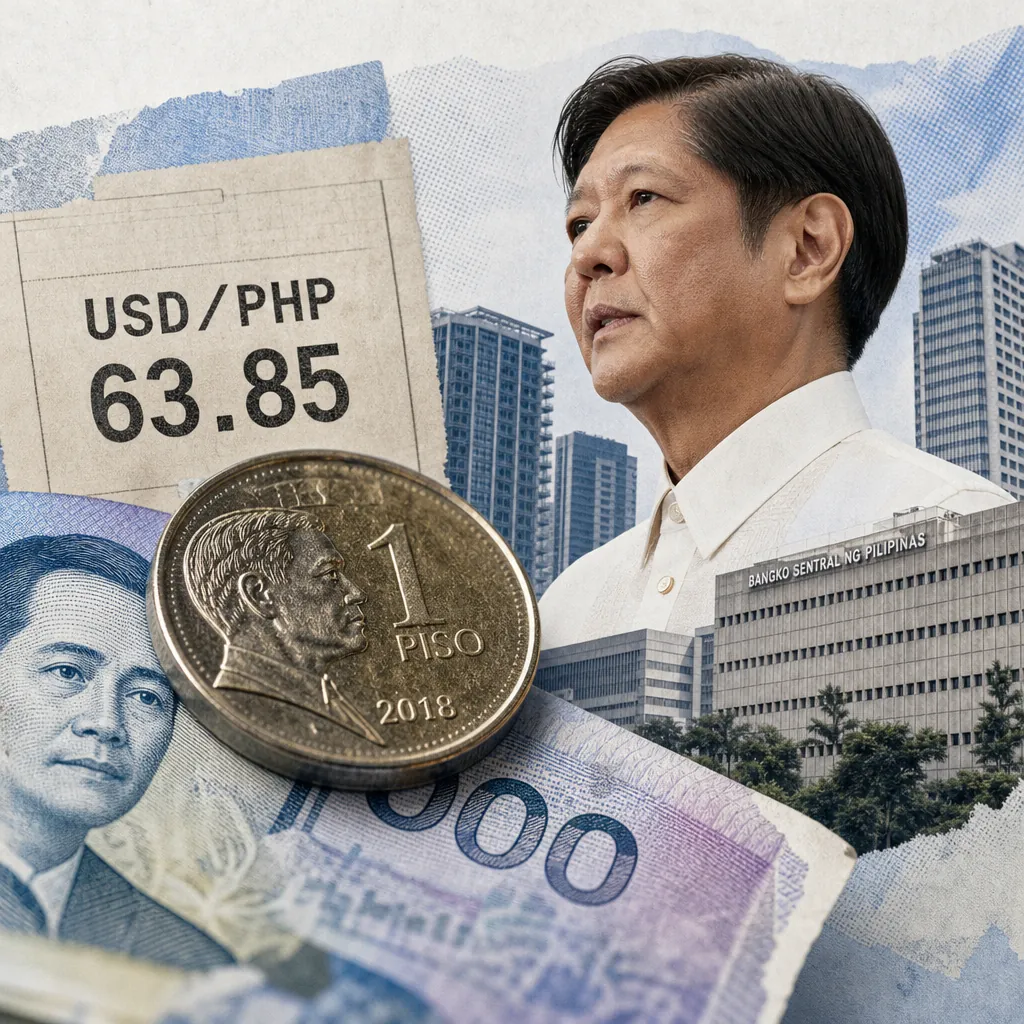
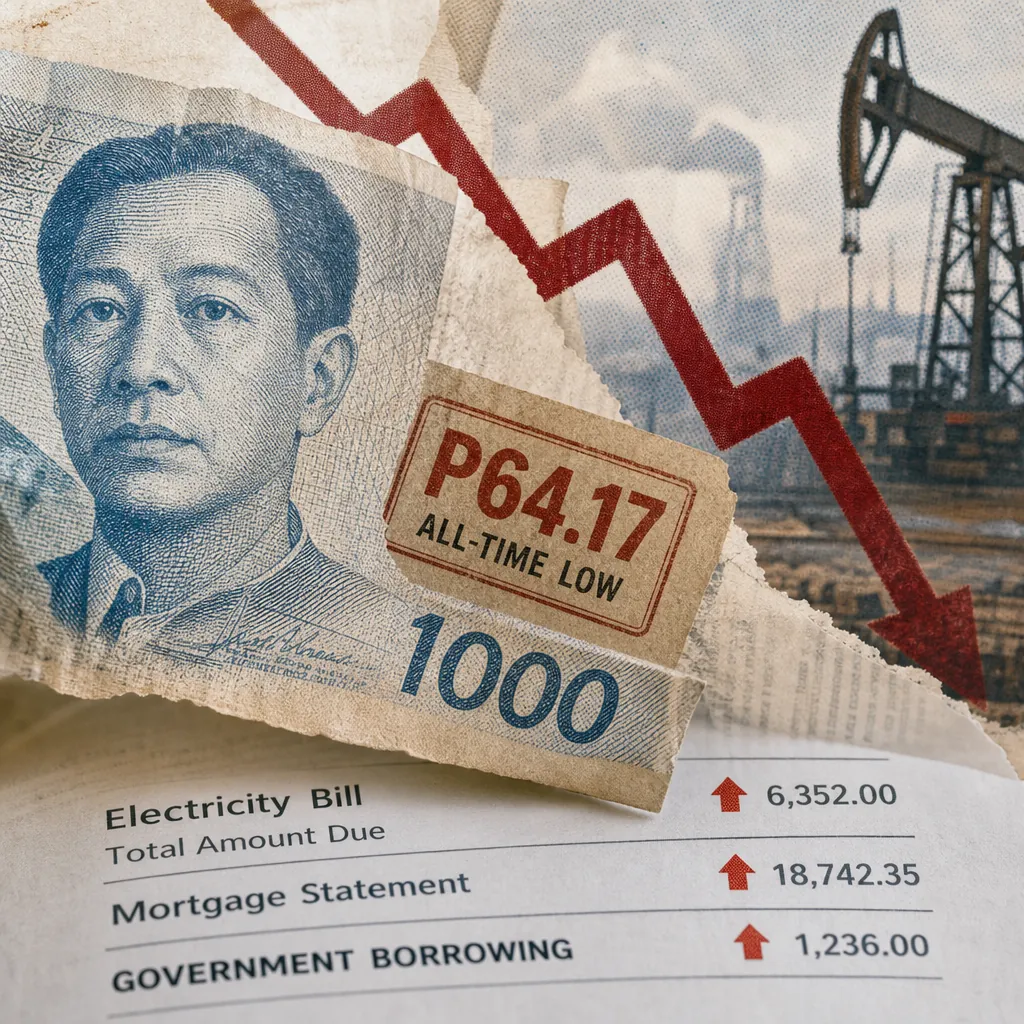
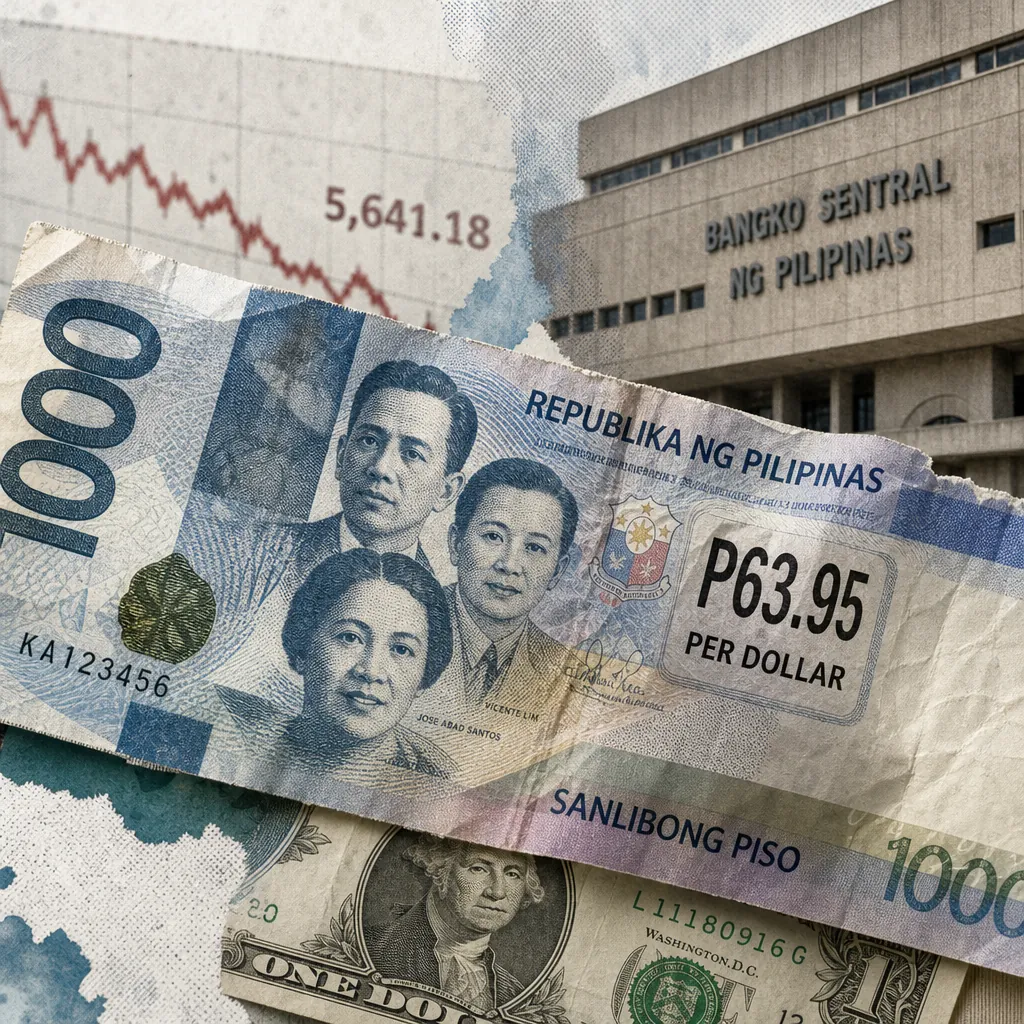
The peso closed at 63.85 to the dollar on Thursday, October 29, recovering from the record low of 64.17 it touched two days earlier, after President Ferdinand Marcos Jr. told reporters the government would "continue to defend the peso as hard as we possibly can" and urged the public "not to panic."2 The currency had fallen to record lows for six consecutive trading days before the two-day rebound, and it has lost more than 8 percent of its value against the dollar since the start of the year.221 The same session brought a second, quieter piece of financial news: the share of Philippine bank loans that have gone unpaid for 90 days or more fell to 3.27 percent of total lending in September, the lowest level since December 2025, according to preliminary Bangko Sentral ng Pilipinas (BSP) data.1063
Those two developments anchored the day's business coverage. The peso story ran across online news outlets and a blog, with the central bank's rate stance and the US Federal Reserve's decision to hold its own benchmark rate feeding into the same narrative.5032 The bad-loan figures were carried by at least four outlets, including broadsheet and online business desks.102063 Around them sat a wider set of economic stories: a year-end forum where economists warned that growth faces pressure from inflation and weak investment, a column arguing the BSP's recent rate hike addresses an inflation risk rather than a supply problem, and a report placing the country's political risk under scrutiny.314762 The items captured here are a monitored selection rather than a complete record of the day's financial press, so the mix reflects what the monitoring was set up to catch as much as where coverage actually sat.
What ties the day together is a single question with several faces: whether the Philippines can hold its currency, its lending quality, and its growth path at the same time. The peso's slide makes imports more expensive and feeds inflation; the central bank's response has been to raise interest rates, which makes borrowing costlier for businesses and households; and the bad-loan data suggests that, so far, borrowers are still paying. Each of those threads carries a different kind of weight. The peso story drew the most prominent placement and the clearest public statement from the country's highest official. The bad-loan story is a data release with consequences for how freely banks will lend in the coming quarters. Neither cancels the other, and both matter to anyone with a loan, a savings account, or a business that imports goods.
Key themes
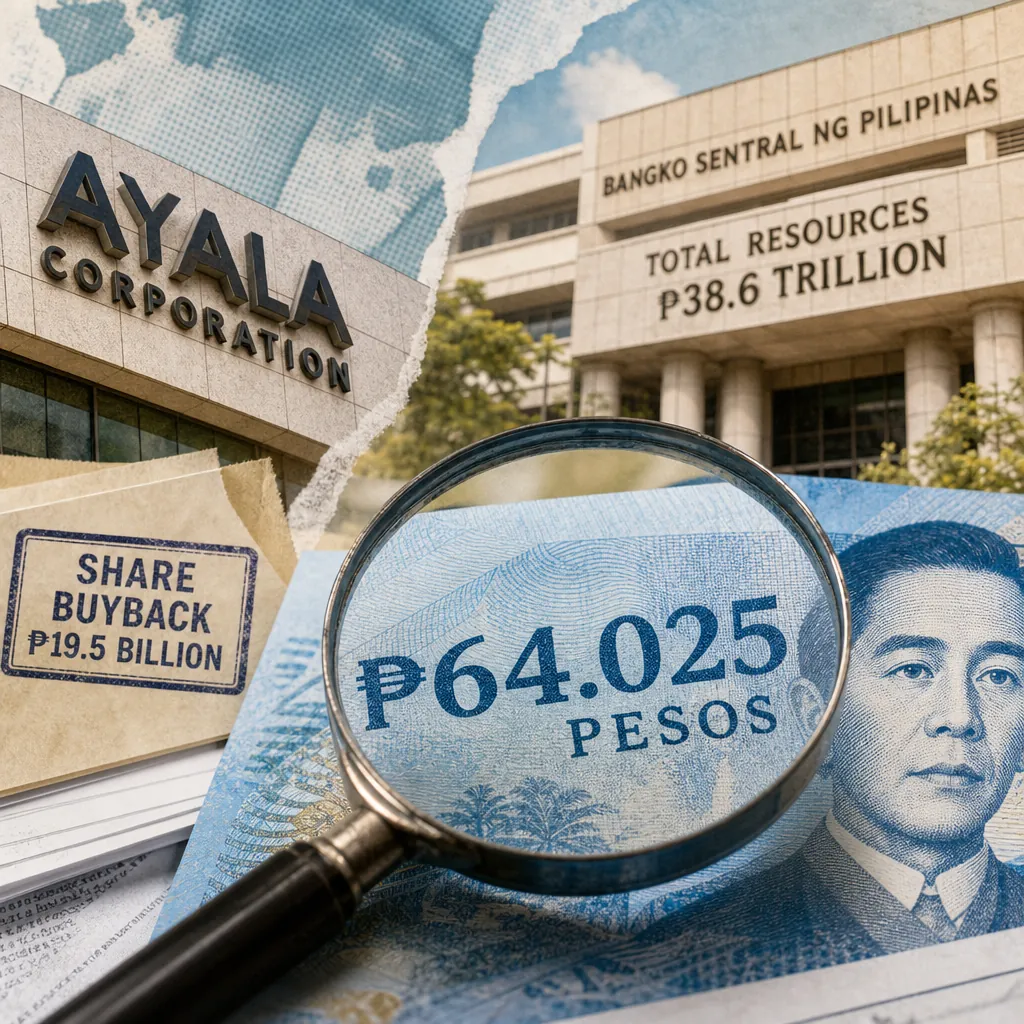
- The peso recovered to 63.85 after Marcos pledged to defend it. The currency strengthened 17.5 centavos from Wednesday's close of 64.025 to the dollar, its second straight day of gains after six consecutive record lows.21 Marcos said foreign exchange reserves are healthy and that the government has "all the means to defend" the currency.2
- Bad loans fell to 3.27 percent of bank lending in September, the lowest in nine months. The nonperforming loan (NPL) ratio — the share of loans whose principal or interest has gone unpaid for at least 90 days — eased from 3.35 percent in August and 3.31 percent a year earlier.2063 In peso terms, however, the stock of bad loans still rose 10.1 percent year on year to ₱593 billion out of an ₱18.1-trillion loan book.10
- The US Federal Reserve held rates at 3.75 to 4 percent, with two officials dissenting in favor of a hike. The 10-to-2 vote on October 28 kept the US benchmark unchanged, and the dissent came from members who wanted to tighten further rather than cut.50 The decision gave Philippine equities short-term relief, with the benchmark Philippine Stock Exchange Index (PSEi) rising 0.92 percent to 5,705.58.32
- Economists warned that Philippine growth faces pressure from inflation, weak private investment, and fragile household finances. At The Manila Times Year-end Economic Forum, Rizal Commercial Banking Corp. chief economist Michael Ricafort pointed to the need for reforms, fiscal discipline, and transparency, noting that growth that once ran at 5 to 6 percent has weakened.3137
- The BSP's surprise 50-basis-point rate hike is aimed at preventing an inflation shock from becoming entrenched. A BusinessMirror column argued that monetary policy cannot fix a supply-side problem directly, but the central bank tightened because Middle East tensions and El Niño had pushed risks beyond the initial supply shocks.47
- A country-risk report flagged elevated and deteriorating political stability and policy risk. The WR Advisory Group's inaugural Philippine Political and Country Outlook Report assessed eight sub-categories and found only one — fiscal and sovereign — outside the deteriorating group, according to a Philstar business report.62
- Asia United Bank posted record nine-month net income of ₱9.4 billion, nearly flat from a year earlier. Trading losses of ₱11.8 million reversed a ₱1.37-billion gain in the same period last year, while net interest income rose 14.5 percent to ₱15.5 billion on 13.8 percent loan growth.13
- Metrobank won Best Asset Manager and Best Client Services at the Citywire Asean Awards 2025/26. The awards cover institutions in Malaysia, the Philippines, and Thailand and considered growth in assets under management, product breadth, and distribution channels.45
How the narratives stack
Dominant. The peso's rebound and Marcos's public commitment to defend it led the day's financial coverage in the items captured here. The story carried a direct presidential quote, a specific exchange-rate move, and a clear link to the central bank's rate policy. It appeared in online news outlets and a blog, and it connected to the stock market's gain and to the Fed's decision, which gave the peso room to recover.2213250 The bad-loan data ran alongside it with a data-driven frame rather than a political one, and its presence across multiple outlets — including broadsheet and online business desks — made it the second most-covered financial story in the set.102063
Counter-narrative. The economists' warnings at the Manila Times forum and the BusinessMirror column on the rate hike both push against the relief implied by the peso's two-day gain. Ricafort's point that growth has slowed from the 5-to-6-percent range and that structural constraints need addressing sits awkwardly beside a currency recovery that lasted two sessions.31 The BusinessMirror column makes a related argument from a different angle: the BSP's 50-basis-point hike is not a fix for supply-side inflation but an attempt to keep an inflation shock from becoming embedded in expectations.47 Together they suggest the peso's rebound is a pause, not a resolution.
Emerging. The country-risk report from WR Advisory Group introduces a frame that the day's other stories do not: that political instability and institutional integrity are themselves economic variables. The report assessed eight sub-categories across governance, macroeconomic structure, and operating environment, and found the outlook deteriorating in most of them.62 This is a new publication — the firm's inaugural report — so it has no track record yet, but it gives analysts a vocabulary for connecting the impeachment trial, the Senate fugitive case, and the currency pressure into a single risk picture.
Under-covered. The DTI-Mastercard partnership to help micro, small, and medium enterprises (MSMEs) go digital, signed October 26, received a single online item in this set.52 It matters because MSMEs employ the majority of Philippine workers and because the shift to electronic payments is exactly the kind of structural change that could cushion the economy against currency-driven import costs. The convert.ph launch — a Filipino-built tool that generates a complete Facebook ads campaign from a short form for ₱2,497 — is a related small-business story that also drew one item.12 Neither was picked up widely in the captured set, though both touch the same small-business digitization theme.
Platform insights
- Facebook. The day's most-quoted political content came from Facebook posts by Defense Secretary Gilberto Teodoro Jr., which a Manila Times column cited as evidence that he holds a 1960s view of China's economy and has urged Philippine business "to stop getting their supplies from China."7 The column's criticism of those posts is itself a Facebook-driven story: the posts were the primary text, and the column was the reaction. This is the platform where official statements become raw material for opinion coverage.
- X (formerly Twitter). No posts from X appear in the items captured here, but the platform's role in the day's financial news is indirect: the Fed's decision and the peso's move were reported across online outlets that aggregate and redistribute social reaction. The absence of direct X engagement data in this set means the platform's contribution to the day's conversation cannot be measured from these items.
- Reddit. No Reddit activity appears in the captured items. The day's financial discussion lived in news columns and data releases rather than in forum threads.
- YouTube. A Manila Times column referenced a YouTube interview with the author about GCash's post-listing performance and the greenshoe — the mechanism by which underwriters stabilize a newly listed stock's price — and noted that a venture capital fund in Singapore had its analysts watch it.9 The column's author, who was disappointed that some viewers misread his point as a recommendation, used the YouTube appearance as the anchor for a broader argument about waiting for the one-month stabilization period before judging the listing. This is a case where a video interview became the reference point for a print column, and the column then became the day's most detailed discussion of the GCash listing.
Key voices and communities
The Marcos administration and the BSP. The President's public commitment to defend the peso, combined with the central bank's intervention in the foreign exchange market and its 50-basis-point rate hike, forms the official response to the currency's slide.247 Marcos framed the situation as one of strength — healthy reserves, available means — and urged calm. The BSP's actions, including its stated intervention to smooth sharp fluctuations, are the operational side of that message.2
Bank economists and market analysts. Michael Ricafort of RCBC, Nicholas Antonio Mapa of Metrobank, Luis Limlingan of Regina Capital Development Corp., Denise Joaquin of COL Financial Group, and Jonathan Ravelas of Reyes Tacandong & Co. all appear in the day's coverage, each offering a slightly different read on the same data.31213220 Their collective message is cautious: the peso's rebound is welcome but fragile, the bad-loan improvement is real but the stock of bad loans is still growing, and the Fed's hold gives temporary relief without solving domestic inflation.
The House prosecution panel and the impeachment trial. Lanao del Sur Rep. Zia Alonto Adiong, a spokesperson for the prosecution panel, said the panel had identified a ₱111.85-million discrepancy between Vice President Sara Duterte's declared income and bank deposits, and raised the possibility of tax evasion charges.60 Adiong also argued that a Social Weather Stations survey showing more Filipinos satisfied with Duterte's defense team than with the prosecution was conducted before financial evidence was presented.11 The impeachment trial resumes November 9, and the financial evidence is the prosecution's central line of attack.5960
Columnists and opinion writers. The Manila Times ran columns on Teodoro's China views, the case for convicting Sara Duterte, and the GCash listing, while Philstar's Cebuano-language column laid out the numbers in Duterte's SALNs against her bank balances.78959 These columns are where the day's political and economic arguments were made most explicitly, and they set the terms for the debates that will continue into November.
Small-business advocates and fintech builders. The DTI-Mastercard partnership and the convert.ph launch represent a community of institutions and startups working on the same problem: getting small Philippine businesses to adopt digital tools and payments.5212 Their framing is practical — lower costs, wider reach, less cash — and their audience is the neighborhood store and the home-based entrepreneur.
Narrative streams
The peso's two-day recovery rests on a presidential pledge and a Fed hold
The peso's move from 64.17 to the dollar on Tuesday to 63.85 on Thursday is the most concrete number in the day's coverage, and it came with a specific explanation: Marcos told reporters the government would defend the currency "as hard as we possibly can," cited healthy foreign exchange reserves, and said there was no reason to panic.2 The BSP had already intervened in the foreign exchange market the previous week to smooth sharp fluctuations, and it raised its key policy rate in a surprise 50-basis-point move.247 The Fed's decision to hold its benchmark rate at 3.75 to 4 percent on October 28 gave the peso additional room, since a steady US rate reduces the pressure on emerging-market currencies to weaken against the dollar.50
For businesses that import raw materials or pay dollar-denominated debts, the two-day gain lowers costs at the margin but does not reverse the year's 8-percent decline. A company that budgeted at 60 pesos to the dollar at the start of the year is still paying nearly 6 percent more for every dollar of imports. The read for the sector is that importers and dollar borrowers should plan for a peso that stays weaker than its early-2026 level even if the immediate panic has eased, and that the central bank's willingness to intervene sets a floor that is higher than the market's worst fears but lower than the year's starting point.
The context matters here. The Philippines' foreign reserves fell to $99.5 billion in September, the lowest level since September 2023, which is why Marcos's claim that reserves are healthy drew attention.2 Reserves are the central bank's stock of foreign currency and other assets it can use to buy pesos and support the exchange rate. A falling reserve level limits how long the central bank can keep intervening at the same pace. The peso's recovery is therefore a function of both the President's words and the market's assessment of how much ammunition the BSP has left.
Bad loans eased to a nine-month low, but the stock of sour debt still grew
The NPL ratio of 3.27 percent in September is lower than August's 3.35 percent and September 2025's 3.31 percent, and it is the lowest reading since December 2025's 3.07 percent.2063 The improvement came as continued credit growth enlarged the industry's loan base: the total loan book reached ₱18.1 trillion, so the same peso amount of bad loans represents a smaller share.10 In absolute terms, gross bad loans rose 10.1 percent year on year to ₱593 billion.1063 Banks also set aside nearly ₱558 billion in provisions against potential losses, a buffer that signals they expect some of those loans to worsen.10
Jonathan Ravelas, senior adviser at Reyes Tacandong & Co., read the decline as a sign of "improving asset quality" that "highlights the resilience of both borrowers and lenders," adding that "steady loan growth and stable economic activity have helped contain credit stress."20 His forecast for the fourth quarter is that NPLs "could remain manageable or even improve further."20
The read for the sector is that banks have room to keep lending, but the growth in the absolute stock of bad loans means they will likely tighten standards for the riskiest borrowers even as the headline ratio improves. For households and small businesses, that translates into continued access to credit for those with clean records and more scrutiny for those without. The ratio is a measure of the share of the loan book that has gone sour, not a measure of how many borrowers are struggling; a bank can have a low ratio and still be turning away applicants it would have approved a year ago.
The BSP's rate hike is a bet against entrenched inflation, not a cure for supply shocks
The BusinessMirror column by Ser Percival K. Peña-Reyes makes the case that the BSP's surprise 50-basis-point hike is justified as an attempt to prevent an inflation shock from becoming entrenched, even though monetary policy cannot directly create the goods whose prices are rising.47 The column's argument is that Middle East tensions driving up global oil prices and El Niño hitting agriculture are supply-side problems, and lower interest rates do not produce more oil or rice. But the BSP tightened because the risks had cascaded beyond the initial shocks: accelerating inflation, a weak peso, elevated global energy prices, and the risk of weather-related food shortages together raised the possibility that expectations of future inflation would become self-fulfilling.47
This is the context a general reader needs to understand the day's rate news. The BSP's key policy rate is the interest rate it charges banks for short-term borrowing, and it influences the rates banks charge their customers. A 50-basis-point hike is half a percentage point. When the central bank raises rates, it makes borrowing more expensive, which cools demand and can slow price increases — but it also slows the economy, which is why the economists at the Manila Times forum warned about weak private investment.31
The read for the sector is that businesses planning to borrow in the fourth quarter should expect higher costs than they budgeted for at the start of the year, and that the BSP's priority is inflation expectations rather than growth support. The peso's recovery gives the central bank some room to pause, but the column's logic suggests it will not reverse course until inflation shows a sustained decline.
Economists at the Manila Times forum called for reforms as growth weakens
The Manila Times Year-end Economic Forum, titled "Beyond UMIC: Locking in on sustainable, equitable growth," brought together economists who warned that elevated inflation, weak private investment, and fragile household finances are pressuring Philippine growth.3137 UMIC stands for upper-middle-income country, a World Bank classification the Philippines has been working toward; the forum's title signals that the debate has moved from reaching that status to sustaining it. Ricafort said the Philippines previously sustained growth of around 5 to 6 percent but recent performance has weakened, and he called for economic reforms, fiscal discipline, and transparency to improve the investment climate.31
The forum's framing connects to the day's other stories. Weak private investment is partly a function of higher interest rates, which are partly a response to the peso's slide and inflation. Fragile household finances are partly a function of the same inflation, which erodes purchasing power. The economists' call for reforms is a recognition that the central bank's tools can only do so much, and that the structural constraints — infrastructure, regulatory burden, skills — need attention from the government's fiscal and regulatory arms.
The read for the sector is that companies planning long-term investments should factor in a period of slower growth and higher borrowing costs, and that the policy debate is shifting toward fiscal and regulatory measures rather than monetary ones. The forum's title suggests the government's own framing is that reaching upper-middle-income status is not the finish line; sustaining it requires reforms that the monetary authority cannot deliver on its own.
The impeachment trial's financial evidence points to a November 9 resumption
The House prosecution panel said it had identified a ₱111.85-million discrepancy between Vice President Sara Duterte's declared income and the deposits that flowed into her bank accounts, based on documents presented in the Senate impeachment trial.60 Adiong said the total amount that moved through Duterte's accounts from 2022 to 2025 was ₱174.96 million, while her declared income was ₱63.11 million, and he raised the possibility of tax evasion charges.60 A Philstar Cebuano-language column laid out the same numbers in more detail: Duterte's Statements of Assets, Liabilities and Net Worth (SALNs) for 2022 to 2025 declared zero cash on hand and zero cash in bank, while her year-end bank balances were ₱59 million in 2022, ₱71.38 million in 2023, ₱22.25 million in 2024, and ₱39.09 million in 2025.59
A SALN is the annual disclosure form that Philippine public officials are required to file, listing their assets, liabilities, and net worth. The column's point is that the SALNs and the bank records are both documents Duterte herself signed or authorized, so the discrepancy is not a matter of interpretation.59 Adiong also addressed a Social Weather Stations survey released Wednesday that showed 47 percent of Filipinos satisfied with Duterte's defense team and 24 percent dissatisfied, against 30 percent satisfied and 35 percent dissatisfied with the prosecution; he said the survey was conducted September 21 to 27, before the financial evidence was presented.11
The read for the sector is that the impeachment trial's outcome will hinge on how the Senate weighs documentary evidence against public opinion, and that the financial records give the prosecution a line of attack that does not depend on witness credibility. The trial resumes November 9, and the prosecution's case will likely center on the gap between what Duterte declared and what her accounts show.5960
A country-risk report puts political instability on the economic ledger
The WR Advisory Group's inaugural Philippine Political and Country Outlook Report warned that the Philippines faces an elevated and deteriorating outlook for political stability, policy and regulatory quality, fiscal and sovereign strength, and economic growth.62 The report assessed eight sub-categories across governance, macroeconomic structure, and operating environment, and found that only the fiscal and sovereign sub-category was outside the deteriorating group.62 The report is new, so it has no track record, but its framing is significant: it treats political instability as an economic variable that affects investment decisions, not as a separate domain.
The read for the sector is that foreign and domestic investors who read country-risk reports will price political uncertainty into their decisions, which raises the cost of capital for Philippine companies and makes the government's reform agenda more urgent. The report's release in the same week as the peso's record low and the impeachment trial's financial revelations gives it a receptive audience.
Small-business digitization drew little coverage despite its reach
The Department of Trade and Industry (DTI) signed a memorandum of understanding with Mastercard on October 26 to help micro, small, and medium enterprises expand online businesses, adopt secure digital payments, and reach more customers.52 The partnership addresses gaps in digital skills, payment security, and technology adoption among small businesses, and it targets neighborhood stores, small retail outlets, and home-based enterprises.52 Separately, convert.ph launched a self-serve web app that turns a business's details into a complete Facebook Messages campaign — including ad creatives, Taglish copy, a Messenger welcome message, and a ready-to-import Meta Ads Manager file — starting at ₱2,497 with no subscription.12
Both items address the same problem: small businesses know what they sell and to whom, but they lack the tools and skills to reach customers digitally. The DTI-Mastercard partnership is institutional and slow-moving; the convert.ph app is commercial and immediate. Neither drew wide coverage in the captured set, but both matter to the economy's structural resilience, because MSMEs employ the majority of Philippine workers and because digital payments reduce the economy's dependence on cash, which is costly to handle and hard to trace.
The read for the sector is that the digitization of small business is proceeding through both public-private partnerships and private tools, and that the businesses that adopt early will have an advantage as electronic transactions become the norm. The coverage gap in this set may reflect the monitoring's focus on macro-financial news rather than a lack of interest in the topic.
Conversation trajectory
The peso's next test comes with the November inflation release. The BSP's next policy meeting and the release of October inflation data will show whether the peso's recovery holds or whether the central bank needs to intervene again. Watch the exchange rate's close on the last trading day of October and the first week of November; a move back above 64 to the dollar would signal that the President's pledge has not changed the market's direction. Observation window: one to two weeks.
The impeachment trial resumes November 9 with financial evidence. The prosecution's case will center on the gap between Duterte's SALNs and her bank records, and the defense will likely challenge the provenance of the documents or the interpretation of the numbers.5960 Watch for new filings from either side in the week before the resumption, and for any change in the Social Weather Stations polling after the financial evidence becomes public. Observation window: through mid-November.
The BSP's next rate decision will signal whether the hike cycle is over. The central bank raised rates by 50 basis points in a surprise move, and the BusinessMirror column argues the hike is about inflation expectations rather than immediate price relief.47 If October inflation shows a decline, the BSP may pause; if it shows acceleration, another hike is possible. Watch the November policy meeting and the inflation release that precedes it. Observation window: four to six weeks.
The country-risk report's reception will show whether political risk becomes a pricing factor. The WR Advisory Group report is new, and its influence depends on whether investors and analysts cite it in their own assessments.62 Watch for references to the report in bank research, analyst notes, and business commentary over the next month. Observation window: four weeks.
The DTI-Mastercard partnership's first programs will show whether the MOU translates into adoption. The memorandum was signed October 26, and the next step is the rollout of training and tools for small businesses.52 Watch for announcements of pilot programs or participating regions. Observation window: six to eight weeks.
Trigger events to watch: the October inflation release, the BSP's November policy meeting, the November 9 impeachment trial resumption, the Senate's response to the Supreme Court petition on the dela Rosa case, and the release of third-quarter corporate earnings, which analysts cited as a reason for cautious trading.32
Response guidance
Currency-sensitive businesses should plan for a peso that stays weaker than its early-2026 level. Importers, dollar borrowers, and companies with foreign-currency costs should stress-test their budgets against a range of 63 to 66 pesos to the dollar rather than assuming the two-day recovery marks a return to the year's starting point. The President's pledge and the central bank's intervention set a floor, but the floor is higher than the market's best days.
Lenders should communicate clearly about credit standards. The bad-loan ratio improved, but the absolute stock of bad loans grew, and banks will likely tighten standards for riskier borrowers even as the headline number looks better.1063 Lenders should explain to customers why a lower ratio does not mean easier credit, and should direct small businesses toward the DTI-Mastercard tools and other digitization programs that can improve their credit profiles.52
Business associations should amplify the economists' reform message. The Manila Times forum's call for reforms, fiscal discipline, and transparency is a message that business groups can carry to policymakers without appearing partisan.31 The country-risk report gives that message an independent data point.62 Associations should cite both when engaging with government on investment climate issues.
Communicators covering the impeachment trial should distinguish documentary evidence from public opinion. The Social Weather Stations survey and the financial records measure different things: the survey measures satisfaction with the defense and prosecution teams, while the records measure the gap between declared and actual finances.1159 Reporting that treats the survey as a verdict on the evidence, or the evidence as a refutation of the survey, will mislead readers about what each measures.
Small-business advocates should connect the DTI-Mastercard partnership to the convert.ph tool. The two items address the same audience from different directions: the partnership provides institutional support and training, while the app provides an immediate commercial tool.5212 Advocates should present them as complementary options rather than competing solutions, and should emphasize the cost — ₱2,497 with no subscription — as a low barrier for businesses that have never run a digital campaign.
Financial communicators should explain the Fed's dissent in plain terms. The 10-to-2 vote with two members favoring a hike is unusual and matters for the peso because it signals that US rates may stay higher for longer.50 Communicators should explain that the dissent is a push to tighten further, not a push to cut, and that a higher US rate makes it harder for the peso to recover.
See the full picture behind today's signals.
This report draws from Media Meter's MediaWatch, our real-time monitoring engine tracking 2,470+ Philippine sources across print, broadcast, digital, and social. Explore how the platform turns raw coverage into decision-grade intelligence, then see how it's configured for teams like yours — whether you're in PR agencies, corporate comms, government, or marketing.
Want more? Browse our Report Library for sector and crisis intelligence, or request a demo and we'll have your brand set up before the call.
Want this kind of intelligence on your brand?
This brief is built on the same MediaWatch methodology that runs continuously across every brand we monitor. See your competitive landscape, Impact Score, and narrative trajectory in a 30-minute demo.