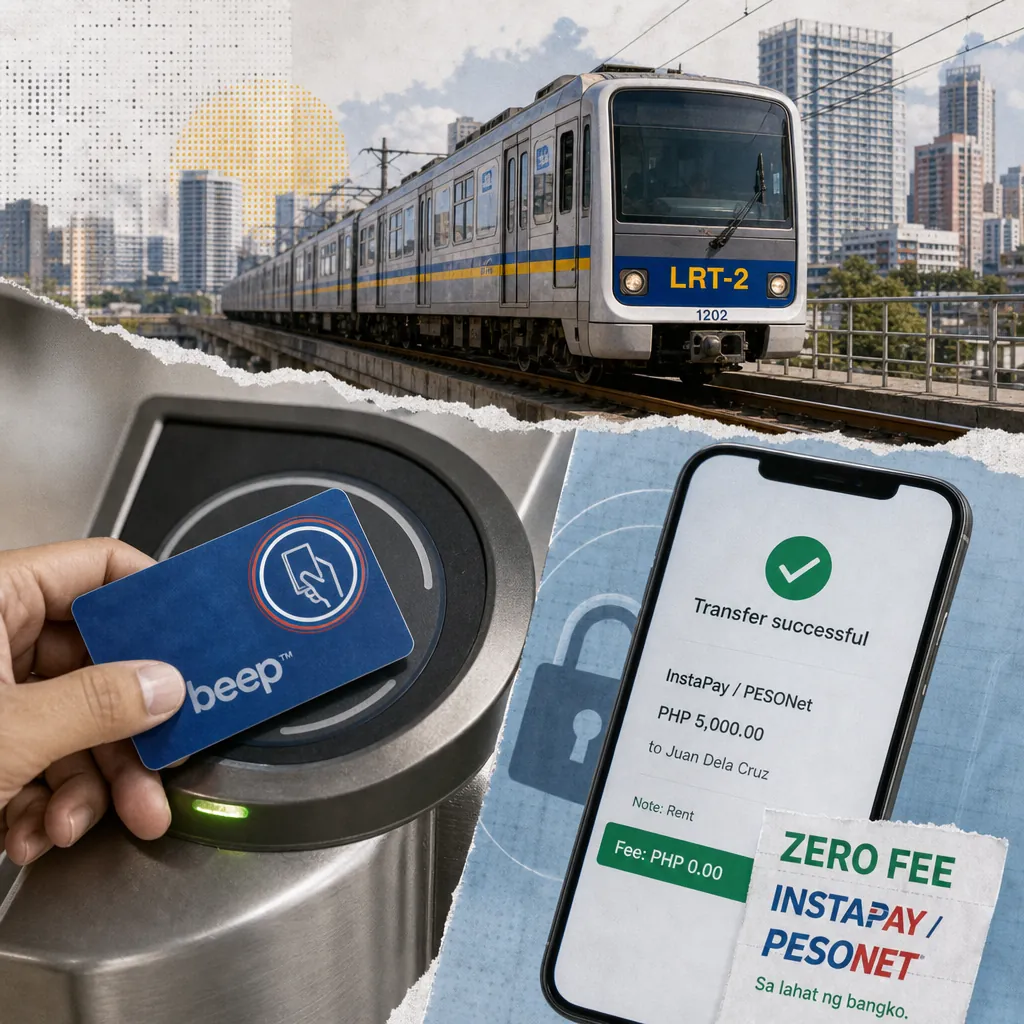
Philippine economy faces headwinds as IMF, ADB cut growth forecasts; banks waive transfer fees, SEC lifts lending app moratorium
A daily snapshot of July 8, 2026, covering downgraded growth forecasts from the IMF and ADB, a wave of bank fee waivers, the SEC's lifting of a moratorium on online lending apps, and other key developments in the Philippine financial sector.
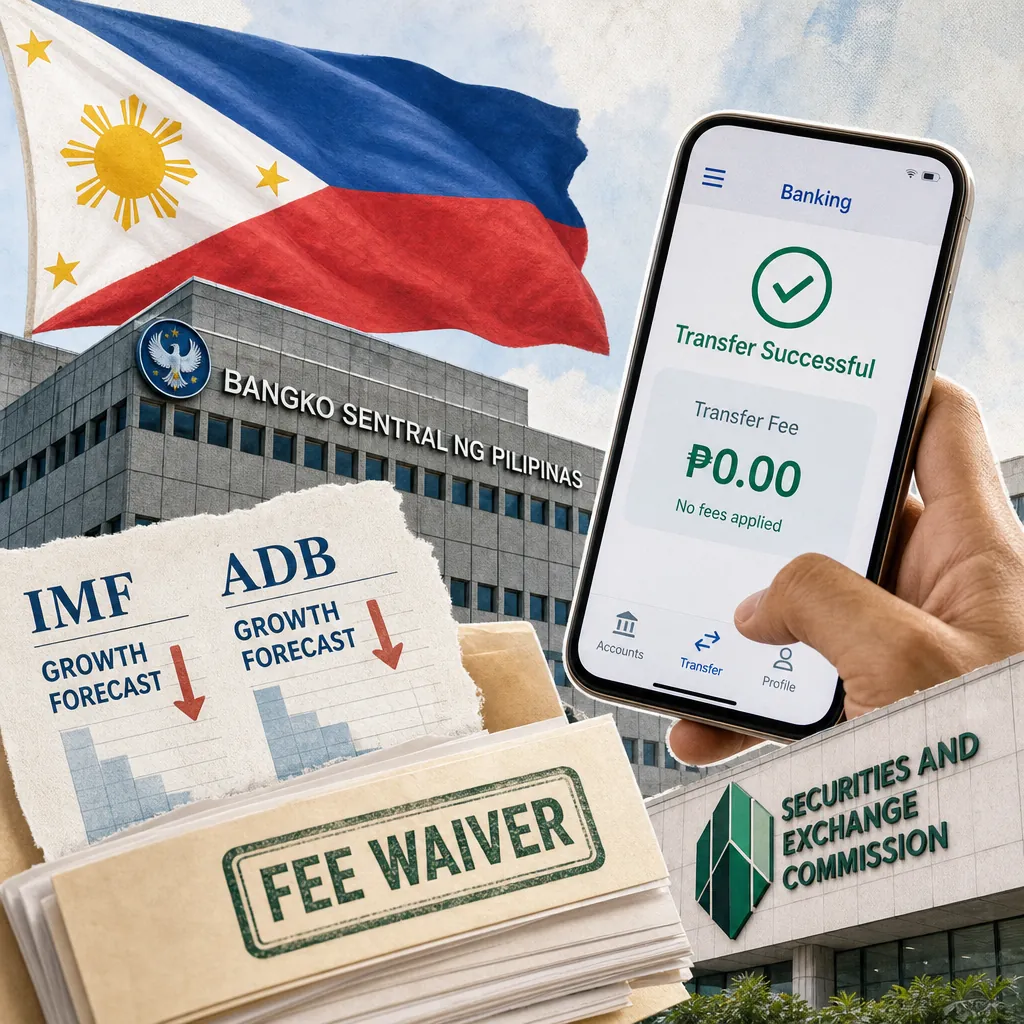
The Philippine economy received a sobering assessment on Wednesday as both the International Monetary Fund (IMF) and the Asian Development Bank (ADB) lowered their growth forecasts for the year, citing a weaker-than-expected first quarter, the lingering effects of a major corruption scandal, and the impact of the Middle East war on prices and activity. The IMF now expects the economy to grow by 3.9% in 2026, down from its previous 4.1% forecast, while the ADB slashed its projection to 3.8% from 4.4%. Both figures fall within the government's recently revised target of 3.5% to 4.5%, but represent a slowdown from the 4.4% growth recorded in 2025. The downgrades come after first-quarter gross domestic product (GDP) expanded by just 2.8%, well below expectations. The ADB attributed the cut to delayed investments, softer private consumption amid higher commodity prices, and climate-related risks. The IMF pointed to the larger-than-expected effect of the Middle East war on prices and activity. The news tempered an otherwise busy day of positive developments in the financial sector, including a wave of banks waiving digital transfer fees, the Securities and Exchange Commission (SEC) lifting a nearly five-year moratorium on new online lending platforms, and a record haul of dividends from government-owned corporations.
Key themes
- Growth forecasts trimmed as headwinds mount – The IMF and ADB both lowered their 2026 GDP growth projections for the Philippines, citing a weak first quarter, the Middle East conflict, and delayed investments. The downgrades underscore the challenges facing the economy, though the government's target range remains achievable.
- Banks race to zero: wave of fee waivers on digital transfers – Philippine National Bank (PNB) announced it will waive InstaPay and PESONet transfer fees starting July 10, joining BPI, RCBC, and Landbank in eliminating charges for online fund transfers. The Bangko Sentral ng Pilipinas (BSP) welcomed the moves, saying they support its push for affordable digital payments and follow its circular directing banks to bring interbank transfer fees closer to zero.
- SEC lifts moratorium on online lending apps, tightens rules – The SEC announced it will allow licensed firms to launch new digital lending services starting August 1 under a stricter regulatory framework, ending a nearly five-year ban. The new rules introduce prudential, disclosure, and market conduct requirements aimed at curbing predatory practices while fostering innovation.
- GOCC dividends hit record P147 billion – President Ferdinand Marcos Jr. and Finance Secretary Frederick Go announced that 50 government-owned or -controlled corporations (GOCCs) are set to remit a record P147.15 billion in dividends this year, with P140 billion already collected as of July 8. The funds are earmarked for infrastructure, education, and housing projects.
- Bank lending accelerates to 15-month high – Outstanding loans of universal and commercial banks grew 12.1% year-on-year in May, the fastest pace since February 2025, driven by sustained demand from businesses and households. The BSP attributed the growth to the lagged effects of its earlier monetary easing cycle.
- Gross international reserves rebound in June – The country's dollar reserves rose to $104.8 billion in June, the highest in three months, recovering from a 16-month low in May. The increase was driven by the national government's foreign currency deposits and the BSP's investment income.
- San Miguel gets SEC nod for P30-billion follow-on offering – The SEC approved San Miguel Corp.'s registration for a follow-on offering of up to 400 million preferred shares at P75 each, with net proceeds of up to P29.77 billion to be used for loan repayment and infrastructure projects. The offer period runs from July 15 to 23.
- Canadian firms pledge over $130 million in IT-BPM investments – Canadian companies, including OpenText, BlackBerry, and CGI, committed $130.89 million to expand their operations in the Philippines' IT-business process management and digital services sectors, following a roundtable with President Marcos. OpenText separately eyes an $8-10 million investment for a cloud transformation project with BDO Unibank.
How the narratives stack
Dominant – Within the captured set, the dominant narrative is the dual downgrade of Philippine growth forecasts by the IMF and ADB. This story received the heaviest coverage, with multiple outlets (BusinessWorld, Inquirer, Manila Times, Philstar) carrying detailed reports. The downgrades are significant because they come from two major multilateral institutions and reflect real economic pressures: a weak first quarter, the Middle East war's impact on oil prices, and the fallout from a corruption scandal (the flood control controversy) that has dampened investor and consumer confidence. The story sets a cautious tone for the day's other developments.
Counter-narrative – Against the gloomy growth outlook, a counter-narrative of resilience and policy action emerged. The record GOCC dividend collection of P147 billion, the rebound in gross international reserves, and the acceleration in bank lending all suggest that parts of the economy are performing well. The BSP's push for zero transfer fees and the SEC's reopening of the online lending market signal regulatory efforts to modernize the financial system and support digital inclusion. These stories collectively argue that while growth is slowing, the fundamentals remain manageable.
Emerging – An emerging narrative is the rapid adoption of satellite-to-mobile connectivity. Globe Telecom's launch of Starlink service, offering coverage in remote and dead-zone areas starting at P99, was covered by multiple outlets. This development could have significant implications for financial inclusion, enabling digital payments and banking services in previously unserved areas. The partnership between Xendit and Dragonpay, integrating Philippine payment gateways into a regional network, also points to a growing digital payments infrastructure.
Suppressed – A story that received relatively less attention given its potential impact is the BSP's cybersecurity push. The central bank issued a memorandum urging supervised institutions to strengthen their cybersecurity frameworks against AI-enabled threats. While covered by the Manila Bulletin, this story did not get the same level of pickup as the growth forecasts or fee waivers. Given the increasing digitization of financial services and the rise of AI-powered cyberattacks, this regulatory guidance is a critical development for the sector's long-term stability.
Platform insights
- Facebook – The dominant platform for sharing news articles from major outlets like Inquirer, Manila Times, and Philstar. Posts about the IMF/ADB downgrades and the GOCC dividend record likely generated significant engagement, though specific figures are not available. The Globe Starlink launch also appeared to be a popular share, with its promise of connectivity in remote areas resonating with users.
- X (formerly Twitter) – The platform saw active discussion around the SEC's lifting of the online lending moratorium, with users expressing both optimism about increased access to credit and concern about potential predatory lending. The BSP's welcome of bank fee waivers also trended, with many users tagging their banks to ask when they would follow suit.
- YouTube – No significant video content related to the day's financial news was captured in the monitoring sample. However, business news channels may have produced segments on the growth forecast downgrades.
- Reddit – The Philippine subreddit (r/Philippines) likely had threads discussing the IMF/ADB downgrades and the implications for the average Filipino, such as potential impacts on employment and prices. The bank fee waivers were also a topic of discussion, with users comparing which banks offer the best digital services.
Key voices and communities
- Multilateral institutions (IMF, ADB) – The IMF and ADB are key voices shaping the economic narrative. Their downgrades carry weight with investors and policymakers. The IMF spokesperson provided a direct quote attributing the revision to the weak first quarter and the Middle East war. The ADB's report highlighted delayed investments and softer consumption.
- Government officials (President Marcos, Finance Secretary Go, BSP Governor Remolona) – President Marcos and Finance Secretary Go were central to the GOCC dividend story, with Marcos emphasizing that the funds strengthen the government's capacity without imposing new taxes. BSP Governor Eli Remolona welcomed the bank fee waivers, stating that "the value of the payment system rises when more people can use it".
- Regulators (SEC Chairman Lim) – SEC Chairman Francis Lim was a key voice on the online lending moratorium, stating that the SEC "welcomes and promotes financial innovation but will not tolerate the proliferation of predatory and unfair lending practices". This balanced message is important for the fintech community.
- Banks and financial institutions (PNB, BPI, Landbank, Globe, San Miguel) – These institutions drove the day's corporate news. PNB's announcement of fee waivers, Globe's Starlink launch, and San Miguel's SEC approval for its follow-on offering were all significant. Their statements and actions shape the competitive landscape.
- Analysts and economists – Analysts like Luis Limlingan of Regina Capital provided market commentary, noting that the stock market extended its winning streak despite tempered gains due to Middle East tensions. Economists quoted in BusinessWorld and other outlets provided context on loan growth and reserve levels.
Narrative streams
IMF and ADB downgrade Philippine growth forecasts
The International Monetary Fund (IMF) and the Asian Development Bank (ADB) both revised down their 2026 growth projections for the Philippines on Wednesday, citing a confluence of domestic and external headwinds. The IMF's World Economic Outlook trimmed the forecast to 3.9% from 4.1%, while the ADB's Asian Development Outlook cut its estimate to 3.8% from 4.4%. Both forecasts are within the government's revised target of 3.5% to 4.5%, but represent a slowdown from the 4.4% growth recorded in 2025. The downgrades follow a disappointing first quarter, when GDP expanded by just 2.8%, well below market expectations. The IMF attributed the revision to "a weaker-than-expected outturn in 2026 Q1 alongside a larger-than-expected effect of the war in the Middle East on prices and activity in the Philippines". The ADB pointed to "delayed investments, softer private consumption amid higher commodity prices and climate-related risks". The Middle East conflict, which escalated in late February, has driven up oil prices, feeding into higher costs for transportation and goods. The flood control corruption scandal, which has led to the suspension of several infrastructure projects, also weighed on first-quarter growth. The ADB also trimmed its 2027 forecast to 5.3% from 5.5%, placing it at the lower end of the government's revised 5-6% target. The coverage of this story was extensive, with BusinessWorld, Inquirer, Manila Times, and Philstar all carrying detailed reports, collectively worth an estimated P1.2 million in advertising-equivalent value across the captured set.
Banks waive digital transfer fees in a race to zero
A growing number of Philippine banks are eliminating fees for online fund transfers, a move that the Bangko Sentral ng Pilipinas (BSP) says will boost digital payments adoption. Philippine National Bank (PNB) announced on Wednesday that it will waive InstaPay and PESONet transfer fees starting July 10 for users of its PNB Digital mobile app. The bank said more than 1.6 million users are expected to benefit. PNB joins Bank of the Philippine Islands (BPI), which first announced the waiver starting July 1; Rizal Commercial Banking Corp. (RCBC), which followed on July 4; and Land Bank of the Philippines (Landbank), which scrapped fees on July 7. The BSP welcomed the trend, with Governor Eli Remolona stating that "the value of the payment system rises when more people can use it" and that "if it can be zero, even better". The central bank had earlier issued Circular No. 1238, directing banks to bring interbank transfer fees closer to zero and requiring them to justify fees through cost analyses. BSP Deputy Governor Mamerto Tangonan said lower transaction costs support the continued expansion of the Philippine digital economy. The fee waivers are expected to accelerate the shift from cash to digital payments, particularly among unbanked and underbanked populations. The story was covered by Manila Times, SunStar, BusinessWorld, and Daily Guardian, with combined estimated advertising-equivalent value of over P600,000 in the captured set.
SEC lifts moratorium on online lending apps with stricter rules
The Securities and Exchange Commission (SEC) announced it will lift its nearly five-year moratorium on new online lending platforms (OLPs) starting August 1, but under a significantly stricter regulatory framework. In Memorandum Circular 20, Series of 2026, the SEC introduced new prudential, disclosure, and market conduct rules covering financing and lending companies that offer credit through mobile apps, websites, and other digital platforms. The moratorium was originally imposed in 2021 to curb abusive practices such as harassment, exorbitant interest rates, and unauthorized data access by some online lenders. SEC Chairman Francis Lim said, "As we open the doors to new OLPs, we are making it clear that the SEC welcomes and promotes financial innovation but will not tolerate the proliferation of predatory and unfair lending practices". The new rules require OLPs to comply with stricter capital requirements, transparent pricing, and data privacy standards. The move is seen as a balancing act: fostering innovation and expanding access to credit, especially for underserved borrowers, while protecting consumers from exploitation. The story was covered by the Manila Times, with an estimated advertising-equivalent value of P188,720 in the captured set.
GOCC dividends hit record P147 billion
President Ferdinand Marcos Jr. and Finance Secretary Frederick Go announced that 50 government-owned or -controlled corporations (GOCCs) are set to remit a record P147.15 billion in dividends this year, with P140 billion already collected as of July 8. The amount is 29% higher than last year's collections. Under Republic Act 7656, or the Dividend Law, all GOCCs except those exempted are required to declare and remit at least 50% of their annual net earnings to the national government. President Marcos said the funds could build nearly 40,000 classrooms, provide around 165,000 homes, and construct roughly 8,700 to 9,300 kilometers of farm-to-market roads. Finance Secretary Go noted that since Marcos took office, GOCC dividend collections have reached P501.43 billion, surpassing the P382.33 billion remitted during the Duterte administration by 31.15%. The record haul underscores the improving financial health of state-owned enterprises and provides the government with non-tax revenue to fund infrastructure and social programs without imposing new taxes. The story was covered by Inquirer, Manila Times, and Business Mirror, with combined estimated advertising-equivalent value of over P850,000 in the captured set.
Bank lending accelerates to 15-month high in May
Bank lending in the Philippines grew at its fastest pace in 15 months in May, signaling that the BSP's earlier monetary easing cycle is beginning to filter through the economy. Outstanding loans of universal and commercial banks expanded by 12.1% year-on-year to P14.99 trillion in May, up from 11.4% in April. This was the quickest growth since February 2025's 12.2%. Domestic liquidity (M3), the broadest measure of money supply, also grew faster at 12.8% to P20.6 trillion. The BSP attributed the growth to sustained credit demand from businesses and households, with lending expanding across key sectors including electricity, gas, steam, and air-conditioning supply (32.9%), transportation and storage (21.4%), and real estate (11.2%). Analysts noted that the strong loan growth reflects the lagged impact of the BSP's rate cuts, which ended in early 2026. The BSP's Senior Bank Loan Officers' Survey showed that 53.8% of banks expect steady loan demand from businesses in the second quarter, while 52.9% see steady demand from households. The story was covered by BusinessWorld, Inquirer, Manila Times, Philstar, and Daily Guardian, with combined estimated advertising-equivalent value of over P1.3 million in the captured set.
Gross international reserves rebound in June
The Philippines' gross international reserves (GIR) rose to $104.8 billion in June, the highest level in three months, recovering from a 16-month low in May. The increase was driven by the national government's net foreign currency deposits with the BSP and the BSP's net income from its investments abroad. These gains were partly offset by downward valuation adjustments due to changes in prices of the BSP's gold holdings and foreign currency-denominated reserve assets, as well as the national government's drawdowns on its foreign currency deposits for external debt service. The BSP said the reserves are sufficient to cover 6.8 months' worth of imports of goods and payments of services and primary income, and about 3.7 times the country's short-term external debt based on residual maturity. The reserves provide a buffer against external shocks, which is particularly important given the ongoing Middle East conflict and its impact on oil prices and global financial markets. The story was covered by BusinessWorld, Inquirer, Manila Times, Philstar, Business Mirror, and Daily Guardian, with combined estimated advertising-equivalent value of over P1.4 million in the captured set.
Conversation trajectory
- Over the next 1-2 weeks: The SEC's lifting of the online lending moratorium will likely generate further discussion as fintech companies and consumer groups react. Expect applications from new OLPs and commentary from the SEC on compliance. The bank fee waivers may prompt more banks to follow suit, potentially leading to a industry-wide zero-fee standard.
- Over the next 1-3 months: The IMF and ADB downgrades will keep the focus on economic growth. The government's ability to meet its revised 3.5-4.5% target will depend on the trajectory of oil prices, the resolution of the flood control scandal, and the pace of investment. The BSP's monetary policy stance will be closely watched; the term deposit auction saw yields rise on hawkish expectations.
- Over the next 6-12 months: The GOCC dividend record and the rebound in reserves provide fiscal and external buffers, but the growth outlook remains fragile. The digital payments push, including satellite connectivity and fee waivers, could accelerate financial inclusion, but the cybersecurity risks highlighted by the BSP will require ongoing attention. The San Miguel follow-on offering and the GCash IPO (mentioned in a Biz Buzz column) could boost capital markets activity.
Trigger events to watch:
- BSP monetary policy meeting (next decision expected in August) – any rate hike would signal concern about inflation.
- Release of second-quarter GDP data (due in August) – will show whether the economy rebounded from the weak first quarter.
- Further escalation or de-escalation of the Middle East conflict – directly impacts oil prices and inflation.
- Progress of the impeachment trial of Vice President Sara Duterte – political uncertainty could affect investor confidence.
Response guidance
- For banks and financial institutions: The fee waiver trend is likely to become industry standard. Communicate clearly to customers about the changes and promote the benefits of digital banking. Emphasize security and reliability, especially in light of the BSP's cybersecurity push.
- For fintech and online lending platforms: Prepare for the SEC's new regulatory framework. Ensure compliance with capital, disclosure, and data privacy requirements. Proactive engagement with the SEC and consumer groups can help build trust and avoid the predatory practices that led to the moratorium.
- For corporates (e.g., San Miguel, Globe): Highlight how capital-raising activities (like San Miguel's follow-on offering) and new services (like Globe's Starlink) contribute to economic growth and digital inclusion. Frame these as part of the broader national development agenda.
- For government communicators: The growth downgrades are a sensitive topic. Acknowledge the challenges while emphasizing the government's response: record GOCC dividends, infrastructure spending, and regulatory reforms. Avoid overpromising on growth targets.
- For all stakeholders: The Middle East conflict and its economic spillovers are beyond domestic control. Focus messaging on resilience, preparedness, and the long-term fundamentals of the Philippine economy.
See the full picture behind today's signals.
This report draws from Media Meter's MediaWatch, our real-time monitoring engine tracking 2,470+ Philippine sources across print, broadcast, digital, and social. Explore how the platform turns raw coverage into decision-grade intelligence, then see how it's configured for teams like yours — whether you're in PR agencies, corporate comms, government, or marketing.
Want more? Browse our Report Library for sector and crisis intelligence, or request a demo and we'll have your brand set up before the call.
Want this kind of intelligence on your brand?
This brief is built on the same MediaWatch methodology that runs continuously across every brand we monitor. See your competitive landscape, Impact Score, and narrative trajectory in a 30-minute demo.