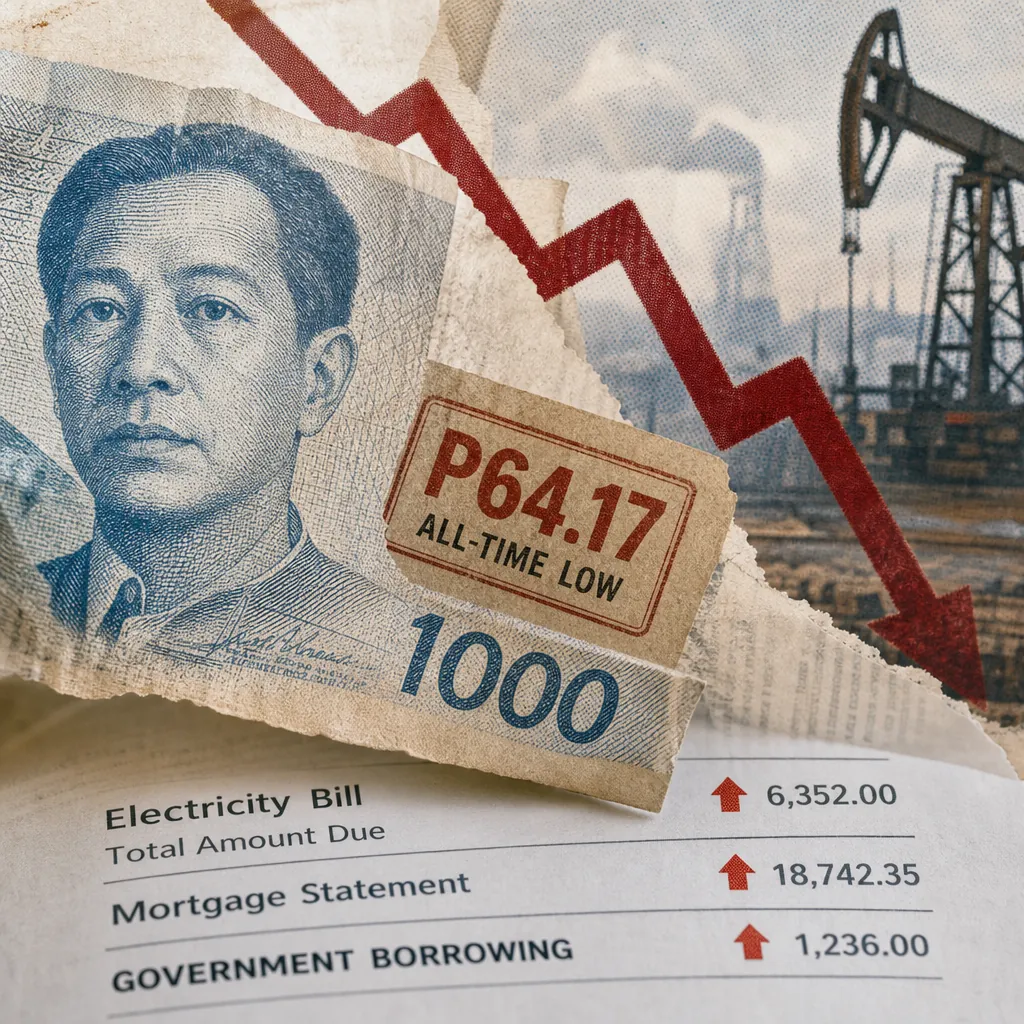
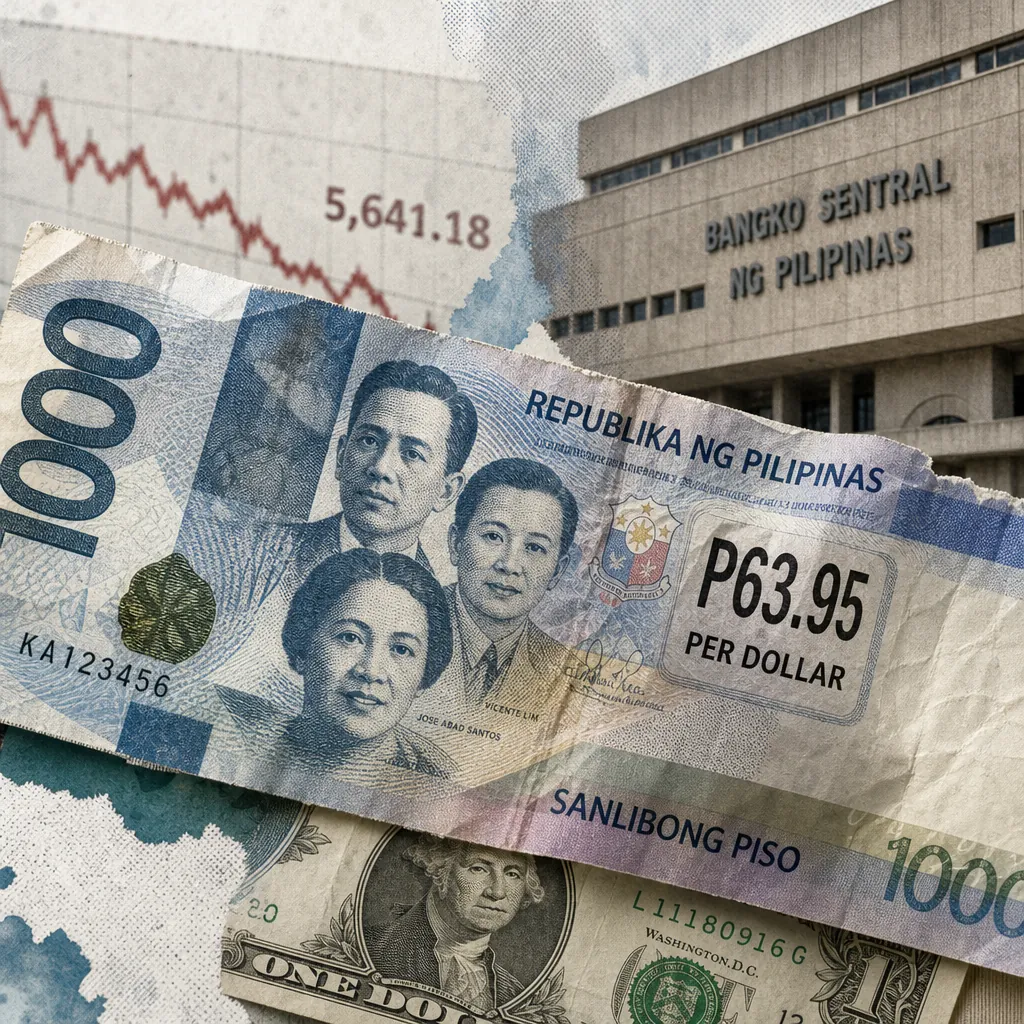
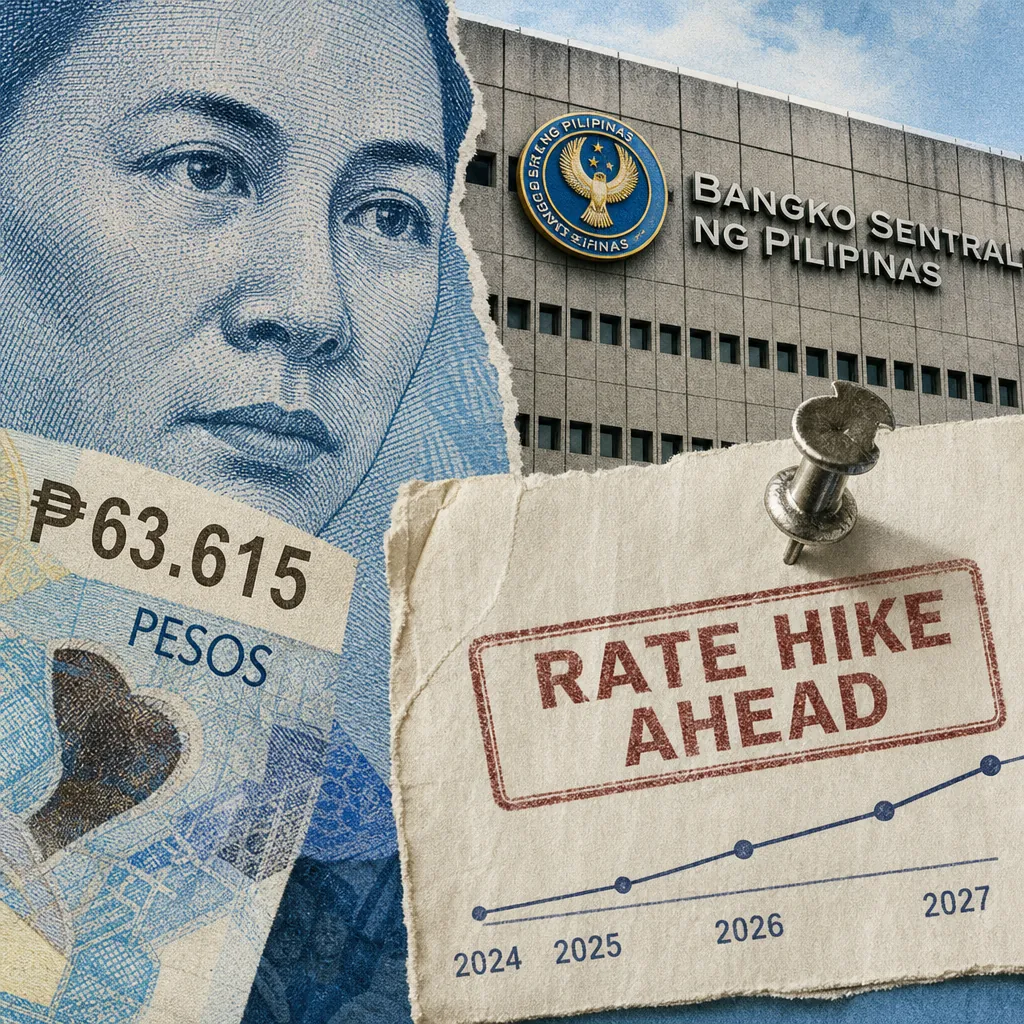
Peso Breaches P64 as Marcos Urges Calm
The peso closed at P64.025 to the dollar after touching a record P64.18, prompting President Marcos to tell Filipinos not to panic while the stock index fell 1.87 percent. Ayala Corp. set a P19.5-billion share buyback ahead of a larger Mitsubishi investment, and the financial system's total resources reached a record P38.6 trillion.
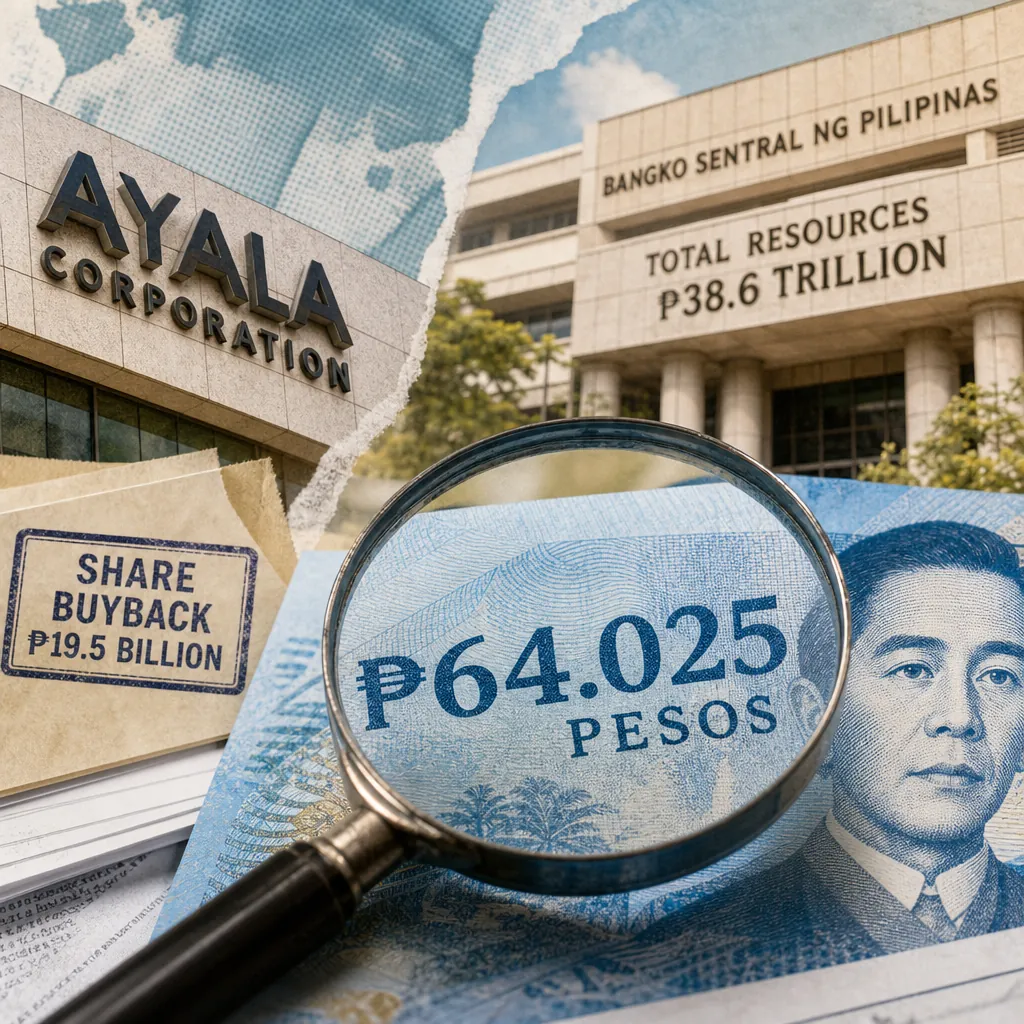
The peso closed at P64.025 to the US dollar on Wednesday, recovering 14.5 centavos after touching a record low of P64.18 in early trading, according to Bankers Association of the Philippines data cited by the Manila Standard1. The rebound ended a seven-session run of record-low closes, but it left the currency above the P64 line it first crossed a day earlier32. President Ferdinand Marcos Jr., speaking to reporters on the sidelines of a visit to the New Bilibid Prison reservation in Muntinlupa City, said the depreciation was driven by rising oil prices tied to the continuing conflict involving the United States and Iran, and pointed to the country's foreign exchange reserves. "Do not take it with alarm. Don't panic," he said40.
The reassurance did not settle the question of why the currency is falling. Former Bangko Sentral ng Pilipinas (BSP) Deputy Governor Diwa Guinigundo said fundamental factors have weakened the peso, and that the slide reflects eroding investor confidence in the economy30. Former BSP Governor Jose Cuisia Jr. said breaching P65 to the dollar is now "very easy," a level he would have called unlikely two weeks earlier57. Emilio Neri Jr., lead economist at the Bank of the Philippine Islands, put a worst case at P69 or P70 to the dollar next year if the peso reaches P65 by year-end49. The peso took only 12 days to move from its first close above P63 to a breach of P6457.
The currency move pulled the stock market down with it. The Philippine Stock Exchange Index (PSEi) — the benchmark gauge of the country's largest listed companies — fell 1.87 percent, or 107.64 points, to close at 5,653.55, its lowest level since Nov. 14, 2025, according to Rizal Commercial Banking Corp. chief economist Michael Ricafort41. Philstocks Financial attributed the decline to worries over the inflation outlook as investors weighed rising energy costs and the weaker peso, and noted that renewed Houthi attacks on a Saudi Arabian refinery had pushed global oil prices higher41. Regina Capital's Luis Limlingan said investors would stay defensive as long as the peso keeps falling to fresh lows58.
Away from the currency, the day's corporate news carried its own weight. Ayala Corp., the country's oldest conglomerate, said it will spend about P19.5 billion to buy back 30.06 million of its own shares from public investors at P650 apiece, a 23-percent premium over the average price of P529.64 as of Tuesday1259. The voluntary tender offer, which opens Nov. 4, covers about 4.85 percent of Ayala's issued and outstanding common shares and clears the way for a larger investment from Japan's Mitsubishi Corp., which announced in September a P44.5-billion deal that will raise its stake in Ayala to 15 percent59. Separately, BSP data showed the total resources of the Philippine financial system reached a record P38.56 trillion in August, up 11.1 percent from P34.69 trillion a year earlier and 1.2 percent from July64.
Key themes
- The peso touched a record P64.18 before closing at P64.025. The currency breached P64 on Tuesday and recovered 14.5 centavos on Wednesday, ending seven straight sessions of record-low closes132. It had moved from a first close above P63 to a breach of P64 in 12 days57.
- Marcos attributed the slide to oil prices and urged the public not to panic. The President said the country's foreign exchange reserves are healthy and that the government will "continue to defend the peso as hard as we possibly can"3240. He also acknowledged concern over rising prices of basic goods1.
- Former central bank officials described the fall as a confidence problem. Diwa Guinigundo said fundamental factors have weakened the currency and that it mirrors eroding investor confidence30. Jose Cuisia Jr. said P65 to the dollar is now "very easy" to reach57.
- The PSEi fell 1.87 percent to 5,653.55, its lowest close since Nov. 14, 2025. Brokers cited inflation worries from higher oil prices and the weak peso, plus elevated treasury yields that dampened demand for equities4158.
- Ayala Corp. set a P19.5-billion buyback at P650 a share. The tender offer for 30.06 million shares, about 4.85 percent of the total, opens Nov. 4 and precedes Mitsubishi Corp.'s P44.5-billion investment that will lift its Ayala stake to 15 percent1259.
- Financial system resources hit a record P38.56 trillion in August. The total was up 11.1 percent year on year, with banks holding P32.17 trillion of it, up 12.5 percent64.
- The BSP hosted the first Green Swan Conference held outside Basel. Central bankers, climate scientists and finance leaders met at the Philippine International Convention Center on Oct. 19 to discuss physical climate risks to the economy and financial system, co-organized with the Bank for International Settlements, Banca d'Italia and the Network for Greening the Financial System2.
- The Financial Executives Institute of the Philippines (Finex) pressed the government to prepare for a strong El Niño. The business group called for immediate action in five areas, warning that shortages could translate into higher prices and that Pagasa has flagged severe conditions extending into 20273.
How the narratives stack
Dominant. The peso's record run and the President's "don't panic" message dominated the business pages in this set. The story ran across broadsheet front pages and business sections, online news, and opinion columns. The Manila Standard put the peso on its front page1; the Manila Times ran it as top business40; the Inquirer's Plus edition covered the recovery and the President's remarks32; Philstar.com carried both the P65 outlook and the market retreat5758; and BusinessMirror ran the peso defense story alongside the P69–P70 worst case49. The coverage value attached to these items was substantial: the Manila Times' top-business piece carried an estimated P726,600 in advertising-equivalent value, the Philstar opinion column on the President's remarks P723,019, and the BusinessMirror peso-defense story P628,704. Those figures estimate what it would have cost to buy the same space as paid advertising; they do not measure how many people read the stories.
Counter-narrative. The most pointed counter to the official line came from former BSP officials and from opinion writers. Guinigundo's argument that the peso mirrors eroded trust rather than merely oil prices ran in the Daily Tribune30. A Philstar opinion column described the slide as "heart-attack level" and argued that a government that appears too complacent makes people more jittery60. A Daily Guardian column, written from a remittance center in Queens, New York, where a dollar bought 64 pesos on Oct. 27, used the number as a personal marker of how far the currency had moved4. These pieces did not dispute the facts of the recovery; they disputed the framing that the move is a temporary external shock.
Emerging. Two threads sit below the currency story. The first is the Ayala–Mitsubishi transaction, which is a concrete capital-markets event with a dated timetable: the tender offer opens Nov. 4, and the company will file a tender offer report with the Philippine Stock Exchange and the Securities and Exchange Commission59. The second is the El Niño preparation push from Finex, which argues that monetary policy alone cannot contain food prices and that government spending and supply systems must respond3. Both are forward-looking and will need follow-through to stay in the news.
Under-covered. The record level of financial system resources — P38.56 trillion in August, the highest since records began in 1970 — received comparatively little attention next to the currency story, appearing in the Inquirer and Philstar business sections564. It is the kind of figure that normally anchors a business page on a quiet day. The BSP's Green Swan Conference, held Oct. 19 but reported in the Manila Standard's business section on this day, also placed low2. Neither was suppressed; both simply ran beneath a currency story that commanded the front pages.
Platform insights
The day's material is drawn from published news items rather than social posts, so engagement figures — likes, shares, views and comments — are not available for this window. What can be observed is how different outlets and formats handled the same facts.
- Broadsheet front pages. The Manila Standard led its front page with the President's "don't panic" line and the peso's 14.5-centavo recovery, pairing the official reassurance with the closing rate in the same breath1. This is the format that gives a currency move the weight of a national event.
- Online business desks. Philstar.com, the Inquirer's business section and BusinessMirror ran multiple items each, splitting the story into its components: the closing rate, the market reaction, the analyst outlook and the policy response41575849. Online desks moved fastest on the analyst quotes, with Cuisia's P65 comment and Neri's P69–P70 worst case appearing the same day5749.
- Opinion and columns. The opinion pages carried the sharpest language. Philstar's column argued the reassurance itself was making people more anxious60; the Daily Guardian column tied the exchange rate to the experience of Filipino workers abroad sending money home4. Opinion is where the confidence argument was made most directly.
- Corporate and press-release channels. The Ayala buyback, the BSP resource data and the Green Swan item ran as straight business reporting and corporate announcements, with less interpretive framing12642.
Key voices and communities
The President and the economic team. Marcos's message was that the reserves are healthy and the government has the tools to defend the currency3240. The framing matters because it sets the official line that other voices respond to.
Former central bankers. Guinigundo and Cuisia spoke with the authority of having run monetary policy. Guinigundo's claim that the peso reflects eroding confidence, and Cuisia's that P65 is "very easy" to reach, gave the market a credible counter-view to the official reassurance3057.
Market economists and brokers. Neri's P69–P70 worst case, Ricafort's note that the index was at its lowest since November 2025, and Limlingan's observation that investors would stay defensive gave the sell-off a named cause494158.
Business groups. Finex, an organization of senior finance executives, shifted the argument to fiscal and supply-side preparation for El Niño, warning that today's inflation response should not become tomorrow's fiscal problem3.
Overseas Filipino workers and their families. The Daily Guardian column, written from a Filipino store in Queens, put the exchange rate in the terms that matter to households receiving remittances: how many pesos a dollar buys4.
Narrative streams
The peso's record run and the official response
The peso's move was fast. It breached P64 on Tuesday, then touched P64.18 in early Wednesday trading before closing at P64.025, a gain of 14.5 centavos from the previous record low of P64.1740. Trading volume reached P1.662 billion, down from P1.726 billion the previous day40. The President's response, delivered at a prison facility visit rather than a press conference, was to attribute the fall to oil prices and to point to the country's gross international reserves — the foreign currency holdings the central bank uses to smooth exchange-rate swings132. "We have all the tools to defend the peso," he said32.
The counter-argument from former officials is that reserves can slow a slide but cannot change the direction of a currency if the underlying demand for dollars is driven by weak confidence. Guinigundo's point is that when foreigners invest less, the peso weakens for reasons that oil prices alone do not explain30. Cuisia's P65 call, made two weeks after he would have ruled it out, suggests the pace of the move has surprised even veteran policymakers57.
For banks and importers, the practical effect is already visible. A weaker peso raises the peso cost of imported fuel, which feeds into electricity and transport costs, and it raises the cost of imported raw materials for manufacturers. The BSP's dilemma is that raising interest rates to defend the currency risks slowing an economy already facing weak growth, while holding rates risks letting inflation expectations drift. The read for the sector is that lenders should expect continued volatility in the peso-dollar rate through the fourth quarter, and that borrowers with unhedged dollar obligations face higher servicing costs if the peso reaches the P65 level Cuisia describes as likely.
The stock market's retreat
The PSEi fell 1.87 percent to 5,653.55, and the broader All Shares index fell 0.97 percent to 3,182.6958. The decline reversed the previous session's gain, which brokers described as profit-taking after a brief rally58. The causes cited were consistent across outlets: higher oil prices from renewed Houthi attacks on a Saudi refinery, the peso's weakness, and elevated treasury yields that make government bonds more attractive relative to stocks41.
The read for the sector is that equity investors are pricing in a period of higher inflation and tighter monetary policy, and that the market's recovery depends on the peso finding a floor. For listed companies with dollar-denominated debt or imported inputs, the combination of a weaker currency and higher yields raises both operating costs and financing costs at the same time. The Ayala buyback, announced the same day, is a reminder that some large shareholders see value at current prices: the P650 offer price is a 23-percent premium to the recent average, which suggests the company believes its shares are undervalued59.
Ayala's buyback and the Mitsubishi transaction
Ayala Corp.'s tender offer is a structural move, not a market reaction. The company will buy 30.06 million shares, about 4.85 percent of its total, at P650 each, for a total of about P19.5 billion12. The offer opens Nov. 4 and is conditional on the satisfaction or waiver of certain terms12. The purpose is to make room for Mitsubishi Corp.'s larger stake: the Japanese trading house announced in September a P44.5-billion deal that will raise its ownership in Ayala to 15 percent59.
A tender offer of this kind lets a company reduce its share count and return cash to shareholders who want to sell, while allowing a strategic investor to increase its stake without buying on the open market. For Ayala, the transaction deepens a partnership with a Japanese conglomerate that has invested in Philippine infrastructure and energy. The read for the sector is that large Philippine conglomerates are using buybacks and strategic partnerships to manage their capital structure through a period of currency weakness, and that the Nov. 4 offer date gives shareholders a clear decision point.
Record financial system resources
The BSP reported that total financial system resources reached P38.56 trillion in August, the highest since records began in 197064. The figure includes cash, loans, deposits, capital, investment securities and the reserves banks hold to absorb losses5. Banks accounted for P32.17 trillion of the total, up 12.5 percent from a year earlier, with universal and commercial banks — the largest lenders — holding P29.78 trillion64.
The record suggests that banks remain well-capitalized and continue to expand lending and deposits despite the currency pressure. The read for the sector is that the banking system has the balance-sheet capacity to absorb a period of peso volatility, but that the quality of the loan book will matter more than the size of the balance sheet if inflation and interest rates rise. A weaker peso raises the cost of servicing foreign-currency loans, and banks with exposure to importers and dollar borrowers will need to watch credit quality closely.
El Niño preparation and the fiscal argument
Finex called on the government to "match the resolve" of the BSP in shielding the economy from a potentially very strong El Niño, the periodic warming of Pacific Ocean temperatures that brings drought to the Philippines and can cut agricultural output3. The group called for immediate action in five areas, warning that shortages could translate into higher prices and that Pagasa, the national weather bureau, has warned of severe conditions extending into 20273. Finex's argument is that monetary policy can contain inflation expectations but cannot grow food, and that government spending on irrigation, supply systems and early preparation must do the rest3.
The read for the sector is that food inflation is the channel through which El Niño reaches bank balance sheets: higher food prices push up headline inflation, which can force the BSP to keep rates higher for longer, which in turn slows lending growth. Banks with agricultural exposure and lenders to food processors and retailers should factor a prolonged El Niño into their credit assessments for 2027.
The BSP's Green Swan Conference
The BSP hosted the first Green Swan Conference held outside Basel, Switzerland, on Oct. 19 at the Philippine International Convention Center in Manila2. The event, co-organized with the Bank for International Settlements, Banca d'Italia and the Network for Greening the Financial System, brought together central bankers, climate scientists and finance leaders from Europe, Asia and the Pacific, the Middle East and the Americas to discuss how physical climate risks affect the economy and financial system2. "Green swan" is the term central banks use for climate-related risks that are hard to model but potentially systemic, in the way that a "black swan" is a rare, unpredictable event.
The read for the sector is that the BSP is positioning itself alongside other central banks in treating climate risk as a financial-stability issue, which will eventually flow into supervisory expectations for banks' climate-risk disclosures and lending practices. For Philippine banks, the immediate relevance is agricultural and coastal exposure, both of which El Niño and typhoon risk make concrete.
Conversation trajectory
The peso's next threshold (observation window: one to two weeks). The peso closed at P64.025 after touching P64.18. Cuisia's comment that P65 is "very easy" to reach and Neri's P69–P70 worst case set the levels the market will watch5749. A close above P65 would confirm the direction and likely prompt a stronger policy response; a sustained recovery below P64 would ease the pressure. The trigger events are the daily closing rates published by the Bankers Association of the Philippines and any statement from the BSP after its next policy meeting.
The Ayala tender offer (observation window: Nov. 4 onward). The offer opens Nov. 4 and runs until the conditions are met12. The trigger events are the filing of the tender offer report with the PSE and the SEC, and the announcement of the final number of shares tendered. A strong take-up would signal shareholder confidence in the Mitsubishi deal; a weak one would raise questions about the P650 valuation.
Inflation and the BSP's next move (observation window: the next inflation release). The PSEi's fall was driven by inflation expectations, and the next consumer price index release will show whether the peso's weakness is feeding through to prices41. The trigger event is the next inflation report and the BSP's subsequent policy decision. A higher-than-expected print would raise the probability of further rate increases, which would affect both the currency and the stock market.
El Niño preparation (observation window: the next three to six months). Finex's call for action in five areas will be tested by whether the government announces concrete spending or supply measures before the drought season3. The trigger events are Pagasa's next seasonal outlook and any budget or agriculture department announcements.
Response guidance
Currency communication. Banks and financial institutions should prepare plain-language explanations of what a weaker peso means for depositors, borrowers and remittance recipients, and should avoid repeating the "don't panic" framing without substance. The public response to the President's remarks showed that reassurance without explanation can increase anxiety60.
Client communication on dollar obligations. Lenders with clients holding unhedged dollar loans should proactively contact them about hedging options and repayment schedules before the peso tests P65. The Cuisia and Neri forecasts give a credible range for scenario planning5749.
Investor relations around the Ayala offer. Companies involved in tender offers should publish clear timetables and explain the premium in plain terms. The Ayala offer's 23-percent premium over the recent average price is the kind of detail that helps retail shareholders decide whether to tender59.
Food inflation and El Niño. Banks with agricultural exposure should begin stress-testing loan books against a prolonged El Niño and should communicate their preparation to regulators and investors. Finex's warning that today's inflation response should not become tomorrow's fiscal problem is a useful framing for public statements3.
Climate-risk disclosure. The BSP's Green Swan Conference signals that climate risk is moving into the supervisory mainstream2. Banks should review their climate-risk disclosures and prepare for questions from regulators and investors about agricultural and coastal exposure.
Avoid speculation on policy. Commentators and institutions should distinguish between confirmed data — the closing rate, the PSEi level, the BSP resource figures — and forecasts, which are inherently uncertain. The P69–P70 worst case is a scenario, not a prediction, and should be presented as such49.
See the full picture behind today's signals.
This report draws from Media Meter's MediaWatch, our real-time monitoring engine tracking 2,470+ Philippine sources across print, broadcast, digital, and social. Explore how the platform turns raw coverage into decision-grade intelligence, then see how it's configured for teams like yours — whether you're in PR agencies, corporate comms, government, or marketing.
Want more? Browse our Report Library for sector and crisis intelligence, or request a demo and we'll have your brand set up before the call.
Want this kind of intelligence on your brand?
This brief is built on the same MediaWatch methodology that runs continuously across every brand we monitor. See your competitive landscape, Impact Score, and narrative trajectory in a 30-minute demo.